
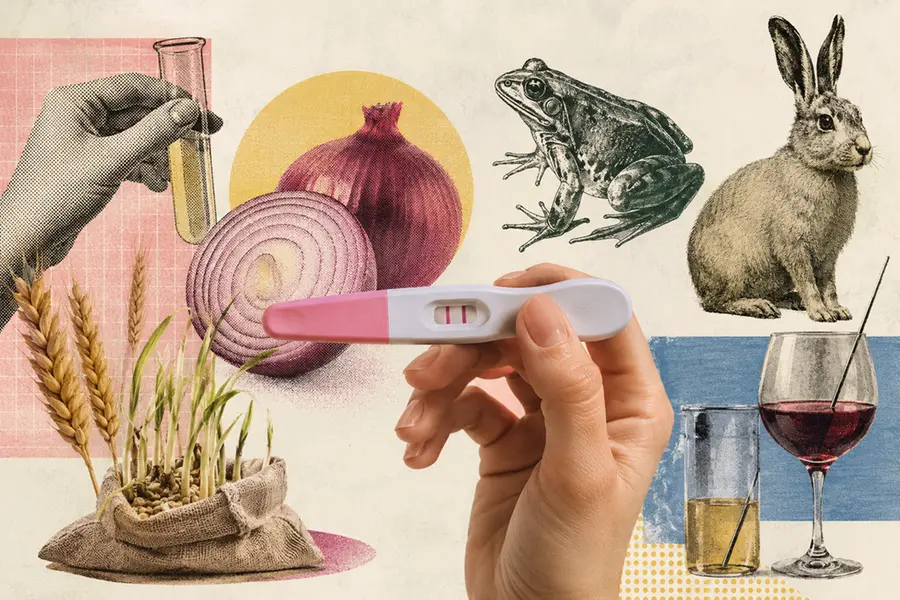
Long before two pink lines, people looked for answers in onions, sprouting seeds, frogs and even rabbits
Today, taking a pregnancy test is one of those things we barely think about. You buy a kit from the pharmacy, wait a few minutes and, just like that, you have your answer. It's quick, private and reliable.
But if you had asked the same question a few hundred years ago, the answer might have involved an onion, a handful of barley, a glass of wine or even a frog.
Long before laboratories and home test kits, people relied on observation, superstition and some surprisingly creative experiments to answer one of life's biggest questions.
When an onion was considered medical advice
Before hormones were discovered, people looked for clues in the natural world.
One of the most unusual methods came from ancient Greece. Women were advised to place an onion, or sometimes another strongly scented bulb, inside the vagina overnight. The belief was that if the smell reached the mouth by morning, the woman was not pregnant. If there was no onion breath, pregnancy was considered likely because people believed the womb had somehow blocked the scent from travelling through the body.
Another famous method came from ancient Egypt around 1500 BCE. Women would urinate on bags of barley and wheat seeds over several days. If the seeds sprouted, the result was considered positive for pregnancy. Some ancient texts even claimed the type of grain that sprouted could predict whether the baby would be a boy or a girl.
Surprisingly, this wasn't entirely random. A small study carried out in the 1960s found that urine from pregnant women encouraged grain germination more often than urine from those who were not pregnant, although the method was nowhere near reliable enough to be considered a real medical test today.
The people who read urine like fortune tellers
Fast forward to medieval and Renaissance Europe and pregnancy testing had become an unusual profession.
There were people known as "piss prophets" or uromancers whose job was to examine urine. They studied its colour, smell, cloudiness and even taste in some cases, believing these clues revealed whether someone was pregnant.
It wasn't just pregnancy either. Urine was thought to reveal almost every illness imaginable.
Medieval physicians even experimented with wine, mixing it with urine to look for changes in colour or clarity. While the reasoning was flawed, alcohol does react with certain proteins found in urine, meaning the method may occasionally have produced accurate results by chance.
Others took experimentation a step further. Some left a metal needle soaking in urine overnight, hoping changes in its colour would reveal pregnancy. A few doctors even believed they could diagnose pregnancy simply by looking into a woman's eyes, convinced that swollen veins or subtle changes around the pupils gave everything away.
Then came the animal era
The early twentieth century brought science into pregnancy testing, but it also introduced one of the strangest chapters in medical history.
In 1927, scientists discovered that the urine of pregnant women contained a hormone that produced changes in animals. This hormone, now known as human chorionic gonadotropin (hCG), became the key to pregnancy testing.
Doctors injected a woman's urine into mice or rabbits. After several days, the animals were examined to see whether their reproductive organs had changed.
The rabbit test soon followed and became one of the best-known pregnancy tests in history. It also gave birth to one of medicine's biggest myths.
For years, people used the phrase "the rabbit died" as another way of saying someone was pregnant. The rabbit died regardless because scientists had to examine its ovaries under a microscope, regardless of whether the result was positive or negative.
Frogs became unexpected medical assistants
Things improved in the 1940s thanks to a rather unlikely helper: the African clawed frog.
British zoologist Lancelot Hogben discovered that when urine from a pregnant woman was injected into this species of frog, it released eggs within hours if hCG was present.
Unlike rabbits and mice, they could be used again, making the process faster, cheaper and far more humane. The frog test became one of the most widely used pregnancy tests before laboratory techniques took over.
Some 16th-century medical texts claimed that if urine was left standing for several days, tiny insects or lice-like creatures would appear. Their colour was even believed to predict the baby's sex.
The hormone that changed everything
By the 1960s, scientists had found a better solution. Instead of relying on animals, laboratories began testing directly for hCG, the hormone produced during pregnancy.
These tests were much more accurate, but there was still one problem. Women often had to visit a doctor, provide a urine sample and then wait days or even weeks for the results to come back from a laboratory.
The woman who changed pregnancy testing forever
The biggest breakthrough came from someone who wasn't even a scientist.
In 1967, Margaret Crane was working as a graphic designer for a pharmaceutical company when she noticed technicians performing pregnancy tests in a laboratory. Looking at the simple procedure, she wondered why women couldn't do it themselves at home.
Using everyday materials including a small mirror, test tube and dropper, she created the first home pregnancy test prototype.
Her employers weren't immediately convinced. Some questioned whether women should receive such personal information without a doctor present, while others worried laboratory testing would lose business.
Despite the resistance, Crane received a patent for her design, and her idea eventually became the blueprint for the home pregnancy tests we know today.
It's remarkable that one of the biggest advances in women's healthcare came from someone who simply asked, "Why not?"
The pregnancy test we know today
Home pregnancy tests first appeared in Canada in 1971.
Dr Judith Phyitis and a colleague developed a quicker hCG test, making home testing faster and easier. By 1978, home pregnancy tests finally reached shop shelves.
Modern tests still rely on the same principle: detecting hCG in urine. The difference is speed and accuracy. Many can now detect pregnancy several days before a missed period, with results appearing in just a few minutes.
It's easy to think of a home pregnancy test as just another item sitting on a pharmacy shelf.
But behind those two little lines lies thousands of years of trial and error, folklore, scientific breakthroughs and changing attitudes towards women's healthcare.
From onions and sprouting grains to frogs and laboratory discoveries, every step brought medicine a little closer to the simple, reliable tests we know today.
Perhaps the biggest change wasn't just the technology itself. It was giving women control over one of the most personal moments of their lives.
Instead of waiting for someone else to interpret seeds, examine urine or deliver laboratory results, they could find the answer themselves, in their own time, in the privacy of their own home.
(Disclaimer: This article is intended for informational purposes only. Historical pregnancy testing methods discussed here are not scientifically valid by modern standards and should never be attempted. If you suspect you may be pregnant, use a medically approved pregnancy test and consult a qualified healthcare professional for confirmation and appropriate care.)
-Compiled by Salma
Published: 22 Jul 2026, 10:33 am IST
ABOUT THE AUTHOR

Disclaimer: Kindly avoid objectionable, derogatory, unlawful and lewd comments, while responding to reports. Such comments are punishable under cyber laws. Please keep away from personal attacks. The opinions expressed here are the personal opinions of readers and not that of Mathrubhumi.