
The airline’s revenue fell 13.4% year-on-year to INR 792 crore, compared to INR 915 crore a year earlier.
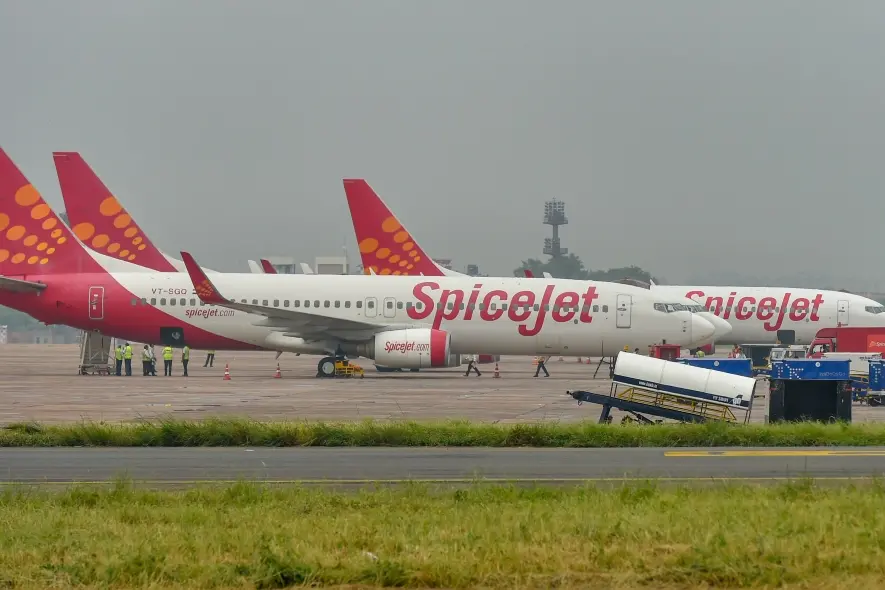
SpiceJet Ltd reported a net loss of INR 621 crore for the quarter ended September 2025 (Q2 FY26), widening from a loss of INR 458 crore in the same period last year.
The airline’s revenue fell 13.4% year-on-year to INR 792 crore, compared to INR 915 crore a year earlier. The company said the September quarter, typically a weak season for travel, was hit by multiple challenges including higher dollar-linked obligations, costs from grounded aircraft, and expenses related to returning planes to service.
The airline’s operating loss stood at INR 297 crore for the quarter. Of this, INR 120 crore was spent on maintaining grounded aircraft, and INR 30 crore on return-to-service (RTS) activities. On an EBITDAR (ex-forex) basis, SpiceJet recorded a loss of INR 203.8 crore, compared to a loss of INR 58.87 crore in the same quarter last year.
Despite the losses, operational performance showed improvement in some areas. The Passenger Load Factor (PLF) – a measure of how full flights are, remained strong at 84.3%, while Passenger Revenue per Available Seat Kilometre (RASK) rose to INR4.04 from INR 3.91 a year ago.
During the quarter, SpiceJet secured $89.5 million in liquidity through its settlement with Carlyle, unlocking $79.6 million in cash maintenance reserves and $9.9 million in credits. The airline also completed a $24 million payment to Credit Suisse, fulfilling a key financial obligation.
To support its growth plans, SpiceJet finalised a damp lease deal for 19 aircraft, ungrounded two aircraft, and signed an interline agreement with Gulf Air to boost international connectivity. The airline also reported zero Level 1 findings in DGCA safety audits over the past year.
Chairman and Managing Director Ajay Singh said the September quarter was a “period of consolidation and groundwork” for SpiceJet’s next phase of growth. “While the results reflect short-term costs related to fleet revival and expansion, these are strategic investments that will start yielding results from the current quarter onward,” Singh said.
He added that the airline plans to add 19 more aircraft for the winter schedule, has ungrounded one Boeing 737 MAX, and is on track to more than double its fleet and triple its Available Seat Kilometres (ASKM) in the coming months.
“With aircraft additions already underway and our network expanding rapidly, SpiceJet is now on a clear trajectory towards stronger operational and financial performance in the second half of the year,” Singh said.
“Our loads of over 84% confirm strong demand, and with the winter schedule now in operation, we have several high-yield routes in the pipeline.” He also welcomed Sanjay Kumar back to SpiceJet as part of the management team, calling his return an important step in the airline’s transformation journey.
Shares of SpiceJet Ltd closed 4.17% higher at ₹35.48 on the Bombay Stock Exchange following the results.
SpiceJet’s widening loss reflects a broader trend in India’s aviation industry, where several carriers are facing mounting costs from fuel prices, aircraft lease payments, and a weak rupee. Analysts say these pressures could eventually push airlines to raise airfares, especially during peak travel months, as they try to maintain profitability.
While airlines continue to report strong passenger loads, the gap between revenue and operating expenses remains largely a concern that could affect affordability for travellers if costs continue to rise.
Published: 12 Nov 2025, 05:16 pm IST
Related Topics
Disclaimer: Kindly avoid objectionable, derogatory, unlawful and lewd comments, while responding to reports. Such comments are punishable under cyber laws. Please keep away from personal attacks. The opinions expressed here are the personal opinions of readers and not that of Mathrubhumi.
