
Rising fuel prices in India may help stabilise the rupee and reduce economic pressure on the government, but they are also increasing the financial burden on households and businesses.
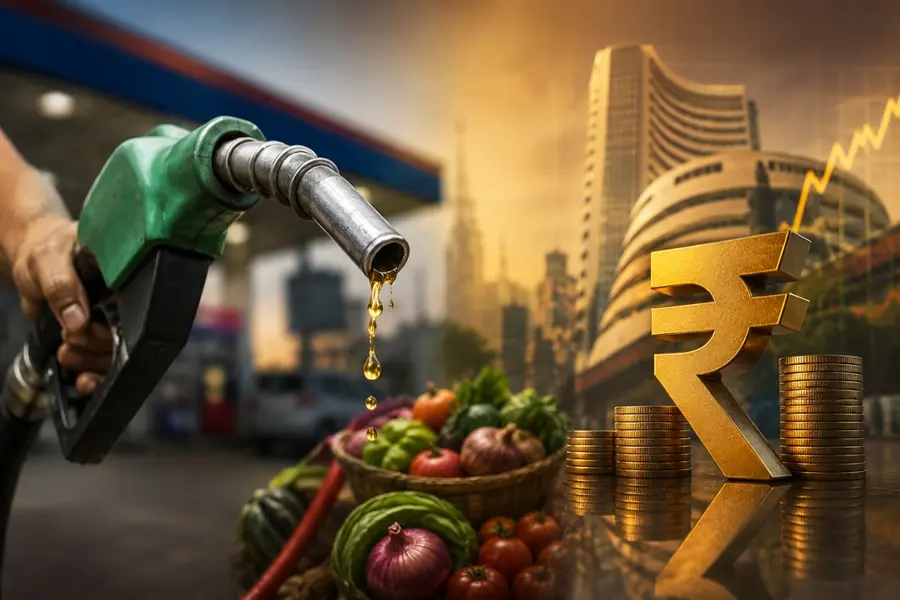
Fuel prices have once again become a major economic and political issue in India as global crude oil markets remain volatile in 2026. Brent crude prices have stayed above the USD 100-per-barrel mark amid ongoing geopolitical tensions, disruptions in global shipping routes and uncertainty linked to conflicts involving Iran and the Middle East.
For India, which imports nearly 85 per cent of its crude oil needs, rising international oil prices quickly translate into pressure on the economy, inflation and household budgets.
Also Read

At the same time, policymakers are trying to prevent excessive pressure on the Indian rupee, which has weakened against the US dollar in recent months. This has created what economists describe as a “fuel price paradox” — where higher petrol and diesel prices may help stabilise the economy in one way while making everyday life more expensive for consumers.
How higher fuel prices can support the rupee
One of the biggest concerns for India is its large oil import bill. Since crude oil purchases are made largely in US dollars, rising imports increase demand for dollars and weaken the rupee.
When domestic petrol and diesel prices rise, fuel consumption often slows. Reduced demand can lower the total oil import burden, helping narrow the trade deficit and reducing pressure on the rupee.
Economists also point out that allowing market-linked fuel pricing improves investor confidence. If the government aggressively subsidises fuel despite high crude prices, it increases the fiscal deficit and raises concerns among foreign investors about India’s financial stability.
By permitting gradual price increases, the government signals fiscal discipline, which may help maintain investor confidence and reduce volatility in the currency market.
A weaker rupee can worsen inflation further
The rupee’s value matters because India imports several essential goods apart from crude oil, including edible oils, machinery, electronics, chemicals and industrial components.
If the rupee weakens sharply, imports become more expensive, leading to broader inflation across sectors. In that sense, policymakers may view controlled fuel price increases as a way to avoid an even larger economic problem caused by a rapidly falling currency.
Why consumers feel the pressure immediately
While the macroeconomic logic may support higher fuel prices, ordinary consumers experience the impact directly and quickly.
Petrol and diesel are central to transportation, logistics and supply chains across India. When fuel becomes expensive, transportation costs rise for nearly every industry, from agriculture to e-commerce.
This often causes a chain reaction:
- Vegetable and food prices rise due to costlier transport.
- Cab fares and public transport costs increase.
- Delivery charges become more expensive.
- Airline tickets rise because of higher aviation fuel costs.
- FMCG companies increase product prices to offset logistics expenses.
- As a result, inflation spreads beyond fuel and affects everyday essentials.
- LPG and household expenses remain sensitive
Cooking gas prices also remain politically and economically sensitive. Any increase in LPG cylinder prices directly affects household budgets, especially middle-class and lower-income families.
Higher fuel and energy expenses leave consumers with less disposable income, reducing spending power in other sectors of the economy.
RBI may face pressure to keep interest rates high
Persistently high fuel inflation also complicates monetary policy for the Reserve Bank of India (RBI).
If inflation remains elevated, the RBI may delay interest rate cuts or even tighten monetary policy further to control rising prices. Higher interest rates can increase EMIs for home loans, vehicle loans and business borrowing, putting additional pressure on consumers and small businesses.
Global tensions are driving oil market uncertainty
Analysts say global geopolitical tensions continue to play a major role in fuel price volatility. Concerns around shipping routes in West Asia, tensions involving Iran, production decisions by oil-producing countries and disruptions in energy supply chains have all contributed to higher crude prices globally.
Any prolonged instability in oil-producing regions could continue affecting fuel prices in India in the coming months.
The balancing act facing policymakers
The government now faces a difficult balancing act between controlling inflation and protecting macroeconomic stability.
Keeping fuel prices artificially low may provide temporary relief to consumers but could:
- widen the fiscal deficit,
- increase subsidy burdens,
- weaken the rupee further,
- and hurt investor confidence.
Allowing prices to rise may help protect the currency and government finances, but it also increases the cost of living and public dissatisfaction.
Why economists call it a “fuel price paradox”
The situation is often called a paradox because the same fuel price increase can produce opposite effects across the economy.
Higher fuel prices may:
- support the rupee,
- reduce import pressure,
- improve fiscal credibility,
- and stabilise external finances.
But at the same time, they can:
- raise inflation,
- increase household expenses,
- reduce purchasing power,
- and slow consumer spending.
What it means for ordinary Indians
For consumers, the biggest concern remains the rising cost of living. Even if higher fuel prices help stabilise the economy at a macro level, households continue to face pressure through rising grocery bills, transport costs and EMIs.
Experts believe the coming months will depend heavily on global crude prices, geopolitical developments and how effectively India manages inflation without severely hurting economic growth.
Published: 14 May 2026, 10:19 am IST
Disclaimer: Kindly avoid objectionable, derogatory, unlawful and lewd comments, while responding to reports. Such comments are punishable under cyber laws. Please keep away from personal attacks. The opinions expressed here are the personal opinions of readers and not that of Mathrubhumi.