
The new EPF Scheme 2026 replaces the 1952 framework but retains the 12% contribution rate and ₹15,000 wage ceiling. Here is what employees need to know about voluntary contributions, PF withdrawals, the 25% minimum balance rule, retirement withdrawals and the 12-month unemployment requirement.
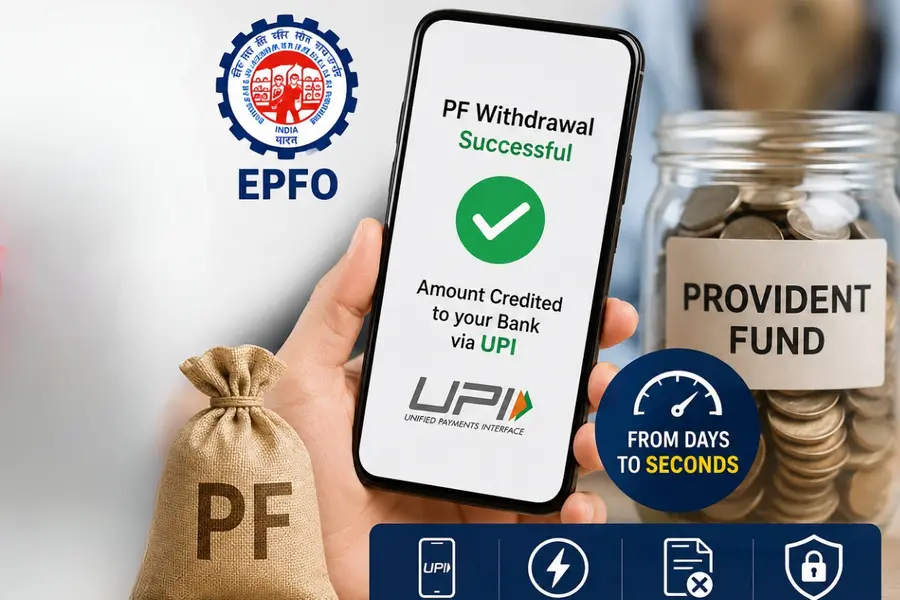
The government has notified the Employees’ Provident Funds Scheme, 2026, replacing the Employees’ Provident Funds Scheme, 1952 under the Code on Social Security, 2020.
The new scheme was notified on June 29, 2026 and came into force after its publication in the Official Gazette. While the basic EPF contribution structure remains unchanged, the new framework provides more detailed rules on voluntary contributions, withdrawals, claim processing and digital administration.
Also Read

For employees, some of the key changes relate to contributions above the statutory wage ceiling and the conditions under which PF money can be withdrawn.
12% contribution and ₹15,000 wage ceiling remain
The basic contribution rate remains 12% of wages for both the employee and employer, subject to the applicable statutory wage ceiling.
The current statutory wage ceiling is ₹15,000 per month. This means the mandatory employee contribution is generally capped at ₹1,800 per month, with a corresponding employer contribution under the applicable rules.
Employees earning more than ₹15,000 can voluntarily contribute additional amounts above the statutory ceiling. Employers can match these additional voluntary contributions, but they are not required to do so.
Employees and employers can also reduce or stop such additional voluntary contributions.
For higher-paid employees, this creates a choice between retaining more money as take-home pay or putting more towards long-term retirement savings.
What changes for partial PF withdrawals?
The 2026 scheme sets out specific conditions for partial withdrawals and introduces a 25% minimum balance requirement.
Generally, members must retain at least 25% of the aggregate contributions credited to their EPF account up to the withdrawal date. This calculation includes employee and employer contributions as well as interest.
The minimum withdrawal amount is ₹1,000.
The provision is intended to ensure that partial withdrawals do not completely exhaust an employee's retirement savings.
PF withdrawal for medical treatment
Members can withdraw money for medical treatment of themselves or family members after completing 12 months of total EPF membership.
Up to 100% of the eligible member balance can be withdrawn for this purpose, subject to the rules.
PF withdrawal for education and marriage
The scheme also allows withdrawals for education of the member or family members.
After completing 12 months of membership, up to 100% of the eligible member balance can be withdrawn for education. This facility can be used up to 10 times during membership.
For marriage of the member or family members, up to 100% of the eligible member balance can be withdrawn after 12 months of membership. This facility can be used up to five times during membership.
Housing-related PF withdrawals
Members can also use EPF savings for specified housing-related purposes after completing 12 months of total membership.
These include:
- Purchasing a flat, house or site for construction.
- Constructing a house.
- Repaying a qualifying home loan.
Making additions, alterations, renovations or improvements to an existing house or flat.
Up to 100% of the eligible member balance can be withdrawn for these purposes, with the facility available up to five times during membership, subject to the scheme's conditions.
When can the entire PF amount be withdrawn?
The new scheme specifies circumstances in which members can withdraw the full amount standing to their credit.
These include:
- Retirement after attaining 55 years of age.
- Retirement because of permanent and total incapacity for work.
- Permanent migration from India or taking employment abroad.
- Mass or individual retrenchment.
- Termination under an agreed voluntary retirement scheme.
- Other specified employment-related circumstances under the scheme.
Leaving a job does not automatically mean an employee can immediately withdraw the entire PF balance in every case.
What happens after resignation or job loss?
For situations that do not fall under the specified full-withdrawal categories, a member generally has to remain unemployed in a covered establishment for 12 continuous months immediately before applying for full withdrawal.
There is an exception for female members who resign specifically to get married.
This means employees leaving a job and not immediately joining another EPF-covered establishment may have to meet the waiting requirement before seeking full withdrawal.
Existing EPF members will not start from zero
The transition to the 2026 scheme does not require existing EPF members to restart their retirement savings.
Employees who were members of the 1952 scheme, or were required to become members before it ceased, become members under the 2026 scheme.
Existing fund accumulations are transferred into the new provident fund framework. EPF balances can also be transferred when members move between covered establishments and certain exempted establishments, subject to the applicable provisions.
Claims to be settled within 20 days
The new framework also sets out a timeline for processing claims.
Complete claims submitted with the required documents are to be settled and the benefit amount paid within 20 days of receipt by the Commissioner.
If a claim has deficiencies, those are also to be communicated within 20 days.
Where a complete claim is not settled within the prescribed period without sufficient cause, the scheme provides for liability for the delay and penal interest at 12% per annum, subject to the applicable provisions.
More digital EPF administration
The 2026 framework places greater emphasis on electronic records and administration.
Employers are required to electronically upload specified employee, contribution and employment-related information through the designated portal.
Members are also required to provide information including Aadhaar, an Aadhaar-seeded bank account, PAN and their Universal Account Number.
The scheme also provides for electronic access to annual account statements and e-Passbooks.
What the new EPF rules mean for employees
The new scheme does not fundamentally change the familiar EPF contribution structure. The 12% contribution rate and ₹15,000 statutory wage ceiling remain.
The more significant changes are in the treatment of voluntary contributions above the ceiling, partial withdrawals and conditions for full withdrawal.
For higher-paid employees, voluntary contributions above the statutory ceiling offer greater flexibility, although employers are not obliged to match the additional amount.
For employees seeking withdrawals, the new framework lays out specific purposes, eligibility periods and frequency limits while requiring a portion of the EPF balance to remain protected in partial-withdrawal cases.
Overall, the Employees’ Provident Funds Scheme, 2026 retains the core EPF structure while providing a more detailed framework for contributions, withdrawals, claim processing and digital administration under the Code on Social Security, 2020.
Published: 08 Aug 2026, 06:35 pm IST
ABOUT THE AUTHOR
Related Topics
Disclaimer: Kindly avoid objectionable, derogatory, unlawful and lewd comments, while responding to reports. Such comments are punishable under cyber laws. Please keep away from personal attacks. The opinions expressed here are the personal opinions of readers and not that of Mathrubhumi.