
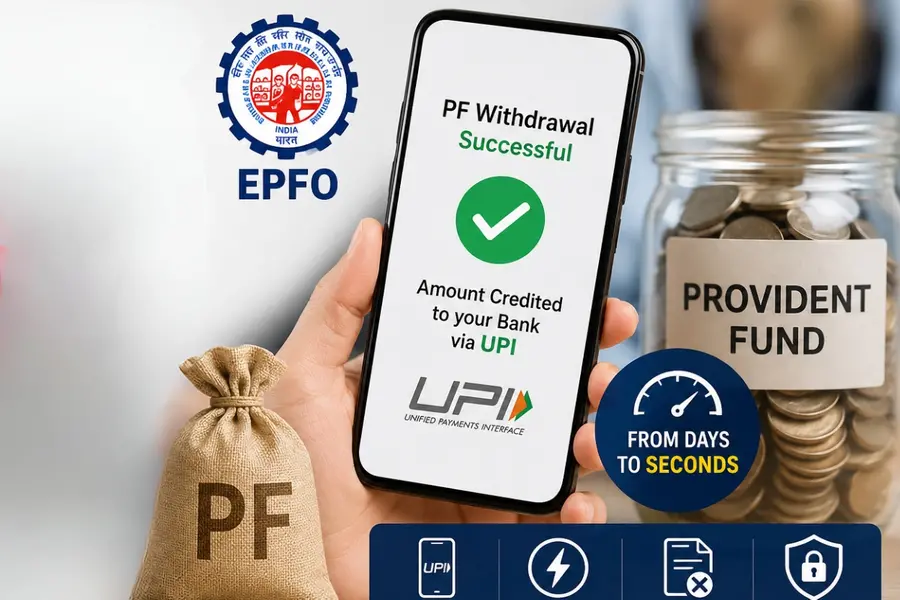
EPFO 3.0 is set to transform provident fund withdrawals by enabling eligible members to access their PF savings through UPI, significantly reducing processing times and paperwork.
The Employees' Provident Fund Organisation (EPFO) is preparing to introduce one of the biggest changes to the provident fund system in recent years.
Under the upcoming EPFO 3.0 framework, members will be able to withdraw eligible portions of their Employees' Provident Fund (EPF) directly through the Unified Payments Interface (UPI), potentially reducing withdrawal times from several days to just seconds.
Also Read

The reform is expected to benefit more than seven crore EPFO members across the country and marks a major step towards digitising retirement savings services.
Why PF withdrawals currently take time
At present, withdrawing money from a provident fund account often involves multiple verification stages.
Members generally need to submit withdrawal requests through the EPFO portal, after which claims undergo verification and processing. In many cases, the process can take between seven and ten days.
Larger withdrawals may require additional scrutiny, while mismatches involving Aadhaar details, PAN information, bank accounts or personal records can lead to delays or claim rejections.
Many members have long complained about waiting periods during emergencies when quick access to funds is critical.
EPFO 3.0 seeks to address these challenges through automation and direct payment integration.
How UPI-based PF withdrawals will work
According to the Labour Ministry, testing of the UPI payment gateway has already been completed.
Once launched, eligible members will be able to view the amount available for withdrawal through the UMANG application.
The platform will display the portion of funds that can be withdrawn immediately. Members can then initiate a transfer directly to their linked bank account using UPI authentication.
Unlike traditional claim processes, the new system is designed to reduce manual intervention and simplify access to funds.
The transferred amount will reach the member's bank account, where it can be used for any eligible purpose.
What makes EPFO 3.0 different?
The biggest change is speed. Instead of waiting a week or longer for claims to be processed, eligible withdrawals could be completed almost instantly.
The updated framework also aims to remove several friction points that currently slow down claims.
These include:
- Reduced dependence on manual approvals
- Lower paperwork requirements
- Automated verification processes
- Faster settlement of eligible claims
- Simplified access through digital platforms
The goal is to create a largely paperless withdrawal system that allows members to access funds more efficiently.
Who can use the new facility?
To access UPI-based withdrawals, members must meet certain requirements.
These include:
- Active UAN: Members must have an active Universal Account Number (UAN).
- Aadhaar verification: Aadhaar must be linked to the UAN and successfully verified.
- PAN linkage: PAN details should also be linked and validated within EPFO records.
Matching personal details
The member's name and date of birth must match across EPFO records, Aadhaar and other linked documents.
Any mismatch could affect eligibility and delay access to the facility.
How much PF money can be withdrawn?
One important feature of EPFO 3.0 is that not all provident fund savings will be available for instant withdrawal. The system is designed to protect retirement savings while allowing members access to eligible funds.
According to the proposed framework, a portion of the total balance will remain locked in the PF account. Generally, around 25 per cent of the fund is expected to remain protected as retirement savings.
The remaining eligible balance, subject to EPFO withdrawal rules, may be accessible through UPI-based transfers. The exact amount available will depend on withdrawal category, eligibility conditions and existing EPFO regulations.
When can members withdraw PF funds?
EPFO currently permits withdrawals under specific circumstances.
These include:
- Medical emergencies
- Members can access funds for treatment and healthcare expenses.
- Education
- Eligible withdrawals are allowed for higher education purposes.
- Marriage
- PF savings may be used for marriage-related expenses under prescribed conditions.
- Housing
- Members may withdraw eligible amounts for home purchase, construction or related housing requirements.
The new UPI system changes the speed of access rather than the eligibility criteria themselves.
WhatsApp chatbot to simplify access
Alongside UPI integration, EPFO is also working on expanding digital services through WhatsApp.
The proposed chatbot will allow members to obtain information by simply sending a message.
Users may be able to:
- Check PF balances
- Verify withdrawal eligibility
- Access account-related information
- Receive service updates
The move reflects the organisation's broader push towards easier digital engagement.
Auto-settlement could be the next major change
EPFO is also exploring further automation beyond UPI withdrawals.
Officials have indicated that work is underway to automate final withdrawal settlements and simplify account transfers when employees change jobs.
The objective is to reduce administrative hurdles and ensure that members can access or transfer their provident fund savings with minimal intervention.
If implemented successfully, these measures could significantly reduce processing times across multiple EPFO services.
What EPFO 3.0 means for members
For millions of salaried workers, EPFO 3.0 represents a shift from a largely administrative process to a more user-friendly digital experience.
The proposed reforms seek to make PF withdrawals faster, reduce paperwork and improve transparency while maintaining safeguards designed to protect retirement savings.
Although the system is yet to be formally rolled out nationwide, the completion of testing suggests that one of the most significant changes in EPFO's history may soon become a reality.
For members accustomed to waiting days for claim approvals, the ability to access eligible PF funds through UPI could fundamentally change how provident fund savings are used during emergencies and major life events.
Published: 03 Jun 2026, 05:35 pm IST
Related Topics
Disclaimer: Kindly avoid objectionable, derogatory, unlawful and lewd comments, while responding to reports. Such comments are punishable under cyber laws. Please keep away from personal attacks. The opinions expressed here are the personal opinions of readers and not that of Mathrubhumi.