
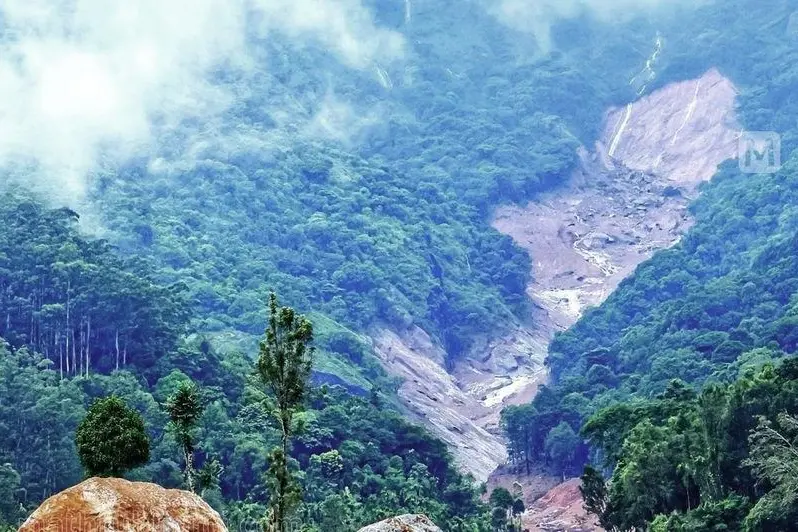
Alappuzha: Geological experts have confirmed that the recent landslides in Wayanad were caused by heavy rainfall and not human activities. The landslides’ point of origin was in forested areas, not in populated regions, and happened in a location previously affected by a landslide in 1984. The area is part of the landslide hazard map.
Dr KS Sajinkumar, Assistant Professor at the University of Kerala's Department of Geology and member of State Advisory Committee on Landslides, explained to 'Mathrubhumi' that human intervention cannot be cited as a factor. According to him, landslides are more likely in areas with slopes greater than 20 degrees. The recent landslide caused massive damage to settlements in the flood-prone areas on both banks of the river. Satellite images did not show any stone quarries within two kilometres of the landslide's epicentre.
Also Read

Dr V Ambili, Deputy Director General of the Geological Survey of India's Kerala Division, also confirmed that the landslides were not caused by human intervention. She explained that there has been no human activity in the landslide-prone area of the mountain. Instead, continuous heavy rains filled the cracks in the rocks with water. The heavy rains also prevented proper runoff. According to Dr Ambili, the accumulated water in these cracks caused the large rocks to split.
Landslides can be predicted
According to Dr Sajin Kumar, the risk of landslides can be predicted through accurate studies based on statistics from previous landslides and the concurrent rainfall data. This involves analysing factors such as the area’s slope, soil texture, density, and water-holding capacity. An extensive network of rain gauges is required for this purpose, ideally set up at the ward level.
Dr Sajunkumar noted that issuing warnings when the landslide risk reaches 50-60 percent could save many lives. Automated weather stations with modern systems are necessary to measure rainfall accurately. A landslide probability map and a landslide route map should also be prepared. He said that 35 percent of the Western Ghats are prone to landslides, but in Kerala's case, it is not feasible to avoid having settlements in these areas.
Published: 07 Aug 2024, 09:39 am IST
Related Topics
Disclaimer: Kindly avoid objectionable, derogatory, unlawful and lewd comments, while responding to reports. Such comments are punishable under cyber laws. Please keep away from personal attacks. The opinions expressed here are the personal opinions of readers and not that of Mathrubhumi.