

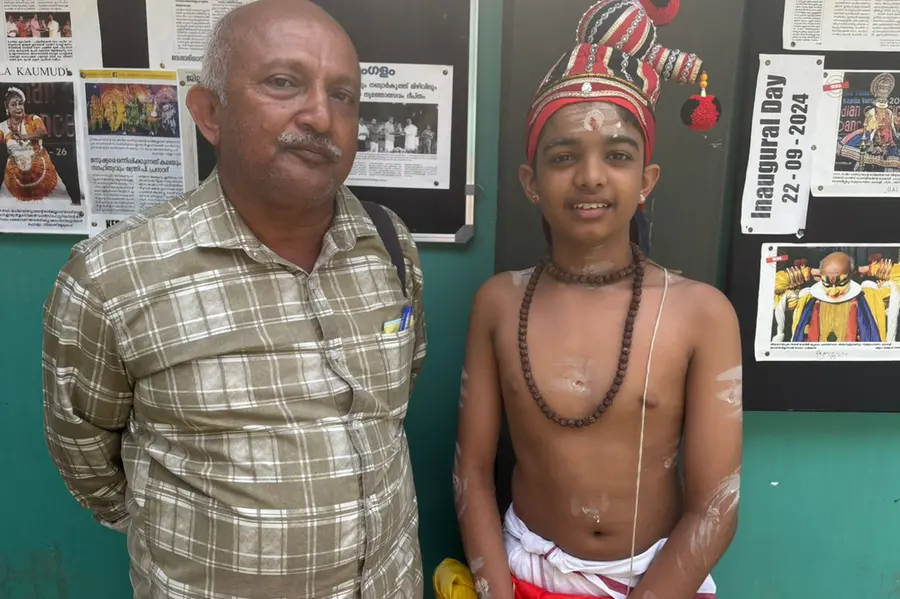
Thiruvananthapuram: In an era where traditional art forms are battling for survival, Padakam, a temple art from Kerala that blends Sanskrit and Malayalam storytelling, is fading into obscurity. Padakam, often compared to Chakyarkoothu for its similar presentation style, is now seen primarily at youth festivals like the Kerala Kalolsavam.
What sets Padakam apart from Chakyarkoothu is that Padakam is a serious, a devotional form of storytelling that is performed without satire or social criticism. Chakyarkoothu, on the other hand, is a satirical art form that blends storytelling with theatrical expression.
"Padakam is an art form that demands devotion and a deep understanding of its roots," says Ramesh Kumar, a seasoned teacher who has spent over 15 years nurturing young talent in this field. "It is the first time I am teaching Krishnatejas, who has an innate talent for reciting Sanskrit. Despite the challenges this art form faces, I strive to let people know about its richness and significance," he says while accompanying his student Krishnatejas who is performing for the first time at the Kerala School Kalolsavam.
Ramesh Kumar's journey into Padakam was driven by adversity. Years ago, when his son expressed interest in learning Chakyarkoothu, he was denied the opportunity due to their Konkani community background. "This rejection spurred me to train students in Padakam, ensuring no one else faces the same discrimination. My aim has always been to preserve and propagate this art form," he recalls.
Padakam, a traditional art performed by the Ambalavasi Nambiars and the Chakyar community, involves narrating mythological tales from Hindu Puranas. It is a minimalist performance, with a single actor donning simple red-dominated costumes and presenting the stories under the warm glow of a Nilavilakku (traditional lamp). A distinctive feature of the costume is the "Kuduma," a red silk garment tied in a knot on the head, adding to the performer’s striking appearance. Despite its elegance, Padakam struggles to capture the interest of today's youth.
"The art form is not just dying; it is being forgotten," Kumar laments. "The lack of patrons, coupled with the decline in Sanskrit education, has contributed significantly to this." He also highlights how misconceptions about Padakam, such as its perceived exclusivity to certain communities or genders, have hindered its popularity.
Traditionally, Padakam was performed only by men, and societal norms restricted women from participating due to its sacred nature. However, in modern competitive settings, women have begun to take the stage. "In fact, girls often grasp the nuances of Padakam better than boys," Kumar notes. He even recalls teaching students from diverse religious backgrounds, emphasizing his commitment to inclusivity.
Kumar’s student, Krishnatejas’ performance of Padakam at the 63rd Kerala Kalolsavam, showcased the potential of the next generation to keep this art form alive. But such moments of recognition are rare.
Padakam’s roots trace back to the gurukula system, where it was taught as a way of life rather than a competition. Today, it is often reduced to a performance meant solely for youth festivals. This shift in purpose, combined with minimal financial support for performers, has led to its decline.
"Most people, including Sanskrit teachers, don’t even know what Padakam is or how it is performed," Kumar says. "It’s heartbreaking to see such a rich art form fading into obscurity."
Despite the challenges, Kumar remains hopeful. "My goal is to ensure this art form doesn’t disappear entirely. Padakam deserves to be celebrated for its cultural and spiritual significance."
As Kerala continues to take pride in its artistic heritage, one can only hope that more efforts are made to preserve and promote Padakam—before it becomes just another chapter in history.
Published: 07 Jan 2025, 06:01 pm IST
ABOUT THE AUTHOR
Related Topics
Disclaimer: Kindly avoid objectionable, derogatory, unlawful and lewd comments, while responding to reports. Such comments are punishable under cyber laws. Please keep away from personal attacks. The opinions expressed here are the personal opinions of readers and not that of Mathrubhumi.