
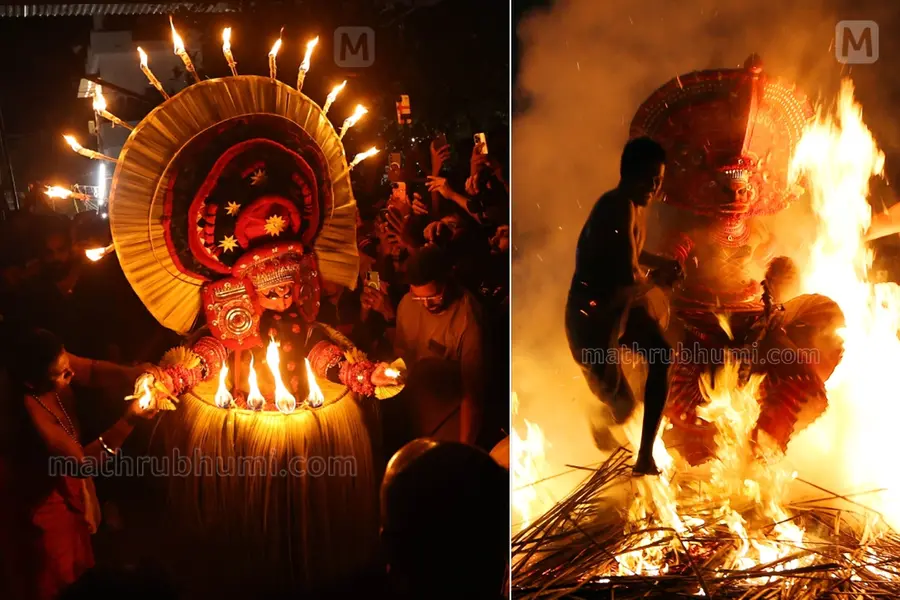
Kannur: Life has gained an unstoppable momentum as traditions and rituals followed by many generations in the past struggle to survive. Unfortunately, many rituals and practices that had been a part of our cultural life have already been wiped out or forgotten. The sweep of modernity, mixed with the advent of technology, has reduced many cultural events and practices to mere namesake rituals, and some of them are already on the brink of being forgotten. One push from the unscrupulous invisible force called ‘Time’ is all that’s needed for them to disappear from our physical world.
One cannot change the pace of time, as it is too powerful to be stopped or influenced. Still, some earnest efforts are being made from various quarters to preserve the invaluable, rich heritage for which we, the Keralites, are so proud.
The Agricultural Technology Information Centre, operating under the Directorate of Extension, Kerala Agriculture University, Mannuthy, Thrissur, has taken up such a cultural mission, as it is connected to the agricultural practices and agricultural history of Kerala. The CULT Culture Agriculture programme, a project of the university, has been working on preserving and documenting the role of agriculture in traditional and ritualistic art forms followed in various parts of Kerala.
"What we have been doing so far is taking a deep look into the rituals and traditional art forms of Kerala, which have deep-rooted connections to the agricultural practices in the state. We could feel the presence of agriculture in all these art forms, like Padayani and Theyyam. This approach is not purely academic. We have already done some documentation based on this perspective," said a senior official of Agriculture University.
At many places, so many rituals have been lost to the ravages of time. However, these enthusiasts have decided to preserve and protect whatever is remaining in our cultural realm. “Some of these art forms needed the support of an institution like a university. That’s where we intervene,” the official said. “At many places across the country, old rituals and art forms connected to such rituals have been wiped away mercilessly. But fortunately for us, in Kerala, we still have many traditional art forms being practiced and followed. So, we have a cultural responsibility to preserve them,” he said.
A couple of years ago, during one of their interactions with the artists of Padayani at Kottangal in Pathanamthitta district, it was communicated to the officials that the artists found it difficult to get arecanut leaf sheaths suitable for making their Padayani costumes. Though they did receive arecanut leaf sheaths, they complained that they lacked the necessary strength. Realizing that it was a genuine concern on the part of the artists, the University decided to provide them with enough arecanut leaf sheaths that were strong enough for their performances.
“The variety available in central Travancore does not match the requirements of these practitioners of Padayani art. So, we have decided to cultivate the strong Kasargodan variety, which is not as popular in this region,” the official said.
“In June 2024, we distributed 5,000 seedlings of the Rathnagiri variety (or Kasargodan variety) to around 46 Padayani groups. Though they may not use them this year or next year, they will be of some help to them in the future,” he said.
Now, as part of the second phase of the program, the University has extended its area of service to the northern part of Kerala as well. “Strong arecanut leaf sheaths are necessary to make costumes for Theyyams as well. So, we plan to distribute 5,000 arecanut seedlings to 100 Theyyakkavus in Kannur on March 2. The program will be held at the Folklore Academy precincts at 11 am,” he said.
The program is being jointly organised by Kerala Agriculture University and Kerala Folklore Academy. Minister Ramachandran Kadannappally will inaugurate the program. Azhikode MLA KV Sumesh will inaugurate the distribution of 5,000 seedlings to 100 Theyyakkavus. Dr V Venkitasubramanian, Director, ATARI, ICAR, will be the chief guest of the function.
The funding for the project is provided by the Agricultural Technology Application Research Institute under ICAR. “I think this is the first time in India that a university has taken an initiative to preserve and protect a cultural art form through a project,” the official said.
Published: 01 Mar 2025, 02:44 pm IST
ABOUT THE AUTHOR

Related Topics
Disclaimer: Kindly avoid objectionable, derogatory, unlawful and lewd comments, while responding to reports. Such comments are punishable under cyber laws. Please keep away from personal attacks. The opinions expressed here are the personal opinions of readers and not that of Mathrubhumi.