

A Bengali journalist, rooted in the magic of Durga Puja, discovers the warmth of Onam in Kerala, finding echoes of home in pookalams, sadhya, and the spirit of community
Kozhikode: For most of my childhood in Kolkata, life revolved around Durga Puja.
I grew up watching Satyajit Ray’s films, devouring Rabindranath Tagore’s works.
My obsession with Tintin comics, and of course, being the foodie, gorging onto the Bong favourite ‘rice and fish curry’ – sort of summed up my early days.
Yet, it was those ten days of unbridled revelry during the Duga Puja that remain conspicuous even till this day.
Come January 1 – and my job was to look for the M-day – the Mahalaya which ushers in Maa Durga’s trip to her parental place. Mahalaya sets the tone as ever – meticulous planning on pandal hopping befitting the nocturnal avatar attired in a new dress every day, ecstatic screams over the choicest of delicacies and et al – wow such an indelible memory defying years, days, minutes and seconds.
As a child Durga Puja meant no school, no homework. However, adulthood has a way of reshaping joy. When yours truly zeroed in on journalism at 21, reality dawned big time.
Life wouldn’t be confined to one city forget your native town – it would be career over emotions as traversing across the country beckoned.
Journalism promised me stories, travel, and cultures to explore.
Over the next seven years, I have flirtatious stints in Mumbai, Bangalore, Hyderabad, and Pune. And the year 2025 had me augmenting my ambitions in Kerala’s Kozhikode.
Kerala!!!! God’s own country I arrived here with little connection to the city, but curiosity was brimming inside.The smells of beef roast, pathiri, and avial welcomed me.
I did miss my beloved Katla and Rohu curries, but Ayakura—kingfish—soon filled that void.
Just as I was settling down, the city was gearing up for Onam, Kerala’s grandest festival.
I remembered my mother’s words when I told her about it: “Mone ache, toke social studies e chotobelay poriyechilam Onam niye?” (Remember, I taught you about Onam in your social studies lessons when you were a kid?). I smiled, because until then, Onam had been just a chapter in a school textbook. Now, I was about to live it.
The air in Kozhikode changed as Onam approached. The streets bristled with excitement. At work, colleagues waxed eloquent on shopping, pookalams (flower carpets), and sadhya (the grand feast).
Back home in Kolkata, flowers were integral to Durga Puja. We offer 108 lotus buds to Goddess Durga during Sandhi Puja. However, out here, each petal is placed with precision, every ring of colour adding to the artistry, and the pookalam felt like Kerala’s heartbeat during Onam.
On the fourth day, I draped myself in a traditional Bengali saree and joined the celebration at my office, where the Mathrubhumi Journalists Union had organised a sadhya.
What struck me most was the warmth — colleagues inviting me over and over again, making sure I didn’t miss out.
Seeing the men in their crisp white mundus (Dhoti) and the women in elegant Kerala sarees, I couldn’t resist sending photos to my family back in Kolkata.
The following days only deepened my joy.
Shopping with my colleague Aiswarya reminded me of the Puja rush back home — the same energy, madness and laughter. People were busy buying sarees, much like we did ahead of Durga Puja.
However, unlike in Kolkata, people got white sarees with yellow borders.
On the contrary the quintessential Bengali preference is saree with red borders.
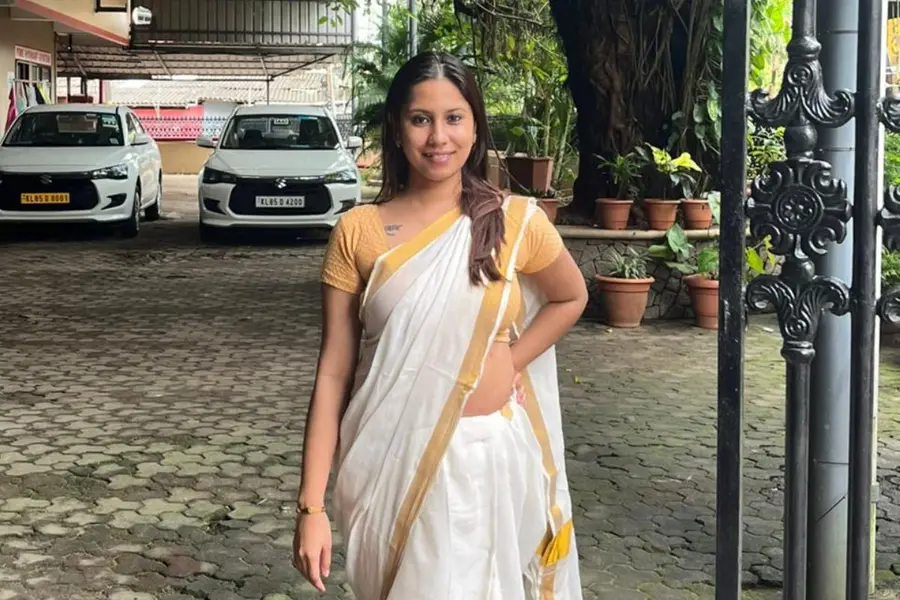
On the seventh day, Aiswarya gifted me a Kerala saree.
The traditional Kerala saree, in its ivory-white with golden borders, radiates a serene elegance, reflecting the calm grace of the land.
In contrast, the Bengali saree in its striking red and white carries the bold vibrance of Durga Puja, symbolising festivity and strength.
While the Kerala drape personifies simplicity and understated charm, the Bengali style is dramatic and full of energy.
One flows like the backwaters in serenity, the other erupts like the dhaak beats in celebration. Together, they tell the story of two regions, united in six yards of culture.
With the help of my roommate (because I still struggle with six yards of fabric!), I wore it to work and found my office buzzing with festivity. Colleagues were busy creating a colorful pookalam, and I joined them briefly before rushing off to the canteen for yet another sadhya.
That meal—eaten on banana leaves, served with love, and shared with colleagues—brought back vivid memories of community feasts during Durga Puja. I especially loved the sambhar and the cabbage fry—simple, flavorful, and unforgettable.
After the feast, I called my mother to tell her about my day. She listened quietly and then said something that made my eyes well up: “This year Durga Puja came to you in a different avatar. Durga came to you amid the pookalams and the sadhyas.”
At that moment, I realised she was bang on.
Festivals aren’t bound by geography.
They are about belonging, community, joy, and love. For the first time, I felt Onam wasn’t someone else’s celebration—it was mine too.
As I wiped a tear and smiled, one truth rang clear in my heart: indeed, Bharat is Atulya—India is incredible.
Published: 05 Sept 2025, 10:45 pm IST
ABOUT THE AUTHOR
Related Topics
Disclaimer: Kindly avoid objectionable, derogatory, unlawful and lewd comments, while responding to reports. Such comments are punishable under cyber laws. Please keep away from personal attacks. The opinions expressed here are the personal opinions of readers and not that of Mathrubhumi.