
Kerala semi-high-speed rail promises faster travel, limited land acquisition and fares above AC chair car rates
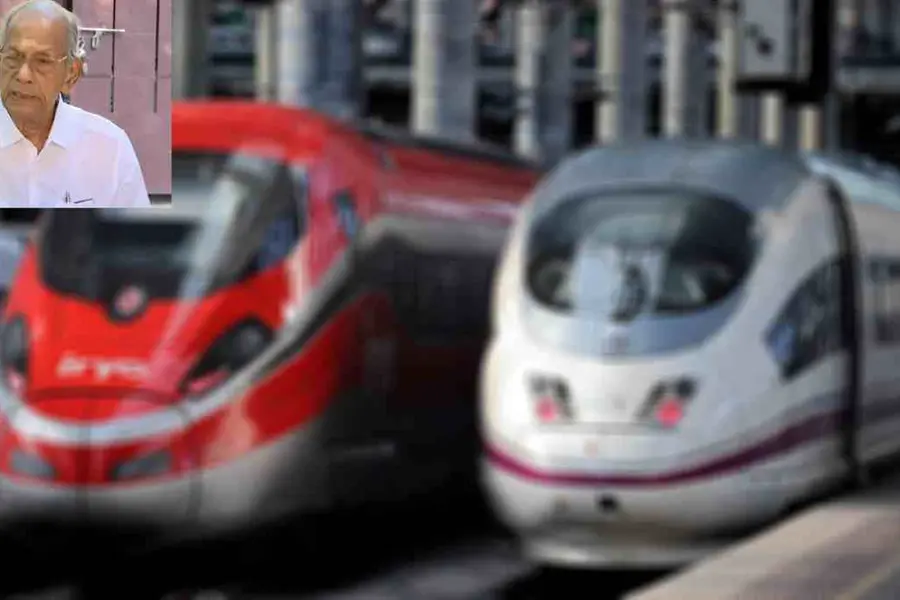
The Union government is considering a semi-high-speed rail corridor in Kerala between Thiruvananthapuram and Kannur, a project expected to sharply cut travel time while limiting land acquisition, technocrat and former Konkan Railway chairman E Sreedharan said on Saturday.
The proposed corridor will allow commuters to travel from Thiruvananthapuram to Kannur in 3 hours and 15 minutes, with Kochi reachable in 1 hour 20 minutes and Kozhikode in two and a half hours. Trains will run every five minutes, operate at speeds of up to 200 kmph, and offer only seated travel.
According to the project outline, only 5 to 10 per cent of the alignment will pass through normal land, with the rest elevated or tunneled. Land acquisition will be limited to a width of 25 metres.
Most sections will run on viaducts, allowing land beneath to be leased back to original owners for agriculture or grazing, subject to conditions. However, construction activities or planting of large trees beneath the viaducts will not be permitted.
The corridor will be double-tracked, and the design aims to extend rail access to areas that currently do not have train services.
Fares, seating and onboard capacity
Fares are expected to be about 1.5 times that of existing AC chair car fares. Standing travel will not be allowed.
Trains will operate with two classes — business class and normal class. Initially, services will run with eight coaches, expandable to 16. Each eight-coach train will be able to carry 560 passengers.
Route, stations and airport connectivity
The 430-kilometre corridor will connect Thiruvananthapuram and Kannur and link Thiruvananthapuram, Kochi and Kozhikode airports. A total of 22 stations are planned along the route.
The proposed stations are: Thiruvananthapuram Central, Thiruvananthapuram North, Varkala, Kollam, Kottarakkara, Adoor, Chengannur, Kottayam, Vaikom, Ernakulam (near Palarivattom bridge), Aluva, Nedumbassery, Thrissur, Kunnamkulam, Edappal, Tirur, Karipur, Kozhikode, Koyilandy, Vadakara, Thalassery and Kannur.
Around 70 per cent of the corridor will be elevated, with the remaining sections passing through tunnels or limited surface stretches.
Cost, funding and repayment plan
The estimated project cost is ₹1 lakh crore, with construction costs pegged at ₹200 crore per kilometre. A special purpose company will be formed to execute the project, with the Railways holding a 51 per cent stake and the Kerala government 49 per cent.
60 per cent of the project cost will be funded by the Union government and the state, while the remaining 40 per cent will be raised as debt. Revenue from the corridor is expected to repay the debt within 10 years.
Over the first five years, the Railways and the Kerala government will together bear ₹30,000 crore.
DPR preparation and construction timeline
Work on the detailed project report (DPR) will begin on February 2. The DPR is being prepared by the Delhi Metro Rail Corporation under the leadership of E Sreedharan, with a dedicated office set up in Ponnani.
The DPR is expected to be completed within nine months. Environmental impact studies and soil testing will be carried out alongside DPR preparation.
Once DPR preparation and construction begin, the project is expected to be completed within five years.
Centre’s response to additional rail demands
E Sreedharan said four demands were placed before Railway Minister Ashwini Vaishnaw: the semi-high-speed corridor, the Nilambur–Nanjangud line, the Chengannur–Pampa semi-high-speed line, and implementation of the European Train Control System to improve speeds on existing tracks.
He said the minister assured that all proposals would be considered and confirmed that a fresh DPR could be prepared for the Nilambur–Nanjangud project.
Published: 25 Jan 2026, 08:46 am IST
Disclaimer: Kindly avoid objectionable, derogatory, unlawful and lewd comments, while responding to reports. Such comments are punishable under cyber laws. Please keep away from personal attacks. The opinions expressed here are the personal opinions of readers and not that of Mathrubhumi.
