
Kargil hero Vikram’s father Panicker dies in Kozhikode.
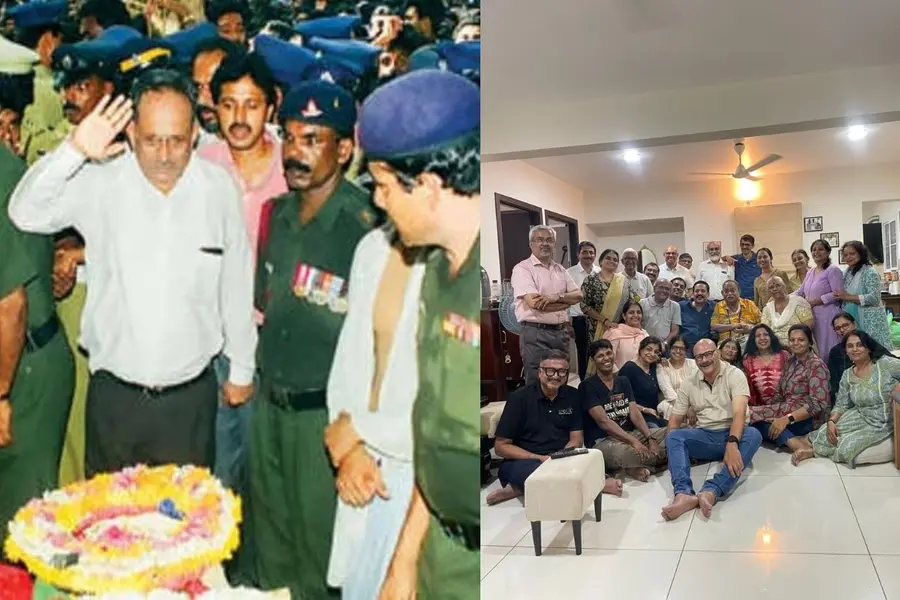
The evening was unlike anything that members of the Rotary Club of Calicut Midtown had ever seen; a formal meeting that, in many ways, was very different and would be remembered by one and all present. The venue was a residence at Gulmohar Apartment at Panniyankara in Kerala's Kozhikode district -- the home of Lt Col (Retd) PKPV Panicker.
The veteran, father of a Kargil martyr, had been a past president of the Rotary Club, and remained active in social circles despite physical difficulties. His wife, Kalyani Panicker, is also known for her strong involvement in community work.
Though illness had kept him away from regular meetings for a while, on May 9, Lt Col (Retd) Panicker insisted they hold a gathering at his residence so he could still be a part of it.
"It was a formal meeting between 7:30 pm and 11:00 pm," said Sreejith Kalathil, an active member and former president of the club. "Panicker sir asked for a minute of silence to honour those lost in Pahalgam and the bravery shown by our soldiers in Operation Sindoor."
Later that evening, during casual conversations amid the meeting, the 82-year-old veteran expressed strong faith in the Indian armed forces' capabilities, even if the conflict escalated to war. "He looked calm, happy and full of pride," Sreejith recalled.
The next day, just hours before United States President Donald Trump made the world aware of a ceasefire between India and Pakistan, Lt Col (Retd) Panicker passed into the ages.
Father to a fallen hero
Lt Col (Retd) Panicker's life was deeply shaped by the service and sacrifice of his son, Captain Vikram, who gave the supreme sacrifice in the 1999 Kargil War. Captain Vikram was martyred on June 2 while fighting to reclaim the Kaksar heights in the Drass sector.
At the time, when Vikram’s mortal remains arrived home draped in the national flag, Panicker stood tall and gave a crisp salute to his son, hiding his pain behind a soldier’s pride. It’s a moment the people of Kozhikode remember to this day.
A soldier even after retirement
Lt Col (Retd) Panicker had served the Indian Army for 30 years, including in the India-Pakistan wars of 1965 and 1971. Most of his career was spent in Jammu & Kashmir and Punjab, in the 141 Field Regiment. His son, Captain Vikram, too, joined the same regiment after training at the Indian Military Academy in Dehradun.
After retiring from the Army in 1994, Lt Col (Retd) Panicker worked as a Human Resources manager at Tata Phone Company in Kanjikode, Palakkad, and later at a Bengaluru IT firm. After Captain Vikram’s death, he returned to Kozhikode and became an active figure in various local organisations, including the Malabar Chamber of Commerce, Calicut Management Association and the Retired Armed Forces Association.
He played a key role in setting up the Ex-Servicemen League in Kozhikode.
Memories held close to the heart
Lt Col (Retd) Panicker never let go of his son’s memories. A photograph of a 13-year-old Vikram standing with him at the regiment stayed on his shelf till the end. The uniform and cap that Brigadier Dinesh Mathur handed him after Captain Vikram’s death were kept safe all these years.
In Captain Vikram’s memory, Lt Col (Retd) Panicker organised quiz competitions and other events under the Vikram Memorial Trust. He attended Independence and Republic Day parades at Vikram Maidan (named after his son) at Kozhikode's West Hill.
When the Sena Medal was posthumously awarded to Captain Vikram, Lt Col (Retd) Panicker said it was the first such honour for the regiment he had once founded -- and that Captain Vikram had completed the duty of a true soldier.
He was known for hiring only ex-servicemen in the gas agency he managed after his son's death, reflecting his lifelong commitment to fellow soldiers.
A legacy of love and service
Lt Col (Retd) Panicker originally hailed from Changanassery, but Kozhikode became his home after he married Kalyani. Together, they built a life rooted in duty, love, and service.
Lt Col (Retd) Panicker will be cremated at Manari crematorium on Sunday. As loved ones gather to bid farewell, they remember not just a soldier or a family man, but a soul who lived for others -- and stood by his country till his very last breath.
Published: 11 May 2025, 01:05 pm IST
Related Topics
Subscribe to our Newsletter
Disclaimer: Kindly avoid objectionable, derogatory, unlawful and lewd comments, while responding to reports. Such comments are punishable under cyber laws. Please keep away from personal attacks. The opinions expressed here are the personal opinions of readers and not that of Mathrubhumi.
