
Months after submitting the detailed project proposal to the state authorities, the former Delhi Metro Rail Corporation (DMRC) chief said there had been no progress on the matter.
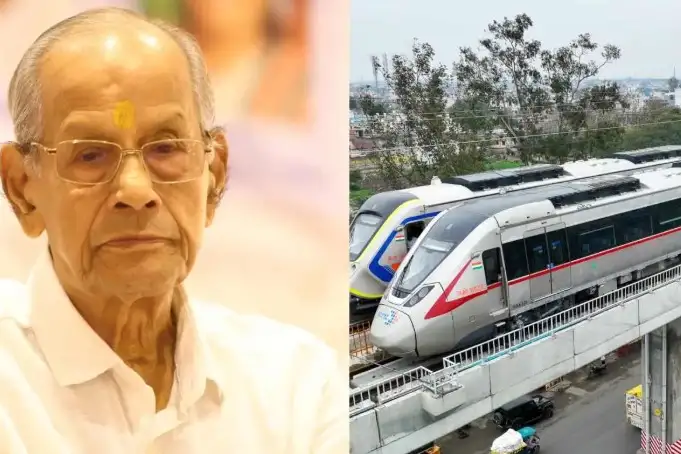
Renowned technocrat E Sreedharan, popularly known as the 'Metro Man', has begun taking his proposed high-speed rail project directly to the public amid delays in obtaining approval from the Kerala government.
Months after submitting the detailed project proposal to the state authorities, the former Delhi Metro Rail Corporation (DMRC) chief said there had been no progress on the matter. He claimed that delays were increasing the project's estimated cost by Rs 2.7 crore every day.
Speaking to Mathrubhumi, Sreedharan said his requests for permission to conduct a preliminary survey had also remained unanswered for the past eight months.
Unwilling to wait indefinitely for the government's response, he has started holding public meetings across Kerala to explain the project and gather people's opinions. Meetings have already been held in Kozhikode, Wayanad and Malappuram. Kochi, Thrissur and Thiruvalla are among the places where further interactions are planned.
However, Sreedharan has warned that continued delays could eventually force him to withdraw from the project.
Sreedharan has also urged the state government to reconsider the objections raised by its expert committee, which had examined the DMRC's project report.
The committee had described the report as incomplete, citing the absence of an environmental impact assessment, passenger projections and details on financial viability.
However, Sreedharan maintains that the panel did not have the necessary technical expertise to evaluate the proposal properly. He said the government should have constituted a technical committee instead of appointing an expert panel.
On the environmental clearance issue, he argued that railway projects involving linear infrastructure are exempt from obtaining prior environmental clearance under the relevant Central Government notification.
He has cautioned against conducting additional studies that he considers unnecessary, saying they could create complications with railway authorities and establish an undesirable precedent for similar projects across the country.
The committee, however, has maintained that Kerala's distinctive ecological conditions make social and environmental assessments necessary.
Sreedharan's position is that the proposed elevated alignment would considerably reduce the project's impact on land and the surrounding environment.
The proposed high-speed rail corridor is being presented as an alternative to the scrapped SilverLine project.
The 473.2-km double-line railway is planned to connect Thiruvananthapuram and Kannur through 23 stations. According to the proposal, around 70% of the alignment will run on elevated pillars, while another 20% will pass through underground tunnels.
The elevated design is intended to reduce land acquisition. Sreedharan has said landowners would be able to use their land again after the construction of the supporting pillars.
The trains are proposed to operate at speeds of up to 200 kmph, bringing the journey between the state capital and Kannur down to three-and-a-half hours.
The project is expected to handle around 2.28 lakh passengers daily.
The estimated cost of completing the corridor is Rs 60,000 crore.
Of this, Rs 36,000 crore is proposed to be contributed equally by the Central and state governments. The remaining Rs 24,000 crore is expected to be mobilised through equity-based crowdfunding via financial markets.
Under this funding model, ordinary citizens would be able to purchase shares in the project. These would be non-dividend shares, according to the proposal.
Sreedharan has presented the arrangement as a way to raise a substantial portion of the project cost without placing an additional financial burden on the state exchequer.
Airport connectivity and dedicated freight route to Wayanad
The proposed corridor is also intended to improve connectivity between major transport hubs in Kerala, including four major airports.
The project envisages significantly shorter travel times between important destinations. The proposed journey from Kozhikode to Kannur would take around 40 minutes, while the journey to Calicut Airport is estimated at 10 minutes. Travel from Kozhikode to Ernakulam is expected to take around one hour and 15 minutes.
Another feature of the proposal is a dedicated freight corridor connecting Wayanad through twin underground tunnels.
The freight tunnels are proposed to run 30 to 40 metres below the ground. Goods trains would operate between 9 pm and midnight, with stops planned at Koduvally, Adivaram, Kalpetta and Sulthan Bathery.
The proposed arrangement is intended to facilitate goods transportation to and from Wayanad without relying entirely on road connectivity.
Pod-based sky metro
Apart from the statewide high-speed rail proposal, Sreedharan has outlined another transport project for Kochi.
In an interaction with The New Indian Express, he proposed a nine-kilometre pod-based sky metro connecting Mattancherry and Ernakulam South.
The suspended pod system is expected to cost less than Rs 100 crore per kilometre, making it considerably cheaper than conventional elevated metro corridors, he said. The proposal comes amid rising land acquisition, electricity and construction costs.
The network would have 10 stations, with small passenger pods travelling at speeds of 50 to 60 kmph. Its estimated daily passenger capacity would be 12,000.
Sreedharan cited a functioning network in Sharjah as a model for the proposed system.
He said the project could complement Kochi's existing transport infrastructure by adding a sky metro to the city's conventional metro and water transport networks.
Published: 18 Nov 2026, 10:39 am IST


Related Topics
Disclaimer: Kindly avoid objectionable, derogatory, unlawful and lewd comments, while responding to reports. Such comments are punishable under cyber laws. Please keep away from personal attacks. The opinions expressed here are the personal opinions of readers and not that of Mathrubhumi.
