
Saturn will reach opposition on Sunday, October 4, putting the ringed planet opposite the Sun from Earth's perspective and offering skywatchers in India a favourable opportunity to observe it through most of the night.
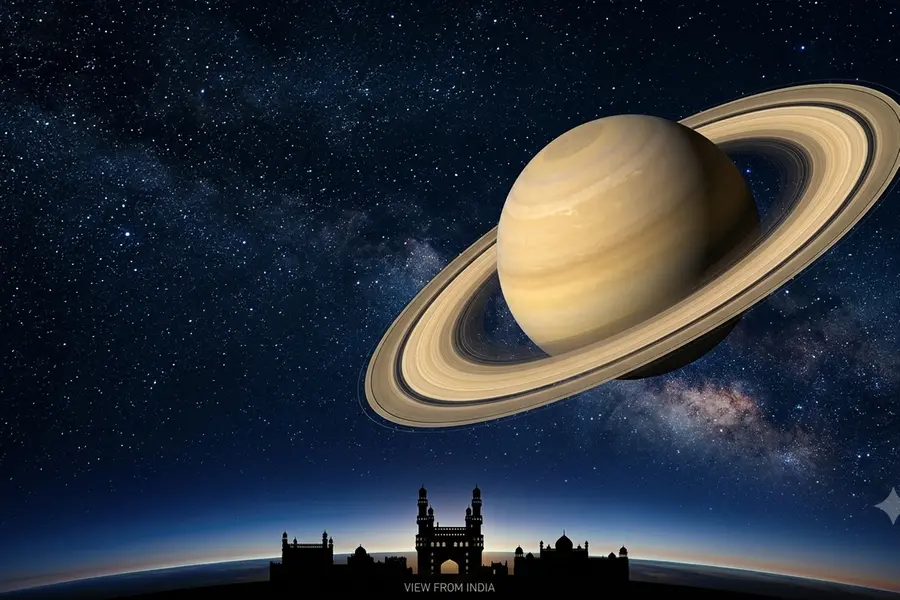
Saturn will reach opposition on October 4, 2026, an event that occurs when Earth passes between the Sun and Saturn, placing Saturn opposite the Sun in the night sky.
This alignment means Saturn rises around sunset, remains visible for much of the night and sets around sunrise. The planet will also be close to its brightest appearance of the year, making the event particularly useful for skywatchers.
Also Read

When can Saturn be seen from India?
For observers in India, Saturn is expected to rise at around 6:11 pm on October 4. It will reach its highest point in the sky at approximately 12:17 am, before setting at around 6:23 am on October 5.
This gives observers an opportunity to look for Saturn from shortly after sunset through the night. The exact visibility and position can vary depending on the observer's location, local horizon and weather conditions.
A location away from bright city lights and with a clear view of the sky will provide better viewing conditions.
Why does Saturn appear brighter?
Saturn's opposition is also associated with the Seeliger effect, a phenomenon that can make the planet's rings appear unusually bright around opposition.
The effect is named after German astronomer Hugo von Seeliger, who studied the phenomenon in the late 19th century.
Saturn's rings are made largely of particles containing water ice. Under normal viewing conditions, these particles can cast small shadows on one another. Around opposition, the geometry of the Sun, Earth and Saturn changes so that many of these shadows are hidden behind the particles from Earth's perspective.
As a result, a greater portion of the visible ring surface receives direct sunlight, increasing its apparent brightness.
What is the Seeliger effect?
The effect is particularly noticeable around the time of opposition because sunlight reaches the rings from almost directly behind the observer's viewing direction.
Light scattering from particles in the rings can also contribute to the increased brightness. NASA research has identified coherent backscattering as one of the mechanisms involved in the opposition brightening.
The effect is relatively subtle to the naked eye but can be more noticeable through a telescope, particularly when observing Saturn's rings.
Best time to observe Saturn
The Seeliger effect is expected to be most noticeable around October 3 to 5, making the nights surrounding the opposition particularly interesting for telescope observers.
Saturn itself should be visible without optical equipment under suitable conditions, although a telescope will provide a much clearer view of its rings.
For the best chance of seeing the planet:
- Find a location with a clear, unobstructed view of the sky.
- Avoid areas with heavy artificial light where possible.
- Look towards the eastern sky after sunset as Saturn rises.
- For telescope observations, allow your eyes time to adjust to the darkness.
- Check local weather conditions before planning an observation.
Why opposition is important for skywatchers
Opposition provides one of the best opportunities each year to observe an outer planet because it is visible for a large part of the night and is relatively bright.
Saturn's opposition is particularly appealing because even modest telescopes can reveal its distinctive ring system. Larger telescopes can provide greater detail, including differences in brightness across the rings and, under good conditions, some of Saturn's moons.
A night-sky event, not an astrological event
The astronomical opposition is a measurable alignment involving the positions of Earth, Saturn and the Sun. It should not be confused with astrological interpretations associated with Saturn.
Claims about the event affecting relationships, careers, finances or individual zodiac signs are astrological interpretations rather than established scientific effects and are separate from the astronomical phenomenon.
For skywatchers in India, the main significance of October 4 is the opportunity to observe Saturn for much of the night, with its rings receiving an additional brightness boost around opposition.
Published: 04 Oct 2026, 03:50 pm IST
ABOUT THE AUTHOR
Disclaimer: Kindly avoid objectionable, derogatory, unlawful and lewd comments, while responding to reports. Such comments are punishable under cyber laws. Please keep away from personal attacks. The opinions expressed here are the personal opinions of readers and not that of Mathrubhumi.