
The balance of power inside the Congress legislative party became evident in the new Kerala cabinet, with leaders aligned to K.C. Venugopal securing a dominant share of ministerial positions while V.D. Satheesan managed to accommodate only a few of his supporters.
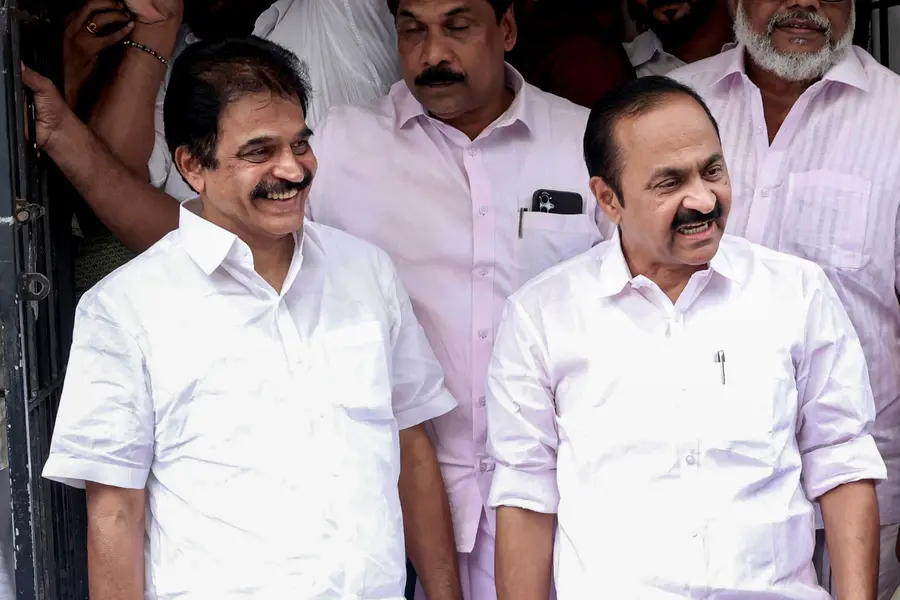
Thiruvananthapuram: The formation of the new Kerala cabinet has revealed the changing power dynamics within the Congress party, with the faction led by K. C. Venugopal emerging as the dominant force.
The final ministerial list reflected the strong influence of the Venugopal camp inside the Congress legislative party, while opposition leader V. D. Satheesan managed to secure only limited representation for his supporters.
Also Read

Venugopal faction secures majority influence
According to party discussions, the Venugopal camp reportedly enjoyed the backing of 47 out of 63 Congress MLAs. This numerical strength was reflected clearly in the cabinet composition, where eight of the Congress party’s 11 ministers are believed to be aligned with Venugopal.
Only a few ministers, including K. Muraleedharan and Roji M. John, are considered close to Satheesan.
The developments highlighted how organisational influence within the party played a major role in cabinet formation, beyond public leadership positions.
Seniority becomes key factor in minister selection
Party leaders reportedly prioritised seniority while finalising the ministerial list. Despite several first-time MLAs from the Ezhava community being in contention, leaders such as M. Liju, Bindu Krishna, and O.J. Jineesh were included in the cabinet.
Senior Congress leader Ramesh Chennithala attempted to secure an additional ministerial berth for another leader from his camp, but the move reportedly failed during final negotiations.
There is also speculation within Congress circles that K.A. Tulsiy may later step down as part of a rotational arrangement, making way for I.C. Balakrishnan during the second half of the government’s term.
Surprise minister selections create discussion
The inclusion of K.A. Tulsiy and O.J. Jineesh in the ministry surprised many within the party.
Congress central leadership reportedly instructed the Kerala unit to ensure balanced representation by including at least two ministers from SC/ST communities and two women ministers in the cabinet.
Apart from A.P. Anil Kumar, Chennithala reportedly proposed I.C. Balakrishnan for representation from the SC/ST category. The name of V.P. Sajeendran was also discussed during internal consultations.
However, final decisions reflected compromises among multiple factions and community considerations.
Muslim representation triggers internal debate
The question of Muslim representation in the cabinet became another sensitive issue during discussions.
The names of T. Siddique, Shanimol Usman, and Anwar Sadath were all considered for ministerial positions. Satheesan reportedly backed Shanimol Usman, while Chennithala supported Anwar Sadath.
The discussions became complicated because both Siddique and Balakrishnan belong to Wayanad district, which has only three Assembly constituencies. Party leaders were hesitant to allocate multiple ministerial positions to leaders from the same district.
As a result, the final decision was delayed until broader political balancing could be achieved.
Venugopal pushes for K.A. Tulsiy
Venugopal strongly supported the inclusion of K.A. Tulsiy, wife of Palakkad MP V.K. Sreekandan, in the cabinet.
Despite resistance from some quarters, Satheesan eventually agreed to the proposal as part of the final compromise formula.
Political observers viewed the move as another indication of Venugopal’s growing authority in Kerala Congress affairs.
Youth representation leads to O.J. Jineesh’s entry
The appointment of O.J. Jineesh, the state president of the Youth Congress, was justified on the grounds of youth representation in the cabinet.
His inclusion effectively closed the remaining opportunities in the ministry, forcing Satheesan to abandon efforts to secure a berth for V.T. Balram.
The development disappointed some younger Congress leaders who had expected greater representation in the cabinet.
Coalition negotiations among UDF allies also influenced the final cabinet structure.
Anoop Jacob and Mani C. Kappan reportedly agreed to share a ministerial arrangement. Satheesan used one of the available vacancies to bring in Roji M. John.
Sources within the alliance indicated that Mani C. Kappan, who represents the Catholic community, may receive a ministerial position only during the second half of the government’s tenure.
Community representation concerns remain
The cabinet formation also triggered discussions regarding community representation.
Although Oommen Chandy’s name was discussed informally in political circles, the Congress leadership reportedly did not seriously consider him during cabinet talks.
The Orthodox Christian community was ultimately left without representation in the ministry, while the Latin Catholic community secured representation through Shibu Baby John of the RSP.
Senior leader Thiruvanchur Radhakrishnan, who was interested in a ministerial berth, was instead accommodated as Speaker of the Assembly. Shanimol Usman was reportedly selected as Deputy Speaker.
Despite the UDF receiving significant electoral support from Kozhikode district, Congress could not include a minister from the district.
The Indian Union Muslim League also reportedly faced similar limitations. Party leaders later informed Congress that Parayil Abdullah would replace Abdul Ghafoor after two-and-a-half years as part of a rotational arrangement within the alliance.
The cabinet formation has therefore highlighted not only factional competition within Congress but also the continuing challenges of balancing regional, community, and alliance interests inside the UDF government.
Published: 18 May 2026, 07:56 am IST
Disclaimer: Kindly avoid objectionable, derogatory, unlawful and lewd comments, while responding to reports. Such comments are punishable under cyber laws. Please keep away from personal attacks. The opinions expressed here are the personal opinions of readers and not that of Mathrubhumi.