
The initiative received funding and support from the Centre of Excellence for Differently-abled Studies (CeDS), under the LBS Centre for Science and Technology, a Government of Kerala undertaking
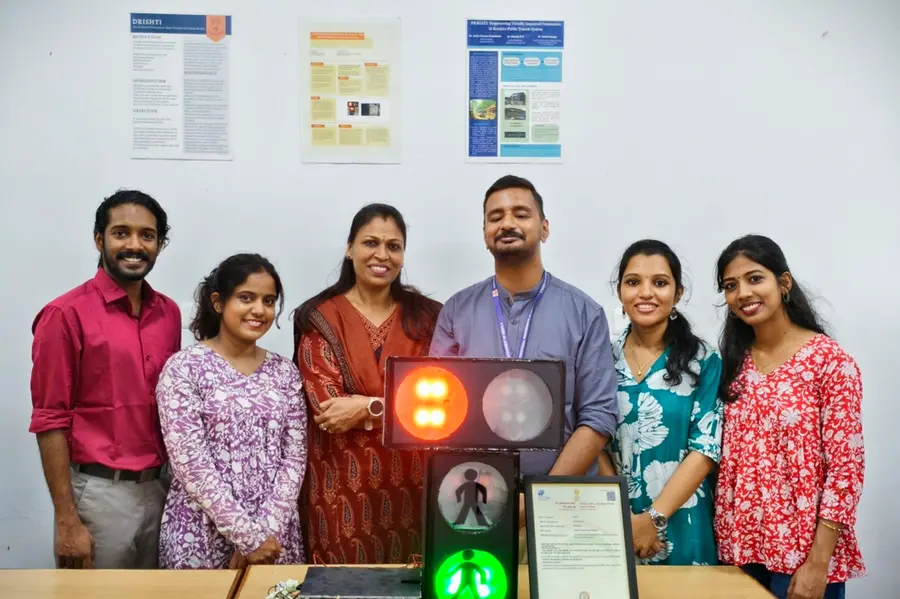
Thiruvananthapuram: In a major boost to urban road safety, an interdisciplinary team from the College of Engineering Trivandrum (CET) has developed and secured an Indian patent for an Artificial Intelligence (AI)-driven traffic signalling system aimed at preventing pedestrian fatalities at zebra crossings.
The Indian Patent Office has granted Patent for the “Intelligent Traffic Signalling System for Improved Pedestrian Safety,” recognising its innovative design and integrated hardware-software architecture. The research has also been selected for presentation at the World Conference of Transport Research (WCTR 2026) in Toulouse, France.
Pedestrian safety continues to be a pressing concern in India. According to data from the Ministry of Road Transport and Highways (MoRTH), 35,221 pedestrians lost their lives in 2023, accounting for nearly one in five road fatalities. Experts attribute this largely to conventional fixed-time traffic signals and unprotected zebra crossings that fail to account for real-time pedestrian movement.
The CET team’s system replaces traditional timer-based signals with an intelligent, adaptive model using computer vision and machine learning. Smart cameras monitor pedestrian movement at crossings, enabling the system to respond dynamically.
A key feature of the innovation is its ability to run advanced AI algorithms on cost-effective, low-power devices such as Raspberry Pi, making it scalable and practical for widespread deployment.
The system operates on two core principles:
Predictive Scheduling: Using historical data and time-series forecasting, the system anticipates pedestrian flow and adjusts signal timings in advance.
Safety Fail-Safe: If any pedestrian, especially vulnerable individuals like the elderly or children, remains on the crossing when the signal is about to change, the system automatically holds the red light for vehicles until the crossing is cleared.
Zero pedestrians left behind
In simulation tests at a mid-density intersection, conventional signals left 17 pedestrians stranded during light changes. In contrast, the CET system recorded zero stranded pedestrians. Notably, it also slightly reduced average vehicle waiting time, demonstrating that enhanced safety need not compromise traffic efficiency.
The project was led by Dr. Jerrin Thomas Panachakel from the Department of Electronics and Communication Engineering and Dr. Anusha S P from the Department of Civil Engineering. The team included researchers and students Adithya S Nair, Ancy S A, Anoop K S, and Surya C K.
The initiative received funding and support from the Centre of Excellence for Differently-abled Studies (CeDS), under the LBS Centre for Science and Technology, a Government of Kerala undertaking. The project was selected for its potential to significantly improve safety for vulnerable pedestrians, including the elderly and persons with locomotor disabilities.
Published: 25 Mar 2026, 06:25 pm IST
Related Topics
Disclaimer: Kindly avoid objectionable, derogatory, unlawful and lewd comments, while responding to reports. Such comments are punishable under cyber laws. Please keep away from personal attacks. The opinions expressed here are the personal opinions of readers and not that of Mathrubhumi.
