
Golden hour lost on NH 544: Ambulances stuck in Thrissur–Ernakulam traffic chaos
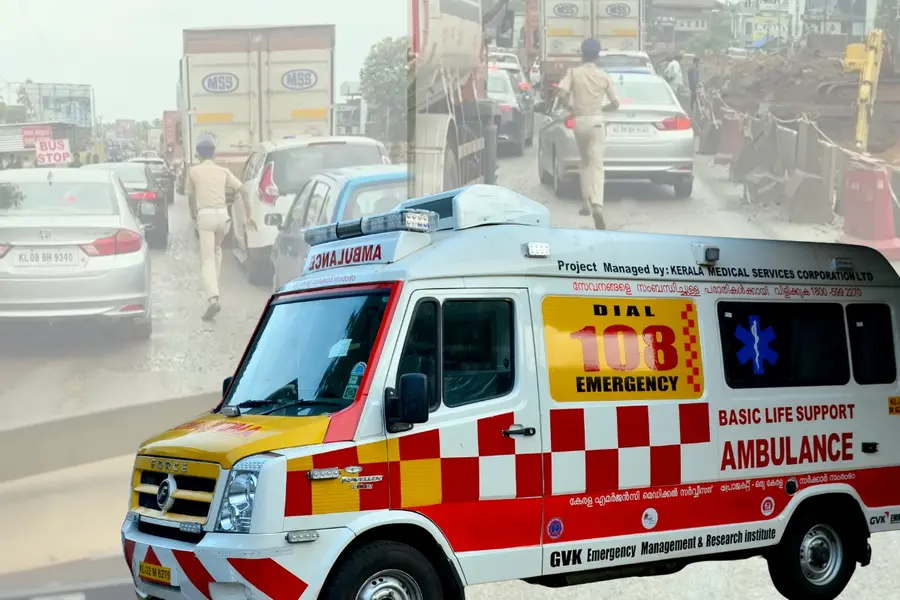
When someone suffers a serious accident or medical emergency, the first 60 minutes — known as the golden hour — can mean the difference between life and death. Swift medical attention during this window is crucial, and ambulances are designed to play a vital role — navigating traffic and racing against time to reach hospitals. But on the Mannuthy-to-Edappally stretch of National Highway 544, this golden hour is steadily slipping away. The reason? Ongoing subway construction works are choking traffic, delaying even emergency vehicles.
The biggest trouble lies between Amballur and Angamaly, where road works have caused daily bottlenecks. The worst-hit points are Muringoor, Koratty, and Chirangara. The works started in the summer have now become a nightmare in the monsoon, as pothole-riddled service roads worsen with rain and mud.
Vinodkumar VK, driver with JVJ Ambulance, Angamaly, says not just emergencies even dead body ferrying are affected.
"Recently, a patient had to be shifted from LF Hospital, Angamaly to St. James Hospital, Chalakudy. It’s just 17 km, normally a 20-minute ride. But it took us 1 hour and 15 minutes,” he recalls. Vinodkumar also points out that even a 60 km emergency trip from Angamaly to Thrissur Medical College, which used to take under an hour, now has no time guarantee.
“Dead body ferrying has also become difficult. The body might land at the airport from abroad, and the family would’ve planned the last rites. But the congestion poses a serious challenge,” he says.
“Sometimes, there are three to four rows of vehicles trying to pass where only two can fit. We cannot move the ambulance even an inch. Other vehicles do try to make our navigation smooth. Lorries and loaded vehicles find it hard to give side — not their fault, there’s no space,” he noted.
Susheel Manalarkaavu, president of the Ambulance Owners and Drivers’ Association, Thrissur district, says around 15 ambulances travel daily from Thrissur to Kochi hospitals like Amrita, Rajagiri, and Aster. “Earlier, it took 45 minutes to one hour. Now it’s much more. If service roads were proper, this wouldn’t have happened,” he says.
He adds that if accidents happen in places like Chalakudy or Pudukkad, it’s difficult to shift patients to advanced emergency care in Kochi or Thrissur after basic first aid.
Traffic flow is uneven throughout the day. In the mornings, Thrissur to Angamaly faces heavy congestion, often caused by vegetable-laden trucks from the Thrissur market. In the evenings, it’s Angamaly to Thrissur that slows down. Weekends tend to be worse, though jams persist all day.
There are alternative interior routes, but they come with their own risks. Sharp curves and potholes make them unsuitable for seriously ill patients. Many drivers avoid them for safety reasons.
While police have been cooperative -- a recent viral video showed a traffic officer running to clear the way for an ambulance -- even they can only do so much when there’s no space to move.
Ambulance drivers often rely on WhatsApp groups rather than Google Maps to check real-time traffic. These drivers before their trip check with peers part of their association to decide whether to wait or divert.
There is growing concern among bystanders as well. They wait anxiously as ambulances remain stuck in traffic, watching as valuable minutes tick away.
Although prohibited, some drivers resort to using sirens while transporting dead bodies when delays risk disrupting scheduled funeral rites. Others admit they are compelled to drive on the wrong side of the road during emergencies. In their view, saving a life sometimes requires bending rigid rules.
Meanwhile, the Kerala High Court has taken note of the traffic congestion on the stretch. It criticised the National Highways Authority of India (NHAI) for poor planning and has directed that the service roads be repaired and maintained immediately. Some damage control work has now begun. But on the ground, the chaos continues.
Published: 04 Jul 2025, 01:24 pm IST
Related Topics
Disclaimer: Kindly avoid objectionable, derogatory, unlawful and lewd comments, while responding to reports. Such comments are punishable under cyber laws. Please keep away from personal attacks. The opinions expressed here are the personal opinions of readers and not that of Mathrubhumi.
