
Actor-turned-politician Vijay is set to become Tamil Nadu’s new Chief Minister today after his party TVK emerged as a major force in the 2026 Assembly elections and secured alliance support to form the government.
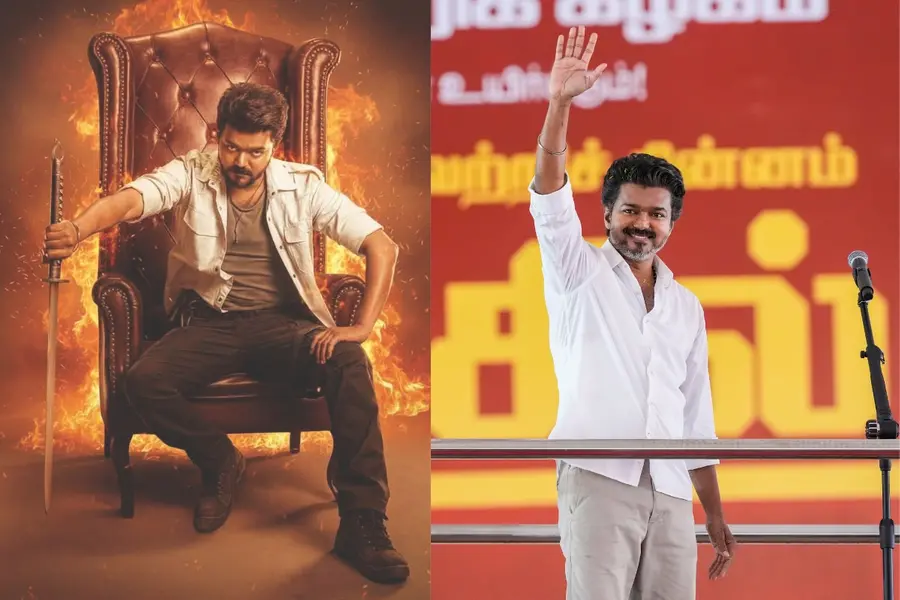
Chennai: Actor-turned-politician Vijay is set to take oath as the Chief Minister of Tamil Nadu on Sunday, marking one of the biggest political shifts in the state in decades.
The swearing-in ceremony will take place at Jawaharlal Nehru Stadium in Chennai, where senior political leaders, alliance partners and supporters are expected to attend.
With his appointment, Vijay becomes the first leader outside the traditional DMK and AIADMK political formations to head the Tamil Nadu government since 1967.
TVK’s debut election creates political upset
Vijay’s party, Tamilaga Vettri Kazhagam, contested its first-ever Assembly election in 2026 and emerged as the single-largest party with 108 seats.
Although the party fell short of the majority mark on its own, Vijay secured post-poll support from Congress, CPI, CPI(M), VCK and IUML to cross the required majority threshold and form the government.
The result marked a major disruption in Tamil Nadu’s long-standing two-party political dominance between the DMK and AIADMK alliances.
Political observers described the outcome as one of the most dramatic electoral changes in the state’s modern political history.
Governor invites Vijay to form government
Tamil Nadu Governor Rajendra Arlekar formally invited Vijay to form the government after he submitted letters of support from alliance partners.
The Governor also directed him to prove his majority on the floor of the Assembly before May 13.
The development officially cleared the way for Vijay’s transition from cinema icon to head of government.
Rahul Gandhi and alliance leaders to attend ceremony
Leader of Opposition in the Lok Sabha Rahul Gandhi is expected to attend the oath-taking ceremony along with senior leaders from alliance parties.
The event is expected to draw significant national attention because of Vijay’s massive fan following and the historic nature of the political transition in Tamil Nadu.
Heavy security arrangements and large public gatherings are expected around the venue in Chennai.
From superstar to political force
Known popularly as “Thalapathy,” Vijay built a strong mass following through his film career before formally entering politics.
For years, speculation surrounded his political ambitions due to the social and political themes present in several of his films, including issues related to corruption, social justice and governance.
His public outreach activities and welfare initiatives also helped build a support base beyond cinema audiences.
During the 2026 election campaign, Vijay attracted large crowds across Tamil Nadu, with many comparing his political rise to former actor-politician and Chief Minister M. G. Ramachandran and later political figures such as Vijayakanth.
Since launching TVK in 2024, Vijay has attempted to position himself as both a continuation and a reformist alternative within Dravidian politics.
In his early political speeches, he named Periyar E. V. Ramasamy, C. N. Annadurai, K. Kamaraj and B. R. Ambedkar as ideological inspirations.
At the same time, he stated that while he respected Periyar’s social justice principles, his party would not adopt atheism as a political position.
Vijay has also openly spoken about secularism and inclusive politics during his campaign speeches.
Double victory in Assembly polls
In the 2026 Assembly election, Vijay contested from both Perambur and Trichy East constituencies and won both seats.
As per election rules, he is expected to resign from one constituency after formally assuming office as Chief Minister.
His dual victory further reinforced his popularity across different regions of Tamil Nadu.
For nearly six decades, Tamil Nadu politics revolved around the dominance of the DMK and AIADMK, parties shaped by leaders such as M. Karunanidhi, J. Jayalalithaa and M. G. Ramachandran.
Vijay’s rise and TVK’s breakthrough victory are now being viewed as the beginning of a new political era in the state.
Analysts believe the success of his government will determine whether Tamil Nadu’s political landscape undergoes a long-term transformation or whether the traditional Dravidian parties regain dominance in future elections.
(With ANI inputs)
Published: 10 May 2026, 08:17 am IST
Disclaimer: Kindly avoid objectionable, derogatory, unlawful and lewd comments, while responding to reports. Such comments are punishable under cyber laws. Please keep away from personal attacks. The opinions expressed here are the personal opinions of readers and not that of Mathrubhumi.
