
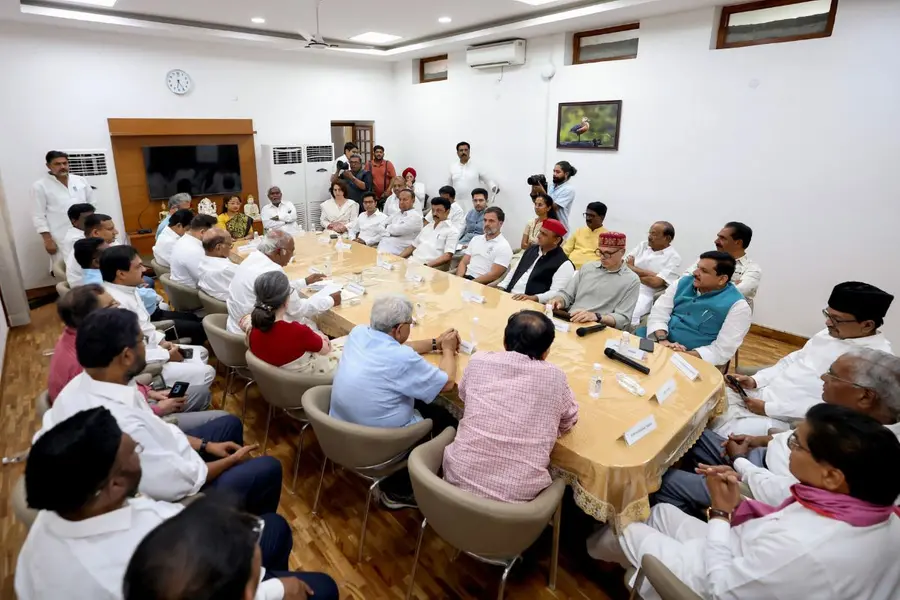
Rahul Gandhi’s recent video message on X, in which he asserted that “only the Congress can defeat the BJP and Narendra Modi,” has landed at a politically sensitive moment. It comes amid shifting alliances in Tamil Nadu, post-election turbulence in West Bengal, and growing unease among INDIA bloc partners about coordination and trust.
Taken together, these developments raise a broader question: is the INDIA bloc fragmenting, or simply entering a phase of realignment?
A bloc formed to defeat the BJP — but struggling after 2024
The Indian National Developmental Inclusive Alliance (INDIA bloc) was formed in 2023 as a broad coalition of opposition parties united primarily by one objective: defeating the BJP in the 2024 general election.
While the alliance did not achieve that goal, it did succeed in reducing the BJP’s parliamentary strength and establishing itself as the principal opposition framework.
However, since the 2024 elections, internal cohesion has weakened. The latest assembly election cycle has exposed tensions that were already present beneath the surface.
Tamil Nadu: the most visible rupture
The sharpest break has emerged in Tamil Nadu between the Congress and the DMK, long-standing allies both at state and national levels.
For nearly two decades, the two parties shared an electoral understanding. But over time, Congress leaders became increasingly uncomfortable with what they saw as shrinking seat allocations within the DMK-led alliance.
Following recent results, actor-politician C Joseph Vijay’s Tamilaga Vettri Kazhagam (TVK) emerged as a major political force in the state. In a closely contested outcome, the Congress extended support to Vijay’s position, helping him edge closer to a governing majority.
That move was widely interpreted as a departure from the DMK alliance. The DMK responded sharply, calling it a betrayal, and senior leaders publicly suggested that the INDIA bloc framework itself had effectively collapsed.
One DMK MP even formally requested parliamentary seating realignment away from Congress, underscoring the seriousness of the rupture.
Ripple effects across opposition parties
The fallout has not been confined to Tamil Nadu.
In Uttar Pradesh, Samajwadi Party leader Akhilesh Yadav has publicly signalled frustration, posting remarks that emphasised loyalty to allies during difficult political moments. His comments were widely interpreted as indirect criticism of Congress.
In West Bengal, the situation is more complex. Mamata Banerjee’s Trinamool Congress (TMC) fought separately from Congress in recent elections but continues to cooperate intermittently in Parliament. After her party’s defeat, she described herself as a “free bird” and reiterated her willingness to engage in broader anti-BJP coordination, even as tensions with Congress remain unresolved.
These overlapping positions highlight the lack of a consistent alliance structure across states.
Competing political strategies inside the opposition
At the centre of the current debate is a strategic divide:
Congress is increasingly projecting itself as the principal national alternative to the BJP, with Rahul Gandhi positioning the party as the only viable challenger.
Regional parties such as the DMK and TMC prioritise state autonomy and negotiated alliances, often resisting Congress dominance within coalitions.
The Samajwadi Party continues to balance regional strength in Uttar Pradesh with selective engagement at the national level.
Meanwhile, newer political entrants such as Vijay’s TVK are further complicating the landscape by positioning themselves as ideological opponents of the BJP while remaining distinct from traditional opposition blocs.
Is the INDIA bloc breaking up?
Despite public statements suggesting fracture, the situation is not a clean break.
Some alliances, like Congress–DMK, are under severe strain.
Others, like Congress–TMC, remain functional but inconsistent.
SP and Congress still cooperate in parts of northern India, particularly in Uttar Pradesh.
The key issue is that the INDIA bloc was never a formal political merger. It is a loose coordination platform, and its stability depends heavily on state-level electoral arithmetic rather than a unified national structure.
What happens next
The next major test for opposition coordination will be Uttar Pradesh, where the SP and Congress performed relatively strongly together in the 2024 Lok Sabha elections against the BJP.
For now, the opposition landscape can be summarised in five broad trends:
- Congress is asserting national leadership ambitions more openly.
- SP is signalling caution about Congress reliability.
- TMC remains unpredictable but open to issue-based cooperation.
- DMK has openly questioned the relevance of the INDIA bloc framework.
- New regional forces like TVK are reshaping state-level equations.
Rather than a sudden collapse, the INDIA bloc is experiencing stress fractures driven by competing ambitions, regional priorities, and post-election recalculations.
What is emerging is less a unified alliance and more a shifting set of regional partnerships, still oppositional to the BJP, but increasingly fragmented in structure, leadership, and long-term direction.
Published: 09 May 2026, 06:05 pm IST
Related Topics
Disclaimer: Kindly avoid objectionable, derogatory, unlawful and lewd comments, while responding to reports. Such comments are punishable under cyber laws. Please keep away from personal attacks. The opinions expressed here are the personal opinions of readers and not that of Mathrubhumi.
