
Founded in 1977, IFAD is a specialised United Nations agency and an international financial institution that tackles hunger and poverty in rural communities
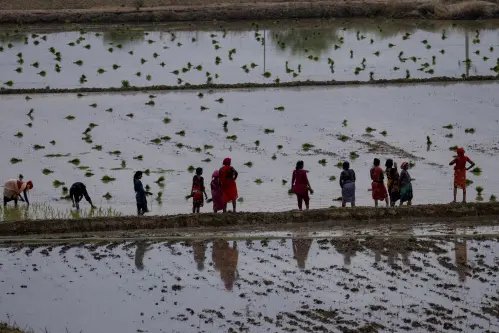
Investments worth around USD 75 billion are required to help India’s small-scale farmers adapt to the growing impact of climate change, according to Alvaro Lario, President of the International Fund for Agricultural Development (IFAD). He stressed that channelling climate finance to rural areas remains a critical challenge for India and many countries globally.
In an interview, Lario outlined three major areas of concern for IFAD in India: “How do we make agriculture more profitable for farmers, how do we boost productivity while addressing climate shocks, and how do we shift from food security to nutrition security?”
A mission rooted in rural resilience
Founded in 1977 during a global food crisis, IFAD is a specialised United Nations agency and international financial institution focused on alleviating hunger and poverty in rural communities. Lario said adapting smallholder agriculture to climate shocks is now central to IFAD’s mission.
“Small-scale farmers need at least USD 75 billion to adapt to current and future climate shocks,” Lario stated.
According to India’s 10th agriculture census (2015–16), small and marginal farmers--those owning less than two hectares--make up 86.2% of all farmers in India but hold only 47.3% of agricultural land.
Climate challenges specific to India
"In case of India we're seeing seasonal water scarcity, rising temperatures, more frequent droughts, so there's a lot of investments that can actually support these small-scale farmers globally. In global climate finance, what we're seeing is that these small-scale producers, hundreds of millions of rural people, are only receiving less than one per cent of the overall global climate finance," he said.
Lario lauded schemes like 'soil health card', and said it gives farmers personalised recommendations on how they can improve their soil health, as well as incentives to adopt treat irrigation and other water-saving technologies.
"The challenges remain and we're seeing that many of the farmers are still struggling to adopt some of the climate smart practices. So still we need to continue investing, we are investing with the government at the central and state levels in India," he said.
He cited examples from Maharashtra, Meghalaya, Mizoram, and Odisha, where their interventions are bringing in investments that combine climate resilient practices with sustainability and income.
Securing long-term rural investment
Lario said IFAD's priority is to mobilise financing, especially long-term financing for rural areas and deliver a long-lasting impact for those who need it most.
"We know that agriculture accounts for around 20 per cent of GDP in India and it employs around 42 per cent of the workforce. So even though there has been a lot of progress, we believe that continuing investing in pro-poor inclusive value chain and connecting small-scale producers to markets continues to be fundamental," he said.
Lario also mentioned how it's important to focus on how these small-scale farmers can continue increasing their income through crop diversification, improved water management, or micro irrigation systems, and also creating community seed banks or using drought tolerant seeds.
"All of this is really gonna have a translation into better lives and better incomes," he said.
Need to attract private capital
He also stressed on bringing private capital into the sector.
"We're also trying to bring private capital, private local companies with the government by really bringing a partnership of the public, the private, and the producers themselves. We're also adopting agro-ecological approaches that are currently supporting commercially viable and sustainable value chains so that once more the goal is to improve the income of small-scale farmers and also the resilience to shock," he said.
Lario gave the example of Meghalaya, where IFAD has promoted and incubated a number of market-driven enterprises which are offering agri-entrepreneurs incubation, mentoring, credit, and access to markets.
In Mizoram, he said, IFAD is promoting integrated farming, bringing together crops, livestock, agroforestry, in community-led clusters.
Weather-based crop planning
"We're introducing weather-based crop planning which is also enabling farmers to align the sowing with the rainfall forecast thereby reducing climate risk," he said.
He said IFAD was the first UN funded programme which received two credit ratings, and currently they're issuing bonds that are being bought by pension funds and central banks all over the world.
"We are also bringing capital and investment, especially private capital to these rural areas," he said.
"We're currently using our own financing to co-invest with the private sector by directly investing in agri-enterprises, in local financial institutions and in value chain institutions that are very much serving small holder farmers," he said.
Lario further said the strategy is very much aligned with the Indian government's approach over the decades.
According to IFAD, it has invested over USD 1.5 billion in India in the last 45 years, reaching over 6 million families.
"Our focus has been very much on investing in women, in tribal communities, small-scale producers and also on strengthening community institutions," he added.
PTI
Published: 06 Jul 2025, 09:27 pm IST
Disclaimer: Kindly avoid objectionable, derogatory, unlawful and lewd comments, while responding to reports. Such comments are punishable under cyber laws. Please keep away from personal attacks. The opinions expressed here are the personal opinions of readers and not that of Mathrubhumi.
