
India’s major public sector oil companies are reportedly losing up to Rs 1,700 crore every day as global crude oil prices surge amid the ongoing US-Iran conflict, raising fears of a possible fuel price hike.
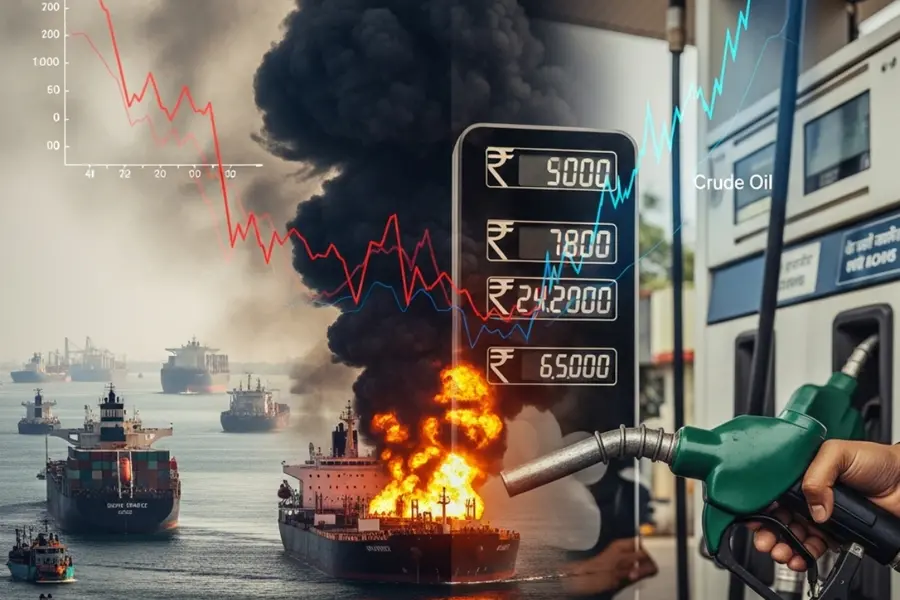
The continuing US-Iran conflict and instability in West Asia are beginning to place significant pressure on India’s energy sector, with state-run oil companies reportedly absorbing daily losses of nearly Rs 1,600–1,700 crore.
Indian Oil Corporation (IOC), Bharat Petroleum Corporation Limited (BPCL) and Hindustan Petroleum Corporation Limited (HPCL) are continuing to sell petrol and diesel at existing retail prices despite a sharp rise in international crude oil rates.
Also Read

According to reports, the gap between rising global crude prices and unchanged domestic retail rates has pushed cumulative under-recoveries beyond Rs 1 lakh crore over the past 10 weeks.
Hormuz tensions disrupt energy markets
The crisis has intensified concerns over the Strait of Hormuz, one of the world’s most critical oil shipping routes.
India depends heavily on imports passing through the region, with reports suggesting:
- Nearly 40% of crude oil imports affected
- Around 90% of LPG imports impacted
- Approximately 65% of LNG imports disrupted
Despite the supply challenges, fuel availability across India has remained stable so far.
Government takes steps to manage pressure
To reduce pressure on imports and domestic supply, the government reportedly increased LPG production from 36,000 tonnes per day to 54,000 tonnes per day shortly after the crisis escalated.
Excise duties on petrol and diesel were also reduced earlier to shield consumers from immediate price shocks.
While LPG prices have seen revisions, petrol and diesel prices have remained unchanged at:
- Petrol: Rs 94.77 per litre
- Diesel: Rs 87.67 per litre
This comes despite international crude prices reportedly rising by nearly 50% since the conflict intensified.
Is a fuel price hike now unavoidable?
Industry experts warn that if global crude prices remain elevated for an extended period, oil marketing companies may face deeper financial stress.
Reports suggest the companies are already operating under tight financial conditions due to mounting under-recoveries.
Sources indicate that a fuel price revision may become increasingly difficult to avoid if international prices continue to rise. However, any decision remains politically sensitive and would depend on government policy choices.
Some reports have suggested that petrol and diesel price hikes could come before 15 May if crude prices continue climbing.
PM Modi’s remarks spark economic speculation
Prime Minister Narendra Modi’s recent public appeal asking citizens to reduce fuel usage, avoid unnecessary foreign travel and limit gold purchases has added to speculation over possible economic measures.
Observers believe the remarks may indicate government concern over:
- Rising import bills
- Pressure on foreign exchange reserves
- Growing energy costs
- Increased gold imports during global uncertainty
Although no official announcements have been made, discussions have emerged around possible hikes in fuel prices, increased gold import duties and tighter foreign exchange management measures if the crisis worsens.
Gold imports and forex concerns also under focus
The Prime Minister’s remarks regarding gold purchases have triggered debate over whether import duties on gold could rise further to reduce demand and ease pressure on India’s current account balance.
India remains one of the world’s largest gold consumers, and higher global prices combined with geopolitical instability have increased demand for safe-haven assets.
Analysts say any prolonged energy shock could also weaken the rupee and increase inflationary pressure across sectors.
India imports the majority of its crude oil requirements, making it highly vulnerable to disruptions in global energy supply routes.
Any prolonged conflict involving Iran or instability around the Strait of Hormuz can directly affect fuel prices, inflation, transport costs and overall economic growth.
With crude oil markets remaining volatile, policymakers are expected to closely monitor global developments before taking major pricing or economic decisions.
Published: 11 May 2026, 08:52 am IST
Disclaimer: Kindly avoid objectionable, derogatory, unlawful and lewd comments, while responding to reports. Such comments are punishable under cyber laws. Please keep away from personal attacks. The opinions expressed here are the personal opinions of readers and not that of Mathrubhumi.