
US President Donald Trump said he has no fixed deadline for Iran to return to negotiations, insisting he is “not in a hurry” to resume talks.
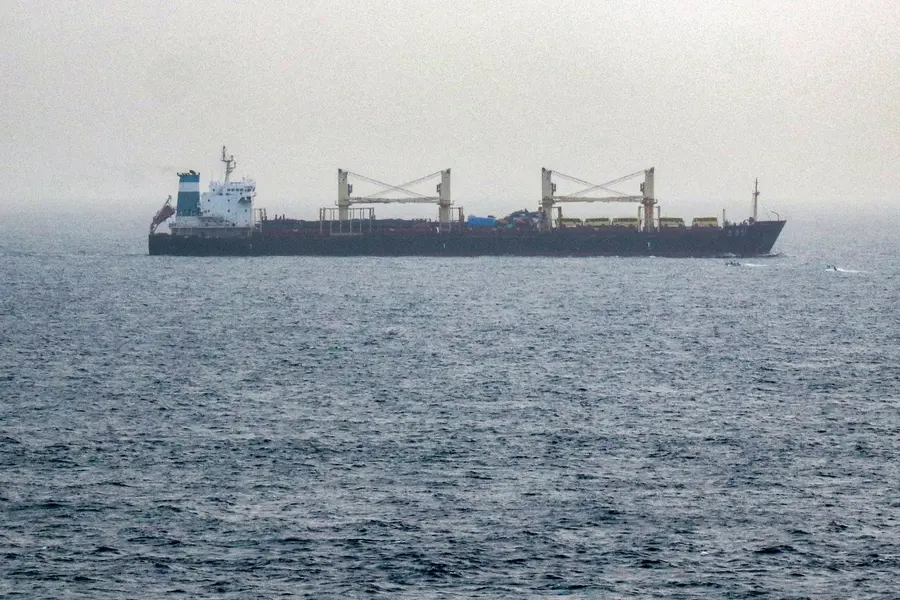
Dubai/Washington: A tanker was struck by an “unknown projectile” near the Strait of Hormuz this week, triggering a fire that was later extinguished, as tensions between the United States and Iran continue to fuel concerns over maritime security in the key waterway.
The United Kingdom Maritime Trade Operations (UKMTO) said early Thursday that the incident occurred near the Omani coastal city of Khasab and was reported to the agency on Tuesday.
Also Read

“Local authorities have reported a tanker has been hit by an unknown projectile causing fire to the vessel which has since been extinguished,” the UKMTO said.
No crew members were injured, and there was no reported environmental impact, the agency said. Authorities are investigating the incident, while the UKMTO notice did not identify the vessel’s nationality or its direction of travel.
The incident comes amid heightened tensions around the Strait of Hormuz, a vital global shipping route. Iran has effectively restricted passage through the waterway since the United States and Israel launched attacks against Tehran in late February, according to reports.
Against this backdrop, US President Donald Trump said he has no fixed deadline for Iran to return to negotiations, insisting he is “not in a hurry” to resume talks.
“I have no time schedule, none. I’m not in a hurry. I have no time schedule at all,” Trump told Al Jazeera on Wednesday when asked how much time Iran had to return to negotiations.
Trump said Washington was “winning very big” and cited Iran’s economic difficulties while explaining his position.
“We are winning very big. They’ve got massive inflation, their economy is falling apart, they’re treating their people very badly, they are killing many, many protesters. I have no time schedule; whatever it takes,” he said.
Asked whether economic measures were more effective than military action, Trump said, “I think they are both effective.”
The comments came as Washington continued to signal a preference for economic and maritime pressure while keeping the possibility of military action open.
US Secretary of State Marco Rubio has told several allied foreign ministers that Washington does not currently intend to launch fresh strikes against Iran “for the time being”, Axios reported.
According to the report, the Trump administration is instead considering increased pressure through naval blockades and economic measures while seeking to keep petroleum shipments moving through the Strait of Hormuz. US officials reportedly said military action remains an option if Iran strikes first.
US Treasury Secretary Scott Bessent on Monday outlined plans for the “economic asphyxiation” of Iran. On August 24, he also announced “Operation Economic Outcast”, saying the campaign was intended to sever Iran’s financial connections around the world and cut revenue sources supporting the Iranian government.
Iranian President Masoud Pezeshkian, meanwhile, said the latest sanctions “will not achieve anything”.
Qatar steps up diplomatic efforts
Qatar is also attempting to mediate between Washington and Tehran. Qatar Prime Minister Mohammed bin Abdulrahman bin Jassim Al Thani is due to travel to Tehran on Thursday for talks with Iranian officials on de-escalation and creating conditions for dialogue, Foreign Ministry spokesperson Majed Al Ansari said.
The visit reflects Qatar’s “firm position that the diplomatic path is the best means of resolving differences & promoting security & stability in the region,” Al Ansari said.
The talks are also expected to address “freedom of navigation in the Strait of Hormuz & the need for it to return to the status quo prior to February 28,” he said.
Qatar’s diplomatic initiative comes alongside efforts by Pakistan to help de-escalate the confrontation. Pakistan Army Chief Asim Munir recently visited Tehran and reportedly delivered a US proposal involving the lifting of blockades and economic sanctions in return for Iran reopening the Strait of Hormuz and halting attacks by regional proxies, according to Al Arabiya English.
Qatar and Pakistan are consequently emerging as key intermediaries in attempts to bring Washington and Tehran back to negotiations.
Trump has also said he believes Iranian Supreme Leader Mojtaba Khamenei remains alive despite suffering serious injuries during the conflict.
“I don’t think he’s dead,” Trump told US commentator Glenn Beck, adding that Khamenei was “very seriously wounded.”
The developments come ahead of Friday, August 28, which would mark six months since the United States launched its military campaign against Iran. Trump had earlier predicted that the conflict would last just “four to six” weeks.
In June, Washington and Tehran had signed a 60-day memorandum of understanding covering issues including transit through the Strait of Hormuz, sanctions relief and negotiations over Iran’s nuclear programme. The agreement expired earlier this month.
Published: 27 Aug 2026, 07:31 am IST
ABOUT THE AUTHOR
Related Topics
Disclaimer: Kindly avoid objectionable, derogatory, unlawful and lewd comments, while responding to reports. Such comments are punishable under cyber laws. Please keep away from personal attacks. The opinions expressed here are the personal opinions of readers and not that of Mathrubhumi.