
With Tamil Nadu set to vote, most opinion polls give MK Stalin an edge, but mixed projections hint the contest may not be as one-sided as it appears.
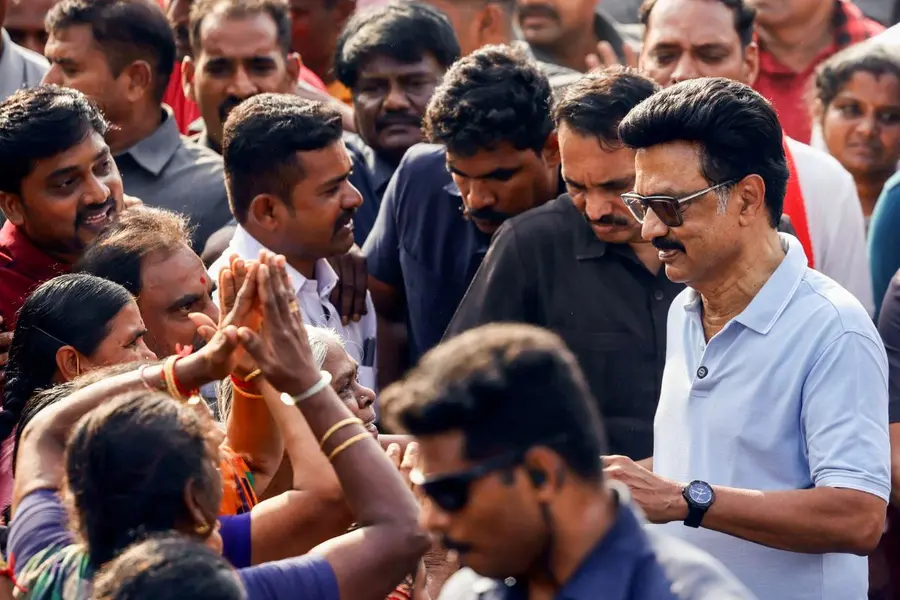
As Tamil Nadu heads into a crucial Assembly election, Chief Minister MK Stalin finds himself in a politically favourable, yet not unassailable, position.
A mix of welfare-driven governance, alliance arithmetic, and opposition fragmentation appears to be working in his favour.
Also Read

However, conflicting opinion polls suggest that the race may be tighter than headline projections indicate.
A strong start: Polls tilt towards DMK
Several pre-poll surveys point to a clear advantage for the ruling DMK-led Secular Progressive Alliance (SPA).
Lok Poll and Poll Tracker projections have placed the alliance comfortably above the majority mark in the 234-member Assembly, aligning with a broader trend seen in multiple surveys.
Some aggregated data indicate the DMK alliance hovering around or above the 150-seat mark in several projections, with vote shares nearing or crossing 40% in certain polls.
Political observers note that anything beyond 150 seats would constitute a decisive mandate in Tamil Nadu’s electoral landscape, reinforcing the perception that Stalin retains a solid base of support.
This advantage is often attributed to a combination of governance continuity, welfare schemes, and Stalin’s personal popularity, which in many surveys outpaces even his party’s support base.
But not a clean sweep: Contradictory signals
Despite the DMK’s apparent edge, not all surveys agree. A notable IANS-Matrize poll suggests the AIADMK-led alliance could stage a comeback, projecting 114–127 seats for the opposition, enough to challenge or even unseat the DMK.
Other similar projections indicate a close contest, with some polls showing a neck-and-neck fight between the two Dravidian majors.
This divergence underscores a key feature of the 2026 election: uncertainty.
While the DMK may lead in aggregated trends, the margins are not uniform across surveys, suggesting volatility in voter sentiment.
The Stalin factor: Leadership as an asset
One of the DMK’s biggest strengths remains MK Stalin himself. Since taking over as Chief Minister, he has worked to project a governance model rooted in social justice, welfare delivery, and administrative stability.
Campaign rhetoric has reinforced this positioning, framing the election as a choice between “Tamil Nadu and Delhi”, an attempt to consolidate regional identity and counter the BJP’s influence.
Stalin’s leadership is also central to the DMK’s messaging, with the party banking heavily on his image to neutralise anti-incumbency.
Opposition troubles: Fragmentation and credibility gaps
The opposition, led primarily by the AIADMK, faces structural challenges. Analysts point to internal weaknesses and questions over leadership cohesion, with critics even describing the party as diminished in strength.
At the same time, the BJP’s presence, while growing, has yet to translate into a dominant electoral force in the state.
The alliance arithmetic between AIADMK and BJP remains a double-edged sword, potentially consolidating votes in some regions while alienating others.
The wildcard: Vijay’s TVK
Actor Vijay’s Tamilaga Vettri Kazhagam (TVK) adds an unpredictable dimension to the contest. While unlikely to win a majority, the party could influence outcomes in several constituencies by cutting into traditional vote banks.
Some surveys estimate TVK could secure a small but significant vote share, potentially playing spoiler in closely fought seats.
Both DMK and AIADMK are wary of this emerging factor, especially among younger and urban voters.
Ground reality vs poll projections
Beyond numbers, ground reports suggest a more nuanced picture. In several constituencies, local issues, from infrastructure gaps to civic grievances, continue to shape voter choices, even in traditional strongholds.
At the same time, the absence of a unified or compelling opposition candidate in many seats continues to benefit the DMK.
The verdict: Advantage Stalin, but race still open
Taken together, the available data suggest that MK Stalin enters the 2026 election as the frontrunner. The DMK-led alliance appears better positioned in terms of organisation, leadership, and coalition strength.
However, the presence of contradictory polls, emerging third forces, and pockets of anti-incumbency means that the outcome is not a foregone conclusion.
If current trends hold, Stalin is likely to secure a second term , but whether it will be a landslide or a tighter-than-expected contest will only become clear on counting day.
Published: 19 Apr 2026, 09:22 am IST
Related Topics
Disclaimer: Kindly avoid objectionable, derogatory, unlawful and lewd comments, while responding to reports. Such comments are punishable under cyber laws. Please keep away from personal attacks. The opinions expressed here are the personal opinions of readers and not that of Mathrubhumi.