
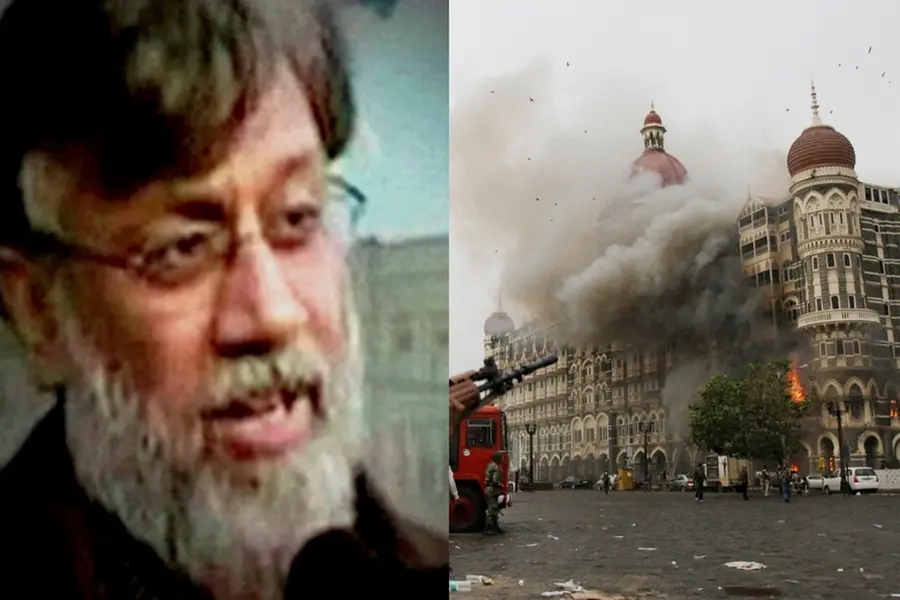
In a major victory for India, sources confirm that Tahawwur Rana, the accused involved in the 2008 Mumbai terror attacks, is expected to arrive in India from the United States "shortly." Government sources in India have stated that a multi-agency team from India has already traveled to the US, and all necessary paperwork and legal formalities are being completed with US authorities to finalise the extradition process.
This development comes just days after Rana's last-ditch attempt to avoid extradition was dismissed by the US Supreme Court. On February 27, 2025, the 64-year-old Canadian national of Pakistani origin submitted an “Emergency Application for Stay Pending Litigation of Petition For Writ of Habeas Corpus,” seeking to delay his transfer to India. However, Associate Justice Elena Kagan of the US Supreme Court had previously denied his application in March, bringing Rana closer to facing justice in India for his alleged role in the 2008 Mumbai terror attacks.
26/11 attack: The 2008 Mumbai terror attacks
The 26/11 attacks, as they are widely known, were among the most horrifying and well-coordinated terror assaults in history. On November 26, 2008, a group of ten heavily armed militants associated with Pakistan-based terror group Lashkar-e-Taiba (LeT) carried out a series of attacks across Mumbai, killing over 160 people and injuring over 300 others. The attacks targeted iconic locations, including the Taj Mahal Hotel, Oberoi Trident Hotel, CST railway station, and Nariman House.
Rana, a former doctor with the Pakistan Army, has long been implicated in aiding the attackers. According to US and Indian officials, Rana was in regular contact with the masterminds behind the attacks and provided logistical support to the terror group. His involvement came to light through his association with Pakistani-American terrorist David Coleman Headley, who played a central role in planning the attacks.
Rana's involvement and Headley's testimony
David Coleman Headley, who was convicted for his role in the Mumbai attacks, testified against Rana during his trial. Headley revealed that he had visited India multiple times in the lead-up to the attacks, conducting reconnaissance for the attackers with the help of Rana. Headley admitted that Rana assisted him in obtaining a five-year visa under the guise of business purposes, which enabled Headley to travel freely in India. Rana also provided Headley with a cover identity and aided him in his mission, which ultimately led to the planning and execution of the brutal attacks.
During one of his visits to Mumbai in 2008, Rana and his wife stayed at the Taj Mahal Hotel, a key location targeted in the attacks. Headley testified that Rana was aware of the details surrounding the attack.
Rana’s convictions
Despite his alleged direct involvement in the Mumbai attacks, Rana was acquitted in 2011 by a US court on the charges of abetting the attacks. However, he was convicted for providing material support to Lashkar-e-Taiba (LeT) and for his role in a separate terror plot targeting Denmark. This conviction led to Rana being held in the Metropolitan Detention Center in Los Angeles.
Rana’s long legal battle in the US to avoid extradition has drawn attention, especially as he maintains that he was unaware of the scale and nature of the terror plot orchestrated by Headley and Lashkar-e-Taiba. Despite his defense, the Indian government has been persistent in pursuing his extradition, as they hold that he was deeply involved in supporting the terror plot, which claimed so many innocent lives.
Rana's links to Pakistan’s ISI
Rana’s connections to Pakistan's Inter-Services Intelligence (ISI) have also raised concerns. Indian officials believe that Rana's support of the terror network extended beyond Lashkar-e-Taiba, with suspicions that he may have had ties to Pakistan’s intelligence services.
The extradition of Tahawwur Rana marks a major step toward justice for the victims of the 2008 Mumbai attacks, as Indian authorities have long sought to bring him to trial. With Rana’s extradition nearing, there is renewed hope that the families of the victims will finally see the man who played a critical role in planning one of the most tragic terror attacks in India’s history held accountable.
Published: 09 Apr 2025, 09:58 am IST
Related Topics
Disclaimer: Kindly avoid objectionable, derogatory, unlawful and lewd comments, while responding to reports. Such comments are punishable under cyber laws. Please keep away from personal attacks. The opinions expressed here are the personal opinions of readers and not that of Mathrubhumi.
