
The RSP has emerged as a dominant force, securing a projected 164 seats—well past the 138-seat majority threshold.
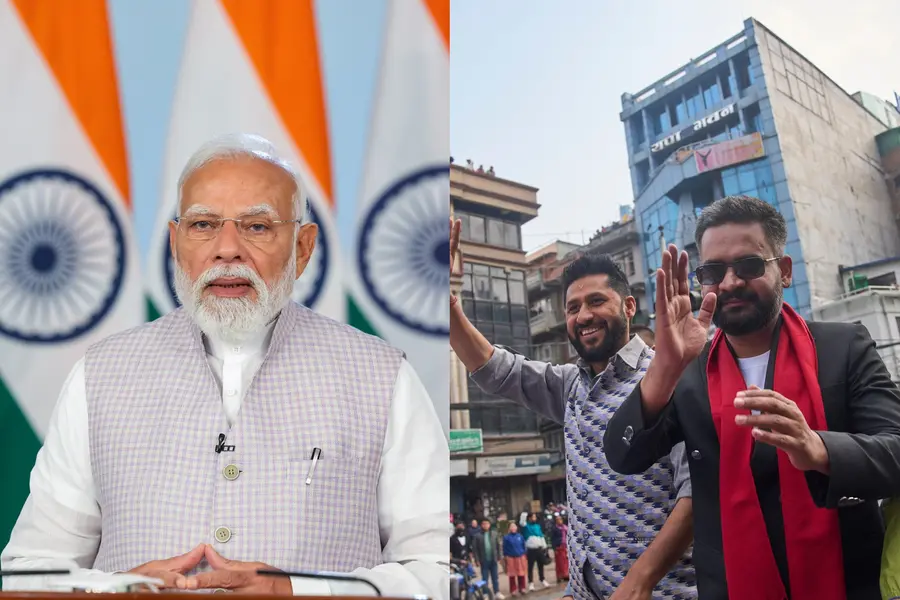
New Delhi: Prime Minister Narendra Modi held high-level telephonic discussions on Monday with the leadership of Nepal’s Rastriya Swatantra Party (RSP), congratulating Chairman Rabi Lamichhane and senior leader Balendra Shah on their decisive victory in the nation’s general elections.
The conversations follow a landmark electoral performance by the RSP, which has fundamentally reshaped Nepal’s political landscape. During the exchange, the prime minister expressed his confidence that the bilateral partnership between New Delhi and Kathmandu would reach new heights through collaborative efforts.
"Had warm telephone conversations with Mr Rabi Lamichhane, Chairman of the Rastriya Swatantra Party (RSP) and Mr Balendra Shah, Senior Leader of the RSP," the prime minister shared in a post on X.
PM Modi extended his best wishes for the formation of the incoming government and reaffirmed India’s steadfast commitment to fostering mutual prosperity, progress, and the overall well-being of both nations.
Electoral Landscape
The victory comes as the final results for Nepal’s 275-member House of Representatives are solidified. The lower house utilises a dual voting system: 165 members are chosen through direct voting (First Past The Post), while 110 are selected via proportional representation.
The RSP has emerged as the dominant force in the polls:
- Direct Voting: Results for 161 of 165 seats have been finalised, with the RSP securing an overwhelming majority of the declared seats.
- Proportional Representation: The RSP has garnered over 4.04 million votes, significantly outpacing the Nepali Congress (NC) at 1.36 million and the CPN-UML at 1.15 million.
Political analysts estimate that the party's strong performance in the proportional count will yield an additional 40 seats. This would bring the RSP’s total projected tally to approximately 164 seats—comfortably exceeding the 138-seat threshold required for a simple majority in Parliament.
The election of Balendra "Balen" Shah, a 35-year-old engineer and rapper who famously defeated veteran former Prime Minister KP Sharma Oli in his own stronghold, is being viewed as a generational shift in Nepali politics following widespread youth-led protests last year.
With inputs from PTI
Published: 09 Mar 2026, 10:07 pm IST
Related Topics
Disclaimer: Kindly avoid objectionable, derogatory, unlawful and lewd comments, while responding to reports. Such comments are punishable under cyber laws. Please keep away from personal attacks. The opinions expressed here are the personal opinions of readers and not that of Mathrubhumi.
