
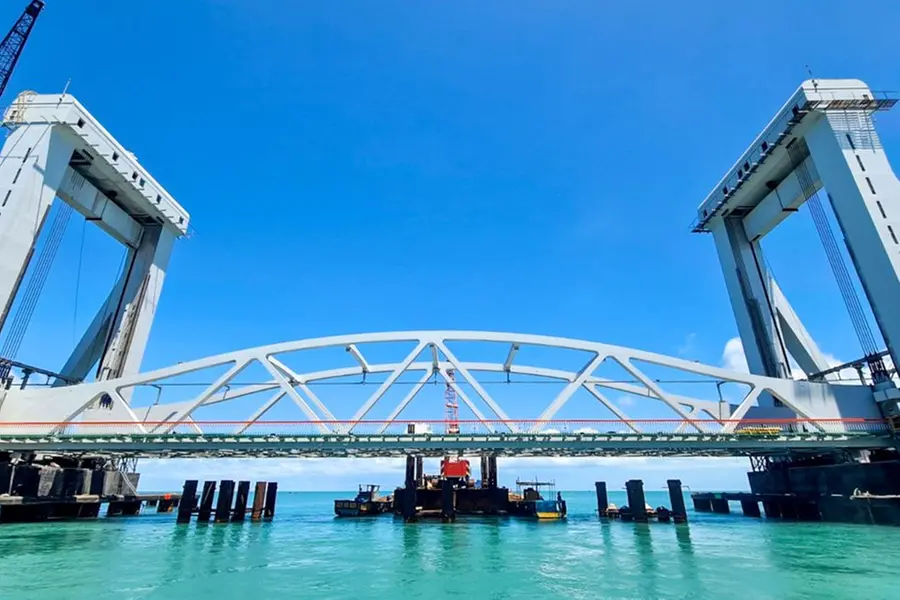
New Delhi: The new Pamban bridge in Rameswaram, Tamil Nadu, is ready for inauguration by Prime Minister Narendra Modi on April 6. According to the Rail Vikas Nigam Limited (RVNL), the bridge is structurally safe for train operations at a speed of 80 kmph for the next 100 years.
MP Singh, Director (Operations) at RVNL and a member of the Expert Committee formed last November to address safety concerns, confirmed that the bridge had undergone thorough assessment.
Expert panel clears safety concerns
“The committee has concluded that the bridge is structurally safe to operate trains at 80 kmph for 100 years,” Singh said.
The five-member panel included senior officials from the Railway Board, Research Designs and Standards Organisation (RDSO), Southern Railway, RVNL, and an external expert from IIT-Roorkee.
They examined concerns raised by the Commissioner of Railway Safety (CRS), who had earlier flagged issues including faults in alignment, absence of anti-corrosion measures, and flaws in the signalling system. As a result, a speed limit of 50 kmph had been initially imposed.
Built to global standards
“Though the bridge is safe to operate trains at 160 kmph, due to a curvature in its alignment towards the Rameswaram end, the speed has been safely fixed at 80 kmph,” Singh said.
He added that the bridge can handle annual traffic of 50 Gross Million Tonnes (GMT) and has been designed for a lifespan of 100 years.
The vertical lift span — a key highlight of the bridge — will rise up to 17 metres to allow ships to pass, and strictly adheres to Indian and Euro Codes. “It is duly assessed for fatigue,” Singh noted.
Surface protection and maintenance
According to a document from Southern Railway shared in January, the bridge’s surface protection system is robust enough to withstand corrosion for up to 38 years without maintenance and up to 58 years with minimal upkeep.
RVNL, the public sector unit responsible for planning, designing, executing and commissioning the bridge, ensured high standards throughout.
“The panel even looked at welding of joints and found that it was done by competent welders. Further, independent weld checking has been done by Welding Research Institute, Trichy, controlled by BHEL,” Singh said.
Backed by IITs and global study
Singh mentioned that institutions like IIT Bombay and IIT Madras were also involved in vetting the designs.
“For two years, from 2017 to 2019, a team of our experts visited the UK, the USA and a couple of other European countries only to study the global practice in the existing moveable bridges and decide a suitable design and structure for Pamban,” he added.
The previous bridge, constructed by the British and commissioned in 1914, was operational until 23 December 2022. It had served for over 108 years in a highly corrosive environment.
According to the Ministry of Railways, the new Pamban bridge is a significant achievement in Indian engineering. “It is built at a cost of over Rs 550 crore. It is 2.08 km in length, features 99 spans and a 72.5-metre vertical lift span that rises up to a height of 17 metres, facilitating smooth movement of larger ships while ensuring seamless train operations,” the ministry said.
(PTI Inputs)
Published: 05 Apr 2025, 09:23 pm IST
Related Topics
Disclaimer: Kindly avoid objectionable, derogatory, unlawful and lewd comments, while responding to reports. Such comments are punishable under cyber laws. Please keep away from personal attacks. The opinions expressed here are the personal opinions of readers and not that of Mathrubhumi.
