
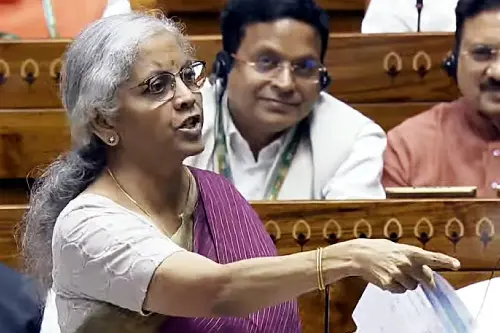
New Delhi: Finance Minister Nirmala Sitharaman responded to criticisms from opposition leaders during a Budget discussion in the Lok Sabha on Tuesday, debunking claims that states not explicitly named in the Budget speech were excluded from budgetary allocations.
Sitharaman asserted unequivocally that no state was being denied financial support, countering opposition assertions that only Bihar and Andhra Pradesh had received funds while others had not. She reminded the House that previous Budgets under the UPA government similarly omitted names of several states without withholding funds.

"I've reviewed Budget speeches from 2004-2005 onward, including 2005-2006, 2006-2007, 2007-2008, and so forth. The Budget for 2004-2005 did not mention 17 states. I ask the former UPA government members: Did these states not receive funding? Did the government withhold it?" Sitharaman challenged.
She was responding to claims by multiple opposition members that the Budget had earmarked funds solely for Bihar and Andhra Pradesh. Reacting to remarks by TMC leader Saugata Roy criticising her for lacking new ideas due to her education at JNU rather than elite universities like Harvard or Oxford, Sitharaman countered by highlighting that West Bengal's Chief Minister and Finance Minister were also products of Indian universities, not foreign ones.
"From the land that gave us 'Vande Mataram,' Professor Saugata Roy implied I'm lacking ideas because I'm from JNU, not Harvard or Oxford... All of us are products of Indian universities. What makes us any less than Harvard or Oxford?" she asserted, defending her credentials.
Responding to Roy's comment on inequality in India, Sitharaman dismissed his comparison of inequality under British rule versus today's India as "shameful." She cited statistics indicating a decline in West Bengal's share of national industrial production from 24% at Independence to 3.5% in 2021.
The Finance Minister assured compliance with fiscal deficit projections, aiming to reduce it to below 4.5% by 2025-26 from the current fiscal year's target of 4.9% (down from 5.6% in 2023-24). "I'm confident we'll achieve this goal," she affirmed.
Prime Minister Narendra Modi endorsed Sitharaman's comprehensive overview of the Budget in a post on X, highlighting the government's commitment to growth and reforms. Sitharaman emphasised India's status as the world's fastest-growing economy and its recovery from pandemic repercussions through substantial capital expenditure.
The Budget allocated Rs 17,000 crore to Jammu & Kashmir this year, including Rs 12,000 crore for the state police, underlining the government's commitment to supporting the region.
Responding to opposition allegations of reduced allocations for agriculture, health, and education, Sitharaman clarified that funds for these sectors had increased compared to the previous year. She described the 2024-25 Budget as balancing social objectives with fiscal prudence.
"Fiscal discipline without compromising on welfare schemes defines the Modi government's approach," Sitharaman asserted, criticising the UPA's practice of off-budget borrowing and lack of transparency in budget figures.
She presented a comparative analysis of inflation management during the UPA and NDA regimes, noting that under the UPA, inflation persisted in double digits for 22 months, with domestic rates exceeding global averages. In contrast, the NDA government lowered inflation to 5.1% over the past decade from 8.1% during the UPA's tenure.
Addressing demands for a legal guarantee on Minimum Support Price (MSP), Sitharaman blamed the UPA for rejecting this proposal, citing concerns about market distortions. She accused the UPA of hypocrisy for criticising the current government's handling of MSP despite their inaction during their decade-long rule.
"The UPA's token effort in farm debt waivers was marred by gross irregularities, as highlighted by the CAG," Sitharaman pointed out. She defended the Modi government's initiation of the PM Kisan Samman Nidhi and formation of a committee to enhance the efficacy of the Commission for Agricultural Costs and Prices (CACP) for farmers' benefit.
Sitharaman underscored the substantial increase in agriculture allocations, from Rs 21,934 crore in 2013-14 to Rs 1.23 lakh crore in FY25. She highlighted that over Rs 3.2 lakh crore had been disbursed to 11 crore farmers under the PM Kisan scheme.
Overall, Sitharaman reiterated the government's commitment to inclusive growth and development, refuting opposition allegations with detailed data and historical comparisons. She urged unity and cooperation across party lines for the nation's progress. PTI
Published: 30 Jul 2024, 10:42 pm IST
Related Topics
Disclaimer: Kindly avoid objectionable, derogatory, unlawful and lewd comments, while responding to reports. Such comments are punishable under cyber laws. Please keep away from personal attacks. The opinions expressed here are the personal opinions of readers and not that of Mathrubhumi.