
Suvendu Adhikari’s political stature has grown substantially after his victories over Mamata Banerjee in high-profile contests.
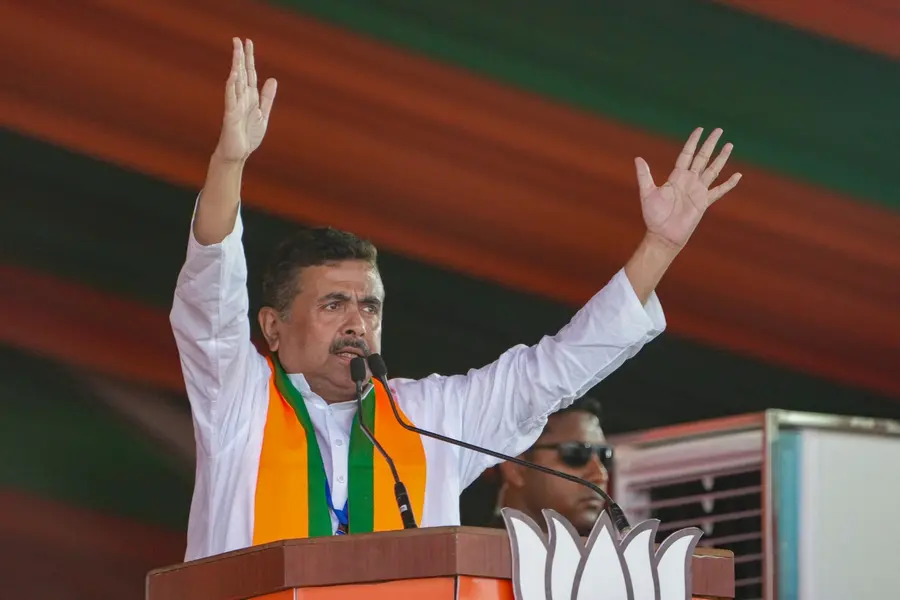
The Bharatiya Janata Party (BJP) has recorded a decisive breakthrough in West Bengal politics by winning 206 of the 293 Assembly seats counted, marking its first-ever victory in the state Assembly elections. The result has reshaped the political landscape, ending the long-standing dominance of the Trinamool Congress (TMC) led by Mamata Banerjee, which secured 81 seats.
At the centre of this electoral shift is Suvendu Adhikari, the Leader of Opposition in the West Bengal Assembly, who has emerged as the frontrunner for the Chief Ministerial post within the BJP. Adhikari’s political stature has grown substantially after his victories over Mamata Banerjee in two high-profile contests. He defeated her in Nandigram in 2021 by 1,956 votes and again in Bhabanipur by a margin of 15,105 votes in the latest election. Party insiders credit his repeated wins over the Chief Minister as a major factor strengthening his claim to leadership.
Also read: How will Vijay’s TVK cross the 118 mark? Congress, Left and PMK emerge as key players
According to BJP functionaries, Adhikari’s role in the party has expanded due to his strong grassroots mobilisation and sustained opposition to the TMC since his defection from the party in 2020. His switch to the BJP was seen as a major political coup, especially given his prior position within the TMC government, where he held key ministerial portfolios. Leaders within the BJP also note that the state government had reportedly filed around 300 cases against him, further cementing his image as a prominent opposition figure.
The campaign leading up to the election saw high-level backing from the BJP’s central leadership. Union Home Minister Amit Shah actively supported Adhikari during his nomination in Bhabanipur, signalling strong endorsement from the party’s top brass. Shah had publicly criticised Mamata Banerjee and predicted a sweeping BJP victory across Bengal, a forecast that appears to have materialised based on the results.
Also read: Congress has 'no existence' outside Kerala, says Pralhad Joshi
Despite Adhikari’s strong position, BJP leaders have clarified that he is not the only contender for the Chief Minister’s post. State unit president Samik Bhattacharya and vice-president Agnimitra Paul are also being considered. Bhattacharya, currently a Rajya Sabha member, is credited by party insiders with strengthening the organisational base in earlier phases of Bengal politics. Agnimitra Paul, who won from Asansol Dakshin, is viewed as a potential choice if the party opts for a woman leader at the helm.
The BJP leadership is expected to convene a meeting of newly elected legislators in Kolkata shortly, following which a legislative party leader will be formally elected. That individual is likely to be appointed Chief Minister. However, the party has not yet announced a timeline for this process, although preparations for government formation are underway.
Adhikari’s campaign strategy, particularly his emphasis on consolidating Hindu votes, has been a subject of political debate. Party leaders believe the BJP’s increased vote share among Hindu communities contributed significantly to its victory, including in constituencies with substantial Muslim populations such as Malda, Murshidabad, Howrah, Kolkata, and Birbhum.
Overall, the election marks a major political turning point in West Bengal, with the BJP establishing itself as the dominant force in the state Assembly for the first time. The internal decision on leadership will determine whether Suvendu Adhikari formally ascends to the Chief Minister’s post in what is now a dramatically altered political environment. (With inputs from Agencies)
Published: 05 May 2026, 10:34 am IST
Disclaimer: Kindly avoid objectionable, derogatory, unlawful and lewd comments, while responding to reports. Such comments are punishable under cyber laws. Please keep away from personal attacks. The opinions expressed here are the personal opinions of readers and not that of Mathrubhumi.
