
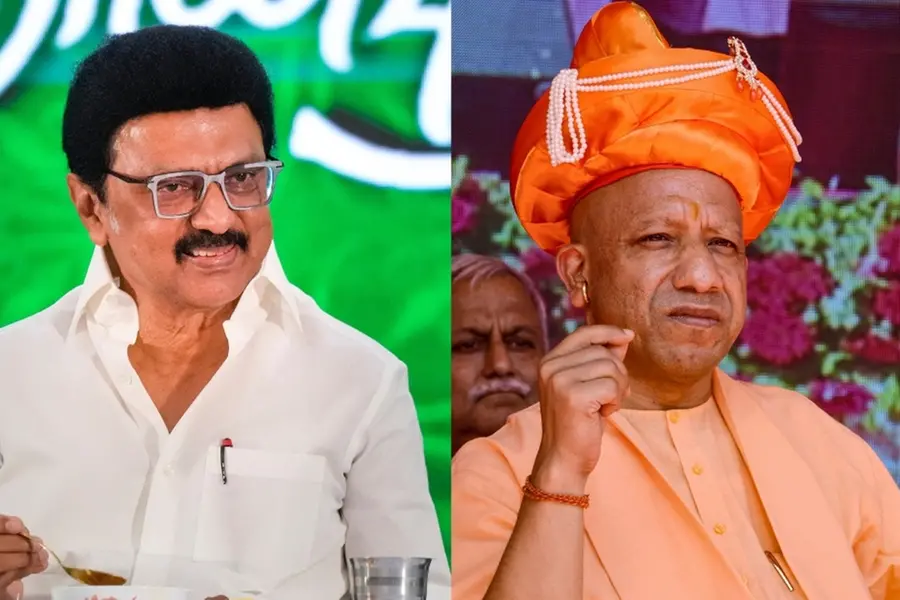
Chennai: Tamil Nadu Chief Minister MK Stalin has launched a scathing attack on Uttar Pradesh CM Yogi Adityanath, calling his remarks on the language row and delimitation debate a “political black comedy.”
Taking to social media, Stalin accused the BJP of being ‘rattled’ by Tamil Nadu’s firm stance on the two-language policy and fair delimitation.
"Tamil Nadu's fair and firm voice on #TwoLanguagePolicy and #FairDelimitation is echoing nationwide—and the BJP is clearly rattled. Just watch their leaders' interviews. And now Hon'ble Yogi Adityanath wants to lecture us on hate? Spare us. This isn't irony—it's political black comedy at its darkest. We don't oppose any language; we oppose imposition and chauvinism. This isn't riot-for-votes politics. This is a battle for dignity and justice," Stalin posted on X.
Yogi Adityanath accuses Stalin of ‘narrow politics’
Earlier, CM Yogi had criticised Stalin, alleging that the Tamil Nadu CM was creating regional and linguistic divisions to protect his vote bank.
"Language should unite, not divide. Tamil is one of India’s oldest languages with a rich heritage. No language divides people; it brings them together. This is narrow politics. When some leaders feel their vote bank is at risk, they try to create divisions based on region and language," Adityanath said in an interview with ANI.
He also dismissed concerns over delimitation, calling it a political agenda and urging the public to stay alert to such divisive politics.
Delimitation row and Tamil Nadu’s stance
The three-language policy has remained a key flashpoint between the Centre and the Tamil Nadu government, with Stalin’s DMK staunchly opposing its implementation under the National Education Policy (NEP) 2020.
On March 22, Tamil Nadu led the first Joint Action Committee (JAC), urging the central government not to penalise states that successfully controlled population growth. The committee passed a resolution expressing concern over the lack of transparency regarding delimitation and its impact on state representation.
With the political war of words intensifying, the debate over language, regional identity, and representation continues to polarise national politics.
Published: 27 Mar 2025, 10:00 am IST
Related Topics
Disclaimer: Kindly avoid objectionable, derogatory, unlawful and lewd comments, while responding to reports. Such comments are punishable under cyber laws. Please keep away from personal attacks. The opinions expressed here are the personal opinions of readers and not that of Mathrubhumi.
