
At the Southern Zonal Council meeting, Tamil Nadu CM Vijay raised three major demands before Amit Shah: safeguards on delimitation, a NEET exemption and stronger action against drug trafficking and unauthorised online medicine sales.
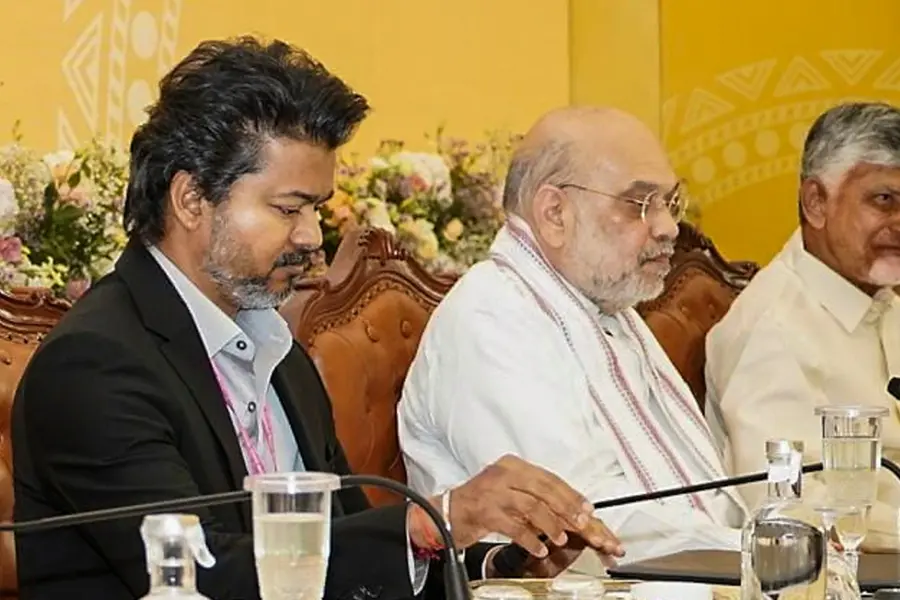
Chennai: Tamil Nadu Chief Minister C. Joseph Vijay raised three major issues with Union Home Minister Amit Shah at the 31st Southern Zonal Council meeting in Tamil Nadu, seeking safeguards for southern states' parliamentary representation, an exemption from NEET for state-quota medical admissions and stronger action against drug trafficking and unauthorised online sales of medicines.
Vijay’s three key requests
At the meeting in Kovalam, Chengalpattu district, Vijay urged the Centre to address three issues that have significant implications for Tamil Nadu and other southern states — delimitation, NEET and drug control.
The meeting was chaired by Amit Shah and attended by Karnataka Chief Minister D.K. Shivakumar, Andhra Pradesh Chief Minister N. Chandrababu Naidu and representatives from other southern states and Union Territories.
1. Delimitation and southern states’ representation
Vijay sought a legislative assurance that no state would lose its existing share of representation in Parliament because of the proposed delimitation exercise.
The concern centres on the possibility that a future delimitation based primarily on population could alter the distribution of Lok Sabha seats between states.
Tamil Nadu and other southern states have argued that they should not face reduced political representation after achieving population stabilisation through family-planning measures.
Vijay said southern states had contributed significantly to population control, human development and economic growth and argued that these achievements should not result in reduced representation in Parliament.
He called for an approach that protects the federal balance and prevents states from being disadvantaged for implementing national population-control objectives.
2. NEET exemption for Tamil Nadu
Vijay also reiterated Tamil Nadu’s demand for an exemption from the National Eligibility-cum-Entrance Test (NEET).
He argued that the examination creates disadvantages for students from rural areas and socially and economically disadvantaged communities.
The Chief Minister asked the Centre to allow Tamil Nadu to fill state-quota seats in MBBS, BDS and AYUSH courses based solely on Class 12 marks.
Tamil Nadu has consistently opposed NEET and has sought an exemption from the centralised medical entrance examination.
The state government argues that its earlier admission system based on school examination marks provides wider access to medical education, particularly for students from government schools and disadvantaged backgrounds.
3. Stronger action against drugs
Vijay's third major request focused on drug trafficking and substance abuse.
He called for stronger coordination between southern states and central agencies to tackle the movement of narcotics across state borders.
The Chief Minister also sought tighter regulation of the online sale of prescription medicines and psychotropic substances, along with stronger enforcement against unauthorised sales.
He argued that drug networks often operate across state boundaries and therefore cannot be effectively tackled by individual states working separately.
Vijay called for improved intelligence-sharing, coordinated enforcement operations and closer cooperation between police, enforcement agencies and health departments.
He also urged the Centre to review the existing legal framework to address emerging forms of substance abuse among young people.
Vijay also raises Cauvery water issue
The Chief Minister also addressed interstate river disputes, with the Cauvery water-sharing issue between Tamil Nadu and Karnataka among the concerns discussed.
Vijay said cooperation between states must be accompanied by compliance with court judgments, tribunal decisions and statutory mechanisms governing interstate rivers.
He stressed the need to protect the interests of lower-riparian states and the livelihoods dependent on assured water flows.
On the Cauvery dispute, Vijay called for timely implementation of the Supreme Court’s judgment and decisions of the Cauvery Water Management Authority (CWMA).
The CWMA had directed Karnataka to release 12,000 cusecs of water daily to Tamil Nadu at Biligundlu from August 12 for 15 days. The Supreme Court also directed Karnataka to comply with the order.
What is the Southern Zonal Council?
The Southern Zonal Council is a consultative forum involving the Centre, southern states and Union Territories.
It is intended to provide a platform for discussing interstate disputes and regional issues, including water sharing, infrastructure, economic development, security and administrative coordination.
The 31st meeting was hosted by the Tamilaga Vettri Kazhagam-led Tamil Nadu government in Kovalam.
Karnataka Chief Minister D.K. Shivakumar, Andhra Pradesh Chief Minister N. Chandrababu Naidu and representatives of other southern states and Union Territories participated in the meeting.
Why these three issues matter
The three demands cover separate but politically significant areas.
Delimitation could affect the future distribution of parliamentary seats and is particularly important to southern states because of differences in population growth between regions.
NEET remains a major Centre-state policy dispute in Tamil Nadu, where the state government has consistently sought an exemption from the examination.
Drug control involves both public health and law enforcement, with trafficking networks operating across state boundaries and online sales creating additional regulatory challenges.
Together, the demands reflect Tamil Nadu’s concerns over political representation, control over education policy and coordination on issues that cross state borders.
Analysis
Vijay’s intervention at the Southern Zonal Council brings three long-running Tamil Nadu policy concerns into the same Centre-state forum.
The delimitation issue is particularly significant because the end of the current freeze on the allocation of Lok Sabha seats based on the 1971 Census could eventually lead to changes in parliamentary representation. Southern states have argued that population-based changes should not disproportionately reduce their political weight after decades of successful population stabilisation.
The NEET demand reflects another longstanding disagreement between Tamil Nadu and the Centre over the balance between national standards for medical admissions and the state’s preferred admission model.
The drug-control request is different in nature but highlights the limits of state-level enforcement when trafficking and online distribution operate across jurisdictions. Vijay’s proposal for greater coordination therefore focuses on cooperation between state and central agencies rather than action by Tamil Nadu alone.
The Cauvery reference adds an interstate water-management dimension to the meeting, keeping implementation of existing judicial and regulatory decisions at the centre of the dispute.
Published: 21 Aug 2026, 07:30 am IST
ABOUT THE AUTHOR

Disclaimer: Kindly avoid objectionable, derogatory, unlawful and lewd comments, while responding to reports. Such comments are punishable under cyber laws. Please keep away from personal attacks. The opinions expressed here are the personal opinions of readers and not that of Mathrubhumi.