
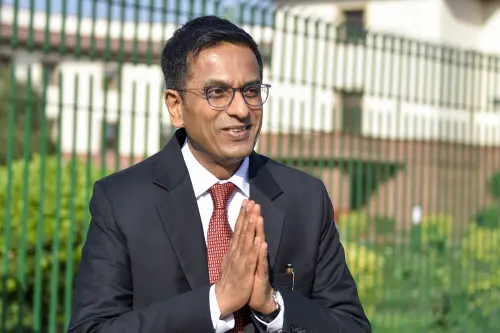
D.Y. Chandrachud, the 50th Chief Justice of India, steps down on November 10, leaving behind a legacy rooted in constitutional values, human rights, and a progressive vision for justice. Appointed as CJI on November 9, 2022, Chandrachud has delivered landmark rulings on fundamental rights, equality, and inclusivity, impacting millions.
Early Life and Career Path
Born on November 11, 1959, Justice Chandrachud’s judicial lineage traces back to his father, Y.V. Chandrachud, the 16th Chief Justice of India. Educated at St. Xavier’s High School, Mumbai, and later St. Stephen’s College, Delhi, he pursued law at Delhi University and Harvard Law School, where he earned an LLM and a Doctorate in Comparative Constitutional Law.
Justice Chandrachud began practising in the Bombay High Court in 1982, eventually serving as Additional Solicitor General in 1998. He became a judge in the Bombay High Court in 2000 and later served as Chief Justice of the Allahabad High Court from 2013 until his Supreme Court appointment in 2016.
Justice Chandrachud's contributions span diverse issues impacting constitutional rights and societal reforms.
Right to Privacy
In a 2017 landmark ruling, Justice Chandrachud led the judgment asserting that privacy is a basic right, essential for autonomy and dignity in a democratic society.
Decriminalisation of Homosexuality and Adultery
Justice Chandrachud was instrumental in the 2018 decriminalisation of homosexuality under Section 377, affirming equality for all. He also ruled to strike down Section 497 of the IPC, a colonial-era law criminalising adultery, for violating women’s dignity and autonomy.
Sabarimala Temple Entry and Triple Talaq
Justice Chandrachud was part of the five-judge bench allowing women’s entry to Kerala’s Sabarimala temple, terming the previous ban unconstitutional. In 2019, he also participated in the judgment banning triple talaq, advancing rights for Muslim women.
Ram Janmabhoomi-Babri Masjid and Delhi Government Power Dispute
In the 2019 Ayodhya verdict, Justice Chandrachud upheld Hindu claimants' rights to the disputed site, ensuring provisions for a mosque. Additionally, in 2023, the Supreme Court confirmed the Delhi government’s administrative power over functions except for land and law enforcement.
Abrogation of Article 370 and Electoral Bonds
A five-judge bench, including Justice Chandrachud, upheld the abrogation of Article 370, revoking Jammu and Kashmir’s special status. Recently, he also led the bench that struck down the Electoral Bonds scheme, challenging anonymous political funding.
Maharashtra Political Crisis and Sub-classification of SC/ST
Justice Chandrachud ruled on the Maharashtra political crisis, citing the governor's lack of objective reasoning in ordering a floor test. His recent ruling allowed states to create sub-classifications within SC/ST categories, enhancing the precision of reserved benefits.
No Immunity for Lawmakers Facing Bribery Charges
In March 2024, Justice Chandrachud ruled that lawmakers could not claim immunity under Articles 105(2) and 194(2) for bribery charges, strengthening legislative accountability.
Published: 10 Nov 2024, 06:31 am IST
Related Topics
Disclaimer: Kindly avoid objectionable, derogatory, unlawful and lewd comments, while responding to reports. Such comments are punishable under cyber laws. Please keep away from personal attacks. The opinions expressed here are the personal opinions of readers and not that of Mathrubhumi.
