
Stormy scenes unfolded in the Lok Sabha as Opposition MPs protested against the India-US interim trade pact, disrupting Question Hour and forcing an early adjournment.
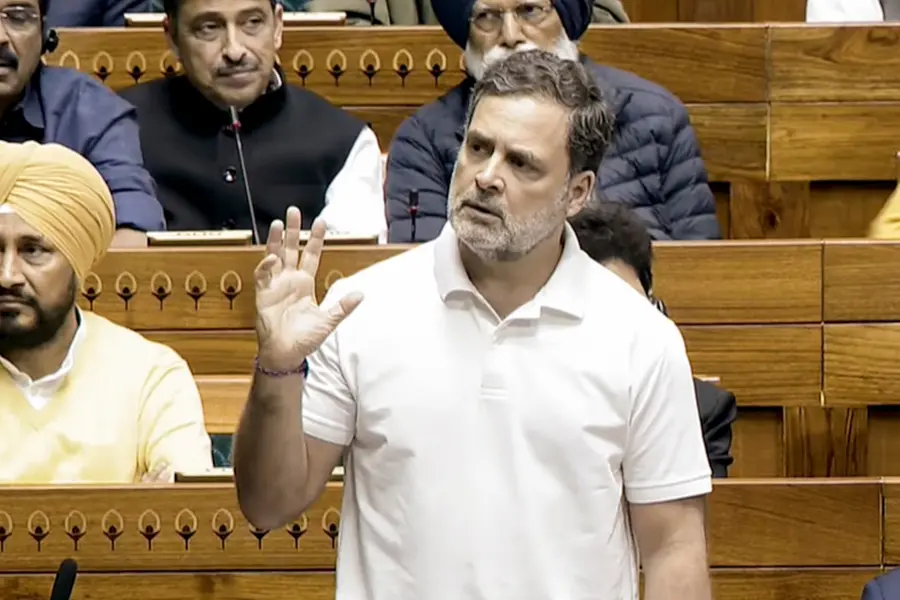
New Delhi: The Budget Session of Parliament witnessed renewed turbulence after the Bharatiya Janata Party (BJP) filed a formal notice seeking the termination of Congress MP Rahul Gandhi’s membership, adding fuel to an already heated standoff between the ruling party and the Opposition.
According to parliamentary sources, the BJP’s move comes amid continuing confrontations over remarks and conduct attributed to the Leader of the Opposition.
Also Read

The notice has significantly sharpened the political rhetoric inside the Lok Sabha, with Congress leaders calling the action “vendetta politics” while the Treasury benches defended it as a matter of parliamentary propriety.
The development triggered noisy scenes in the House, with Congress MPs strongly objecting to what they described as an attempt to silence the Opposition. Several members raised slogans and demanded clarity from the Chair regarding the nature and grounds of the notice.
The protests contributed to disruptions during proceedings, echoing the pattern of frequent adjournments seen during the current session.
The house was adjourned till 12 noon after a dramatic uproar by Opposition members protesting against the interim trade pact between India and the United States, which disrupted proceedings minutes after the House convened for the day.
The protest occurred during Question Hour, severely limiting parliamentary business to just one question and its supplementaries over roughly seven minutes of proceedings.
As the lower house met at around 11 am, several Opposition MPs began shouting slogans and displaying placards criticizing the trade agreement, forcing the presiding chair, Krishna Prasad Tenneti, to repeatedly urge them to return to their seats and maintain parliamentary decorum.
MPs trooped into the Well of the House in an attempt to raise grievances, with many shouting slogans such as “trade deal wapas lo” (take back the trade pact).
Several of the placards also demanded the withdrawal of the new labour code, reflecting broader discontent over recent policy moves. The Chair noted that displaying placards inside Parliament violated House rules and asked members to put them down.
However, the protests continued, prompting the Chair to adjourn the House until noon in an effort to restore order.
Opposition concerns over the interim India-US agreement
Opposition parties have voiced deep concerns about various concessions they say India has made in the interim trade framework with the United States, particularly related to the agriculture sector, labour protections, and energy policy.
Congress MP KC Venugopal alleged that nationwide trade union strikes reflect the government’s “anti-labour, anti-farmer, anti-youth” stance, claiming the India-US trade deal would sacrifice farmers’ interests.
Opposition members argue that the deal disproportionately favours US interests and could undermine Indian farmers and small producers.
Several Opposition MPs staged protests outside Parliament’s Makar Dwar earlier in the day, carrying banners that labeled the pact a “trap deal” and accusing the government of “surrendering” national interests.
Senior leaders from the Congress and INDIA bloc, including Mallikarjun Kharge and other MPs, joined the demonstrations and criticized the government for failing to adequately consult Parliament on the deal.
Congress MP Imran Masood accused the government of silencing the Leader of the Opposition, saying switching off his microphone was provoking justified anger, not indiscipline.
Congress MP Manish Tewari also moved an adjournment motion in the Lok Sabha seeking a full statement and debate on the pact, alleging that commitments on Russian oil purchases and agriculture concessions in the interim trade agreement raised serious questions about India’s energy security and farmers’ livelihoods.
Lok Sabha MP Shambhavi Choudhary criticised Congress MPs for “uncultured” conduct and alleged derogatory language near the Prime Minister’s chair, calling it a bad example for youth and demanding action.
Government position and broader context
The government, meanwhile, has defended the interim trade pact with the US as a step toward deepening economic cooperation and expanding export opportunities for key Indian sectors.
Proponents argue it secures tariff reductions and market access without compromising sensitive agricultural staples.
However, critics both inside and outside Parliament, including farmer unions planning nationwide protests, warn that the deal could expose domestic producers to competitive pressures from subsidised US imports.
With tensions high and the Budget Session already marked by multiple disruptions, further debate on the India-US interim trade pact is expected to be a significant flashpoint in Parliament in the coming days.
Published: 12 Feb 2026, 12:08 pm IST
Related Topics
Disclaimer: Kindly avoid objectionable, derogatory, unlawful and lewd comments, while responding to reports. Such comments are punishable under cyber laws. Please keep away from personal attacks. The opinions expressed here are the personal opinions of readers and not that of Mathrubhumi.