
An Italian report claims Air India Flight 171’s pilot intentionally shut the fuel switches before the Ahmedabad crash.
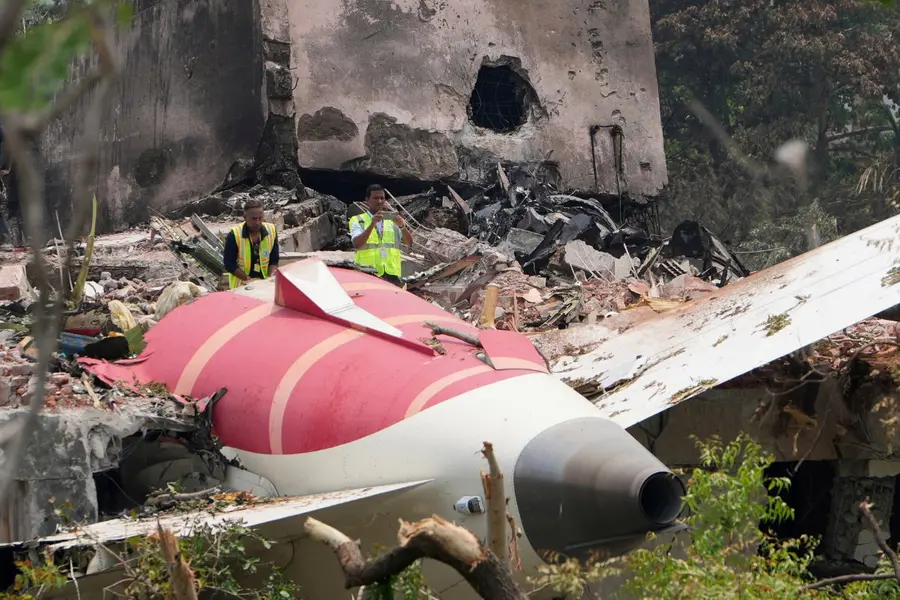
Indian investigators may be preparing to attribute the catastrophic crash of Air India Flight 171 to deliberate cockpit action, according to a detailed account published by Italian newspaper Corriere della Sera. Citing unnamed Western aviation officials, the paper said the final accident report could state that one of the pilots “almost certainly” turned off both engine fuel switches, leading to the deadly June 2025 crash in Ahmedabad.
The claim has not been confirmed by Indian authorities, and no official conclusion has been released. However, the report has reignited debate over the direction of the inquiry, particularly against the backdrop of long-running tensions between Indian and US investigators.
What the Italian report claims
According to Corriere della Sera, technical examinations have ruled out mechanical failure as a cause of the near-simultaneous loss of thrust in both engines of the Boeing 787 Dreamliner. The aircraft plunged into a medical student hostel just 32 seconds after takeoff on 12 June 2025, killing 260 people – 241 of the 242 on board and 19 on the ground.
The newspaper said investigators re-analysing cockpit voice and flight data recorder readings in Washington identified which pilot moved the engine fuel switches from “run” to “cutoff”. The action, the report claims, appeared intentional rather than accidental.
The preliminary report, issued one month after the crash, had already recorded that both engines shut down after the switches were moved. It also captured an exchange between the pilots, “Why did you turn off the engines?” followed by the reply, “It wasn’t me.” The document, however, did not attribute the remarks to either crew member.
Focus on the flight crew
Western experts cited by the Italian newspaper said their analysis pointed towards the aircraft’s commander, Captain Sumeet Sabharwal, who died in the crash. Sabharwal was reportedly acting as pilot monitoring, while First Officer Clive Kunder was flying the aircraft.
Flight data suggested the left engine–on the captain’s side–failed first, with the right following shortly after. The first officer’s control yoke was said to show an attempt to regain altitude in the final seconds, while the captain’s remained still.
Enhanced audio processing of cockpit recordings allegedly allowed investigators to pinpoint which pilot manipulated the fuel switches, with sources insisting the action could not have been a mistake.
US-India divergence and possible ‘political’ review
The newspaper reported that Indian officials initially resisted conclusions suggesting pilot involvement, prompting what it described as weeks of “confrontations” with their US counterparts. Simulator testing conducted by American experts reportedly found no scenario where both engines would shut down without human intervention.
According to Corriere, Indian investigators shifted their position amid warnings from Western authorities that India’s airline safety ratings could be reviewed. One source told the newspaper: “Admitting that it was one of the pilots who knocked down the plane is increasingly considered a sustainable sacrifice.”
The report also said that final conclusions may undergo “political” scrutiny before publication, noting the possibility of a toned-down version to avoid national controversy.
Pilot bodies and family reject allegations
Pilot associations in India and the family of Captain Sabharwal had earlier opposed any narrative implying intentional wrongdoing. The Indian Commercial Pilots’ Association had earlier condemned such suggestions as a “gross violation” and a “disservice to the profession,” particularly warnings against speculative theories hinting at pilot suicide.
Government’s position in Parliament
In December 2025, the Union Civil Aviation Ministry informed Parliament that the Aircraft Accident Investigation Bureau (AAIB) was conducting the probe in line with ICAO norms. Minister of State Murlidhar Mohol told the Lok Sabha that both Enhanced Airborne Flight Recorders were recovered within days of the crash and had remained under AAIB custody with continuous surveillance.
He also rejected calls for an independent review, stating that the AAIB functions autonomously under the Aircraft (Investigation of Accidents and Incidents) Rules, 2025.
Indian authorities, including the AAIB, Directorate General of Civil Aviation and the Civil Aviation Ministry, have not commented on the Italian newspaper’s claims.
Published: 12 Feb 2026, 09:04 am IST
Related Topics
Disclaimer: Kindly avoid objectionable, derogatory, unlawful and lewd comments, while responding to reports. Such comments are punishable under cyber laws. Please keep away from personal attacks. The opinions expressed here are the personal opinions of readers and not that of Mathrubhumi.
