
The discovery of a 6th century BCE Tamil settlement is challenging north-centric history and fuelling pride and controversy in Tamil Nadu
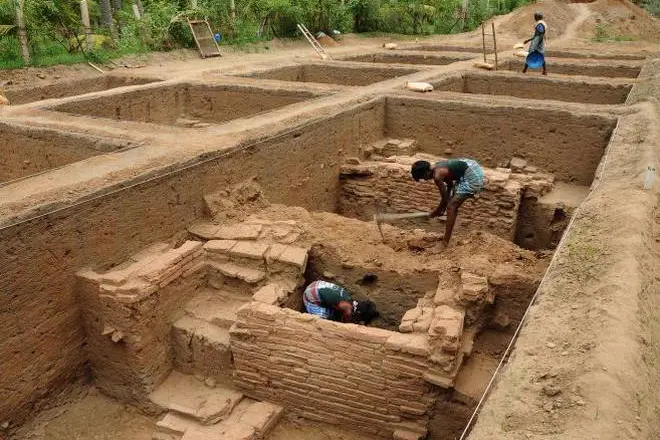
Keezhadi, Tamil Nadu: The quiet village of Keezhadi near Madurai is now at the centre of a major political and historical controversy. Excavations at the site have revealed evidence of an urban Tamil settlement dating back to the 6th century BCE, with artefacts such as brick structures, ring wells, and Tamil-Brahmi inscriptions, pointing to a highly literate and developed culture along the Vaigai River.
According to a report by The News Minute the excavation, initially led by archaeologist K Amarnath Ramakrishna under the Archaeological Survey of India (ASI), found thousands of artefacts suggesting trade links, writing systems, and advanced habitation, possibly contemporary with or even predating some Gangetic settlements. Some inscriptions also resemble Indus Valley symbols, hinting at cultural continuity that could reshape India’s early civilisational history.
But Keezhadi’s significance has not remained limited to archaeology. After Ramakrishna refused to amend his report—which dated the site’s habitation to around 580 BCE—he was transferred, sparking outcry in Tamil Nadu. The DMK-led government, along with Tamil scholars, accused the BJP-led Centre of trying to suppress Tamil heritage in favour of a north Indian narrative centred on the so-called Saraswati civilisation.
Chief Minister MK Stalin condemned the ASI’s actions, calling the order to revise the report an attack on Tamil identity and cultural pride. Meanwhile, Union Culture Minister Gajendra Singh Shekhawat maintained that the ASI was only seeking further validation of the findings.
The Madras High Court later handed over responsibility for the site to the Tamil Nadu State Archaeology Department, signalling a win for state autonomy over cultural heritage.
The Keezhadi findings, if upheld, could redate Tamil script development and reaffirm the Sangam era’s historicity—long celebrated in literature but dismissed by many as myth. Keezhadi could establish that India’s civilisational origins were not limited to the north, but shared across the subcontinent, with the south playing an equally foundational role.
As of mid-2025, over 20,000 artefacts have been excavated. Ramakrishna insists that his dating is backed by carbon dating and AMS tests conducted in India, the US, and Italy, and consistent with stratigraphic science.
But this is now more than a debate about carbon dating—it is a struggle over historical ownership, identity, and federal power in India’s cultural discourse.
Keezhadi is no longer just a dig. It’s a defining battle between archaeology and ideology, with the ancient past colliding with today’s politics.
Published: 28 Jun 2025, 09:02 pm IST
Related Topics
Disclaimer: Kindly avoid objectionable, derogatory, unlawful and lewd comments, while responding to reports. Such comments are punishable under cyber laws. Please keep away from personal attacks. The opinions expressed here are the personal opinions of readers and not that of Mathrubhumi.
