
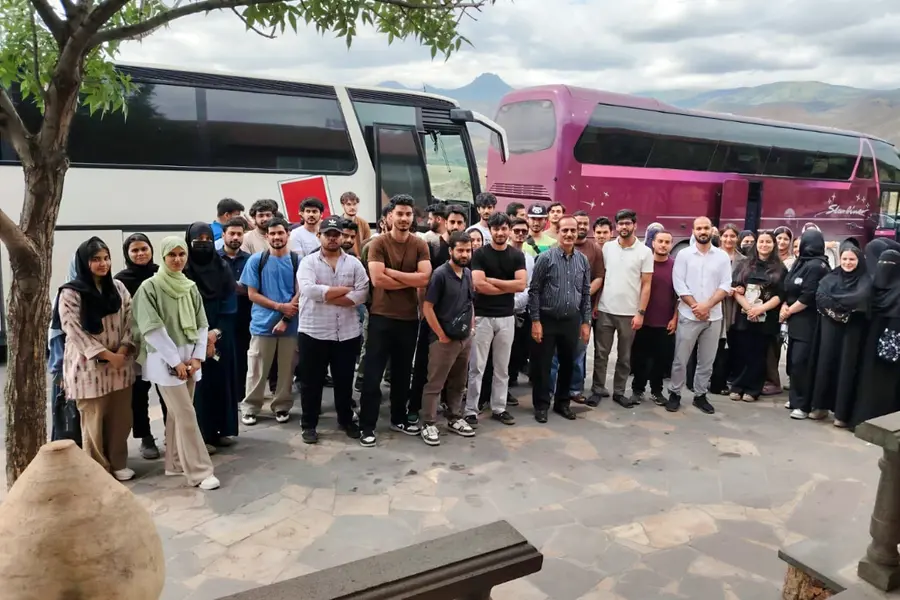
New Delhi: Indian students who were recently evacuated from war-affected Iran have expressed gratitude to the Indian government for bringing them home safely. However, they voiced concerns over the condition of the buses arranged by the Jammu and Kashmir government for their onward journey from Delhi, saying the vehicles were not suitable for their long and tiring trip back home.
Under 'Operation Sindhu', 110 students from Urmia Medical University in Iran landed in Delhi early this morning after being evacuated via Armenia and Doha. The students, who arrived safely, appreciated the Centre’s efforts to ensure their return.
Concerns over bus travel to Jammu and Kashmir
Despite their relief at being brought back to India, many students, particularly those from Kashmir, have criticised the condition of the buses arranged to take them from Delhi to their home districts.
Shaikh Afsa, a student and resident of Kashmir, stated that the buses provided were not in a “stable condition” and described how physically draining it would be to travel such a long distance after an already tiring journey.
“We are tired, and it would be difficult for us to travel back to our homes in a bus,” she said. Afsa has reportedly reached out to Jammu and Kashmir Chief Minister Omar Abdullah, requesting alternative arrangements.
Another student voiced concern over the impact the Israel-Iran conflict has had on their academic future. “We want the conflict to end soon. Our studies are getting affected,” the student added.
J&K government responds to students' plea
In response, the office of Chief Minister Omar Abdullah has confirmed that it is aware of the students’ concerns. The government stated it is working in coordination with the Jammu and Kashmir State Road Transport Corporation (JKSRTC) to provide “proper deluxe buses” for their onward journey.
The Israel-Iran conflict
The evacuation was triggered by the escalating military conflict between Israel and Iran. Last Friday, the Israeli military launched “Operation Rising Lion”, striking Iranian cities. The Israeli government claimed the offensive was necessary as it believed Tehran was nearing the development of a nuclear weapon.
The attacks have led to over 250 deaths, with more than 220 fatalities reported in Iran alone.
Israeli Prime Minister Benjamin Netanyahu, in a televised address late Wednesday, said the operation was aimed at eliminating what he called two existential threats to Israel.
“We are advancing step by step to remove these threats,” he said.
Netanyahu further claimed that Israel’s military “now controls the skies over Tehran” and added, “We are striking the Ayatollahs’ regime with great force. We are attacking nuclear installations, missiles, command centres and the symbols of the regime.”
Thousands of Indians still in iran
According to government data, more than 4,000 Indian nationals reside in Iran, with nearly half of them being students. The situation remains tense as Indian authorities continue to monitor the evolving conflict, with further evacuations expected if conditions worsen.
Published: 19 Jun 2025, 09:48 am IST
Related Topics
Disclaimer: Kindly avoid objectionable, derogatory, unlawful and lewd comments, while responding to reports. Such comments are punishable under cyber laws. Please keep away from personal attacks. The opinions expressed here are the personal opinions of readers and not that of Mathrubhumi.
