
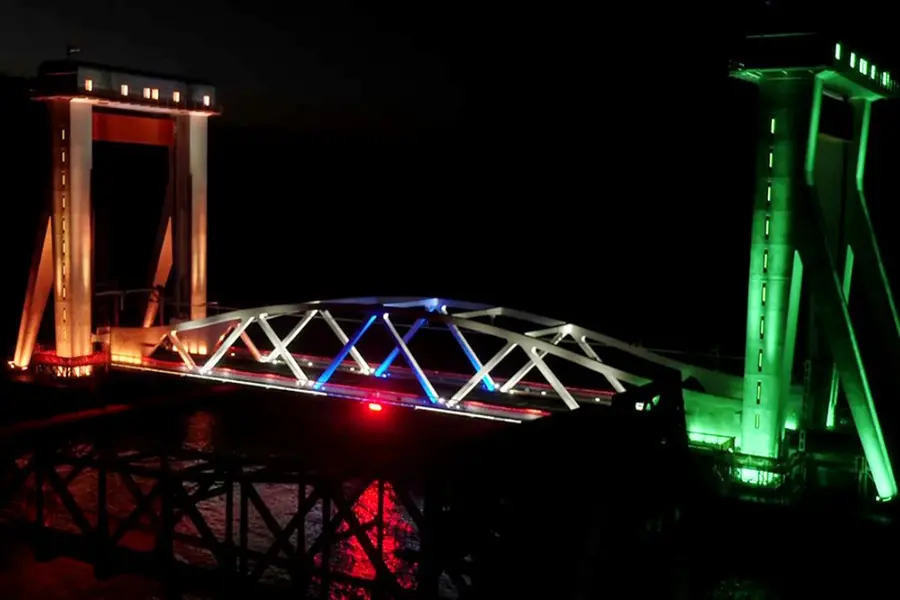
As India gets ready to unveil its first vertical lift railway sea bridge, the new Pamban Bridge stands as a shining testament to the country's growing engineering prowess and infrastructure ambition. Scheduled to be inaugurated by Prime Minister Narendra Modi on April 6, the bridge connects Mandapam on the mainland to Rameswaram Island—replacing the iconic British-era structure that served the nation for over a century.
A technological marvel
Spanning 2.078 kilometres across the Palk Strait, the new Pamban Bridge is hailed as a landmark in sustainable and advanced engineering. Designed to accommodate growing rail traffic and enhance maritime navigation, the bridge features a 72-metre-long vertical lift span that elevates 22 metres above sea level, allowing ships to pass beneath with ease. The lift mechanism, a first for Indian railway bridges, operates in just 5 minutes and 30 seconds—dramatically improving efficiency and reducing the manpower required compared to the old system.
Drawing comparisons with global engineering icons such as London’s Tower Bridge, the Arthur Kill Vertical Lift Bridge in the US, and even the Golden Gate and Öresund Bridges, the Southern Railway and Rail Vikas Nigam Limited (RVNL) regard this new structure as a symbol of India’s entry into the league of global infrastructure giants.
Built to last: Design, durability and sustainability
While the original Pamban Bridge, inaugurated in 1914, lasted an impressive 108 years despite enduring extreme coastal conditions, the new bridge is expected to remain functional for up to 58 years with minimal maintenance—thanks to modern materials and technology. A robust surface protection system, including polysiloxane paint commonly used in high-corrosion zones around the world, has been applied. This replaces the special silver paint used by British engineers on the old structure.
The bridge is also reinforced with high-grade stainless steel in its concrete elements and designed to withstand seismic activity, high-velocity winds and cyclonic weather—frequent challenges in the region. An elevated girder design reduces exposure to sea spray, a key factor in preventing corrosion.
From vision to reality: A challenging build
The foundation stone for the new bridge was laid in November 2019, with work commencing in February 2020. However, the project faced huge delays due to the COVID-19 pandemic and adverse weather conditions. Despite these hurdles, the execution remained injury-free—a remarkable achievement given the complexity of working in a high-risk marine environment involving the fabrication and installation of 1,400 tonnes of components, including 99 girders and electrification systems.
Strategic use of tidal patterns and logistics planning ensured smooth transportation of materials to the remote construction site.
Faster, heavier, smarter
Unlike the old bridge, where trains were limited to a sluggish 10 km/h, the new structure can accommodate speeds up to 160 km/h. However, considering signaling and curvature constraints on the approach routes, trains will initially operate at speeds up to 98 km/h—still a significant upgrade in efficiency. The bridge also supports axle loads up to 25 tonnes, making it future-ready for increased freight movement.
CRS concerns and engineering assurance
The Commissioner of Railway Safety (CRS), in its report, raised concerns regarding the estimated lifespan and adherence to construction norms. Despite this, Southern Railway has expressed strong confidence in the durability of the structure, asserting that modern construction techniques, materials and design considerations will ensure its resilience.
A bridge to the future
The new Pamban Bridge is more than just a physical structure; it is a symbol of progress and a bridge between heritage and future aspirations. As a catalyst for regional development, the bridge is expected to boost tourism, create employment and enhance connectivity in southern Tamil Nadu.
(With PTI inputs)
Published: 05 Apr 2025, 10:51 pm IST
Related Topics
Disclaimer: Kindly avoid objectionable, derogatory, unlawful and lewd comments, while responding to reports. Such comments are punishable under cyber laws. Please keep away from personal attacks. The opinions expressed here are the personal opinions of readers and not that of Mathrubhumi.
