
At the Ram Temple ceremony, PM Modi linked the Dharma Dhwaja hoisting with a call for India to reclaim cultural confidence and move beyond its colonial mindset.
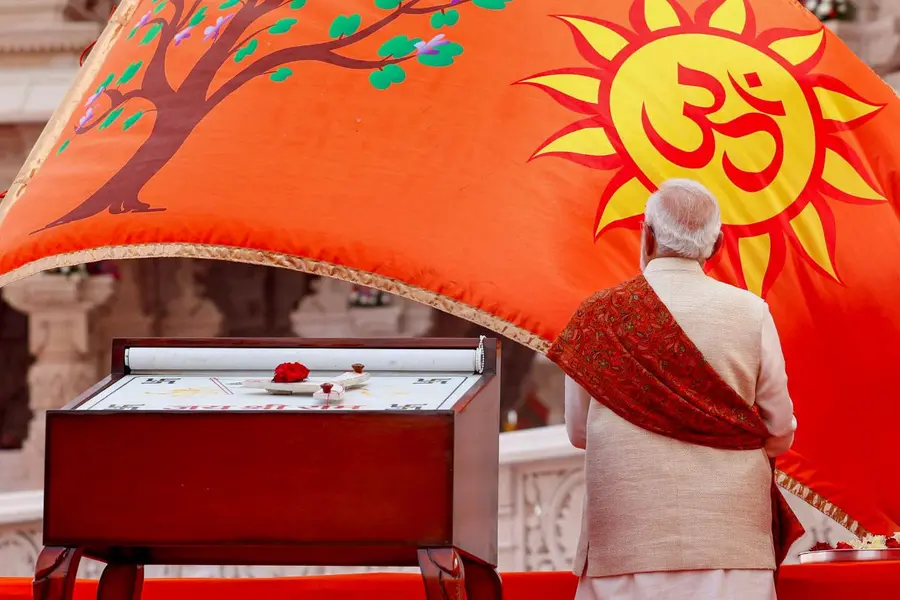
Ayodhya (Uttar Pradesh): Prime Minister Narendra Modi described the raising of the Dharma Dhwaja (flag) atop the Ram Janmabhoomi Temple as a “historic” moment, saying that India must draw strength from its civilisational roots while shedding its “slave mentality” in order to become a fully developed nation by 2047.
After unfurling the saffron Dharma Dhwaja at the newly constructed Ram Temple, the Prime Minister invoked the ideals associated with Lord Ram to highlight his vision of a confident, future-oriented India. Addressing devotees at the ‘Dhwajarohan’ ceremony, he stated, "Ram is not a person, He is a value. If we want to make India developed by 2047, we have to awaken Ram within ourselves. What day can be better than today for this resolution?"
Reiterating that Lord Ram resonates with people through emotion, PM Modi noted that devotion, cooperation and shared cultural values form the foundation of Indian society.
Reflecting on the developmental work undertaken over the past decade, he said, "In the last 11 years, every section of society, women, Dalits, backward classes, extremely backward classes, tribals, the deprived, farmers, workers and youth, has been placed at the centre of development."
He emphasised that the centenary of India’s Independence in 2047 must mark the realisation of the goal of a Viksit Bharat.
PM Modi urged citizens to work with long-term foresight, adding, "We must strengthen the foundation of India for the next thousand years… This nation existed even before us, and it will continue to exist even when we are no longer here."
Highlighting the symbols inscribed on the Dharma Dhwaja, he spoke about the Kovidar tree as a representation of cultural revival. According to him, its presence on the flag signifies the restoration of India’s identity and civilisational continuity.
He noted that India must also work to free itself from the “slave mentality”, tracing its origins to the Macaulay education system introduced in 1835. PM Modi said the country should aim to overcome this legacy by 2035, remarking, "Macaulay laid the foundation of slavery in India... For the next 10 years, we have to move ahead with the goal of freeing India from the mentality of slavery."
Calling the moment spiritually relevant, PM Modi said the Dhwajarohan symbolised the healing of “centuries of wounds” and the fulfillment of a long-awaited cultural aspiration. "Today, the entire India and the world is Ram-may... The pain of centuries is being put to rest today," he said.
He added that the Dharma Dhwaja mounted on the temple’s 191-foot shikhar embodies the values of Ram Rajya. "This Dharma Dhwaja is not just a flag. It is the flag of the rejuvenation of Indian civilisation... For the coming thousands of centuries, this flag will proclaim Lord Ram's values," he said.
Earlier in the day, PM Modi and RSS chief Mohan Bhagwat performed the ceremonial hoisting of the saffron flag, marking the formal completion of the Ram Temple’s construction. The triangular Dharma Dhwaja features three sacred symbols—Om, the Sun and the Kovidar tree—each representing key elements of Sanatan tradition.
The event also coincided with the Abhijit Muhurat during Vivah Panchami, linked to the divine wedding of Lord Ram and Goddess Sita.
PTI
Published: 25 Nov 2025, 03:55 pm IST
Disclaimer: Kindly avoid objectionable, derogatory, unlawful and lewd comments, while responding to reports. Such comments are punishable under cyber laws. Please keep away from personal attacks. The opinions expressed here are the personal opinions of readers and not that of Mathrubhumi.
