
India has approved seven new bullet train corridors, promising dramatically shorter travel times and expanding the country's high-speed rail network beyond the Mumbai-Ahmedabad route.
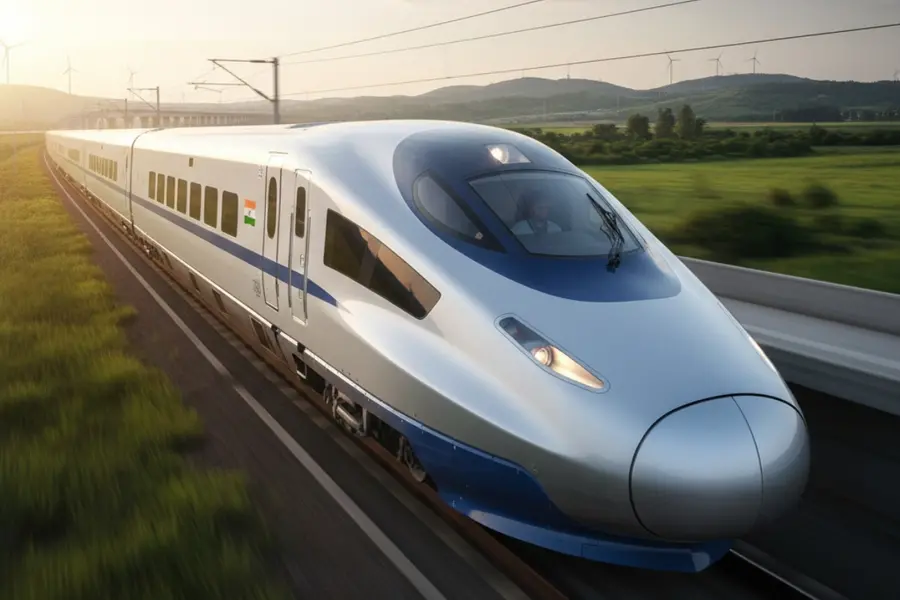
India's ambitious high-speed rail programme has taken a major step forward after the approval of seven new bullet train corridors, including routes connecting Mumbai-Pune, Delhi-Lucknow and Bengaluru-Chennai, significantly reducing travel times across key economic regions.
Union Railway Minister Ashwini Vaishnaw announced that Prime Minister Narendra Modi has approved seven new high-speed rail corridors, expanding India's bullet train vision beyond the under-construction Mumbai-Ahmedabad route.
Also Read

The newly approved projects are expected to transform inter-city travel by cutting journey times dramatically and creating stronger economic links between major urban centres.
Seven new bullet train corridors approved
The approved corridors are:
- Mumbai–Pune
- Bengaluru–Chennai
- Bengaluru–Hyderabad
- Pune–Hyderabad
- Delhi–Lucknow
- Delhi–Varanasi
- Delhi–Siliguri
The routes span western, southern and northern India, forming the foundation of a broader national high-speed rail network.
Proposed travel times
The government has outlined the expected journey times for the corridors:
| Route | Expected travel time |
|---|---|
| Mumbai–Ahmedabad | 1 hour 57 minutes |
| Mumbai–Pune | 48 minutes |
| Bengaluru–Chennai | 73 minutes |
| Bengaluru–Hyderabad | 2 hours 10 minutes |
| Pune–Hyderabad | 2 hours 8 minutes |
| Delhi–Lucknow | 2 hours |
| Delhi–Varanasi | 3 hours 15 minutes |
| Delhi–Siliguri | 6 hours |
The Mumbai-Pune route would become the fastest among the newly approved corridors, while Delhi-Siliguri would see one of the biggest reductions in travel time, falling from around 20 hours by conventional rail to approximately six hours.
Vision of integrated economic corridors
According to Vaishnaw, the expansion is not only about faster travel but also about creating interconnected economic regions.
Cities such as Mumbai, Pune, Ahmedabad, Surat and Hyderabad could become part of a closely linked economic ecosystem, allowing businesses, workers and investment to move more efficiently between urban centres.
The concept mirrors successful high-speed rail models seen in countries such as Japan and China, where bullet train networks have helped drive regional economic growth.
More railway expansion planned
The announcement comes alongside broader railway development plans. Vaishnaw recently stated that Bihar is expected to receive more than 200 new trains over the next seven to eight years.
The government has also launched new train services connecting Chhapra and Delhi, as well as additional routes linking other regions of Bihar with major cities.
What happens next?
While the corridors have received approval, detailed feasibility studies, route planning, land acquisition and construction timelines will determine how quickly the projects move forward.
The Mumbai-Ahmedabad bullet train project remains India's first operational high-speed rail initiative under construction and is expected to serve as the model for future corridors.
The approval of seven additional bullet train corridors signals India's transition from a single pilot project to a nationwide high-speed rail strategy. If completed as planned, the network could significantly reduce travel times, improve regional connectivity and reshape economic activity across multiple states.
Published: 21 Jun 2026, 10:10 am IST
Related Topics
Disclaimer: Kindly avoid objectionable, derogatory, unlawful and lewd comments, while responding to reports. Such comments are punishable under cyber laws. Please keep away from personal attacks. The opinions expressed here are the personal opinions of readers and not that of Mathrubhumi.