
From LPG price revisions and Tatkal booking changes to CKYC 2.0, India Post rules and banking updates, here are the key changes taking effect from August 1.
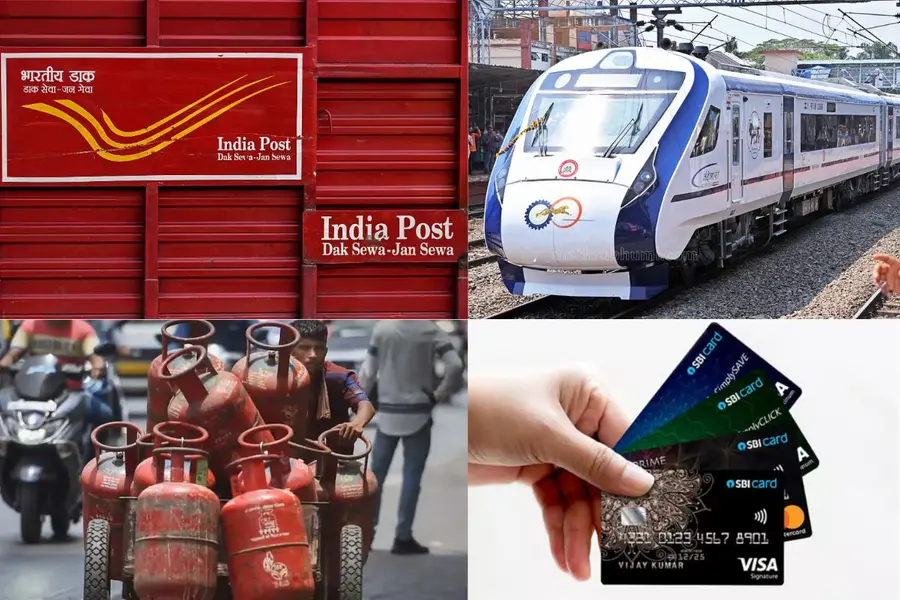
Several important changes will come into effect across India from August 1, affecting households, commuters, bank customers and taxpayers. Monthly LPG price revisions, updated Tatkal ticket booking rules, the rollout of CKYC 2.0, changes to banking services and Income Tax Return deadlines are among the key developments people should be aware of.
Here are the major changes taking effect from August 1:
1. LPG cylinder prices to be revised
As it does at the beginning of every month, oil marketing companies will revise the prices of domestic and commercial LPG cylinders on August 1.
The revision comes amid continued fluctuations in the international crude oil market due to geopolitical uncertainty in oil-producing regions.
Any increase in commercial LPG cylinder prices could raise operating costs for hotels, restaurants and food outlets, which may eventually be reflected in dining and food delivery prices. Domestic cooking gas prices will also be reviewed as part of the monthly revision.
2. New Tatkal ticket booking process for railway passengers
Indian Railways is introducing changes to the Tatkal ticket booking process from August 1 to make bookings at reservation counters more efficient.
Under the revised system, the timing for issuing booking tokens will now be aligned with the opening time of Tatkal bookings.
Earlier, passengers often had to wait in separate queues to collect tokens before returning for the actual booking process. The new arrangement is expected to reduce waiting time, minimise inconvenience and improve crowd management at reservation counters.
3. CKYC 2.0 rollout to simplify banking and financial services
Banks and other financial institutions will begin rolling out the Central Know Your Customer (CKYC) 2.0 framework from August 1.
The upgraded system allows verified KYC details to be securely reused across multiple financial institutions with the customer's digital consent through a centralised registry.
Initially, the framework will be adopted by banks and insurance companies, while mutual funds, brokers and other financial institutions are expected to join in phases.
For customers, this means they may no longer have to repeatedly submit physical KYC documents while opening new bank accounts, purchasing insurance policies or accessing other financial services. The new framework is expected to speed up digital onboarding and improve verification processes.
4. India Post introduces new document and parcel rules
The Department of Posts has notified new rules classifying documents and parcels, along with rates for its 24-hour and 48-hour Speed Post services from August 1.
Documents will include letters, printed material and complimentary items without resale value. Banking and financial documents such as passbooks, cheque books, bank statements, debit cards and credit cards will also be treated as documents.
Government-issued documents, including PAN cards, Aadhaar cards, passports, voter ID cards and driving licences, will fall under the document category. Rakhi envelopes, greeting cards and similar items weighing up to 500 grams will also be included, provided they are not commercial merchandise.
All other items will be treated as parcels.
The department has also notified rates for its new 24 Speed Post and 48 Speed Post services, which promise delivery within 24 hours and 48 hours respectively. These services are currently available in Delhi, Mumbai, Chennai, Kolkata, Bengaluru and Hyderabad.
There is no change in Speed Post rates for retail customers, although separate rates have now been notified for bulk bookings under the document category.
5. Banks revise charges and credit card reward policies
Several banks are introducing changes to credit card reward programmes, service charges and SMS alert fees from August 1.
Some lenders are restructuring reward point systems, annual maintenance charges and other service fees. Customers are advised to review the latest fee schedules issued by their respective banks.
Among the changes, Ujjivan Small Finance Bank has revised its SMS alert charge to ₹0.30 per message, subject to a monthly cap.
Banks may also revise debit card maintenance charges and other banking service fees depending on their individual policies.
6. RBI monetary policy decision next week
The Reserve Bank of India (RBI) will announce its latest monetary policy decision on August 5, following the Monetary Policy Committee (MPC) meeting scheduled from August 3 to August 5.
The policy announcement could influence home loan EMIs, lending rates and fixed deposit returns, depending on the RBI's decision on interest rates and liquidity.
7. Income Tax Return deadlines
The deadline for filing Income Tax Returns (ITR) for salaried individuals and non-audit taxpayers is July 31, 2026.
Those who file forms such as ITR-1 or ITR-2 after the deadline may have to pay a late filing fee based on the applicable provisions.
Meanwhile, taxpayers filing ITR-3 and ITR-4 who are not subject to tax audit—including freelancers, self-employed professionals, small businesses and those opting for presumptive taxation under Sections 44AD and 44ADA—have time until August 31, 2026, to submit their returns.
Missing the August 31 deadline could attract a late filing fee of up to ₹5,000 under Section 234F, along with applicable interest on unpaid tax liability under Section 234A.
Published: 31 Jul 2026, 06:05 pm IST
ABOUT THE AUTHOR

Disclaimer: Kindly avoid objectionable, derogatory, unlawful and lewd comments, while responding to reports. Such comments are punishable under cyber laws. Please keep away from personal attacks. The opinions expressed here are the personal opinions of readers and not that of Mathrubhumi.