
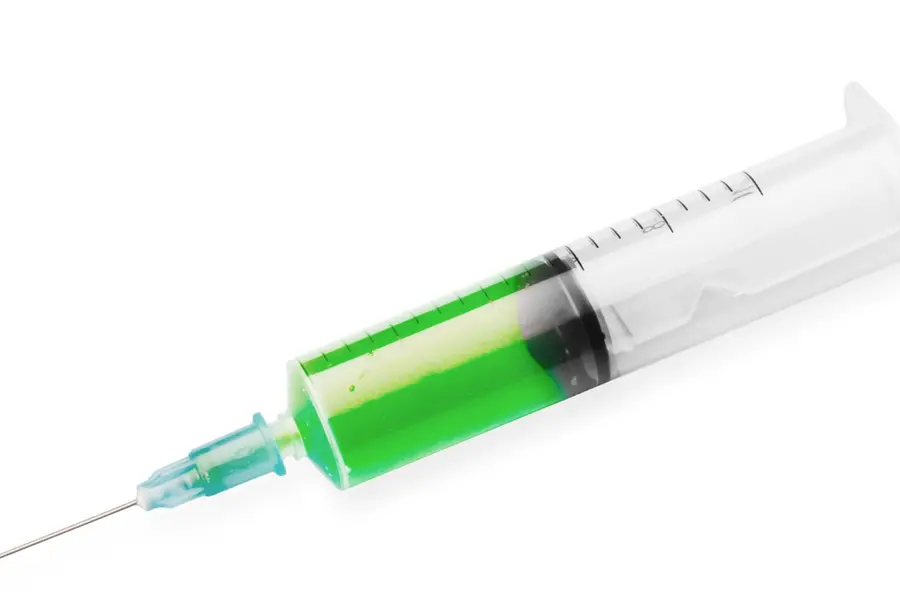
You don’t have to be scared of the needles anymore. A team of researchers at the Indian Institute of Technology (IIT) has developed a prototype of a needle-free syringe. Surprisingly, this invention was inspired by the world of aerospace engineering and not medicine as one would assume.
The said syringe was developed by a team led by Professor Viren Menezes of the Department of Aerospace Engineering, IIT Bombay. This invention comes as a solution to those patients who fear needle pricks often leading to missed vaccinations and delayed treatments.
A research paper in the Journal of Biomedical Materials & Devices published in 2024 compared the efficiency of the shock syringe’s drug delivery to traditional needles. The experiment was conducted for laboratory rats and the results were found to be promising. The results even revealed reduced skin trauma and quicker healing.
How does this syringe work?
A conventional syringe, as we know, relies on needles to penetrate the skin. The shock syringe however uses high-energy shock waves, which travel faster than the speed of sound, to deliver drugs to the body. Furthermore, the drug infusion takes place without any major discomfort for the receiver. The effect is similar to what happens during a sonic boom, where an aircraft travels faster than the speed of sound, shock waves compress the surrounding medium, pushing it at high speed.
Priyanka Hankare, research author and lead author of the study, said the team started working on the syringe in 2021. It took the team two and half years to develop the syringe. The syringe looks slightly longer than a ballpointpen with three components: driver, driven and drug holder. “It releases pressurised nitrogen gas, which generates a microjet that travels at speeds twice as fast as a commercial airplane during takeoff,” said Hankare.
The shock syringe holds a world of immense possibilities by making immunisation drives quicker and more efficient, particularly for children and adults with a needle phobia. The design reduces the risk of needle-stick injuries, which can spread blood-borne diseases and also offers cost-effective reliability with over 1000 uses per nozzle replacement.
The team is currently working in the process of filing for a patent.
Published: 28 Dec 2024, 07:54 am IST
Related Topics
Disclaimer: Kindly avoid objectionable, derogatory, unlawful and lewd comments, while responding to reports. Such comments are punishable under cyber laws. Please keep away from personal attacks. The opinions expressed here are the personal opinions of readers and not that of Mathrubhumi.
