
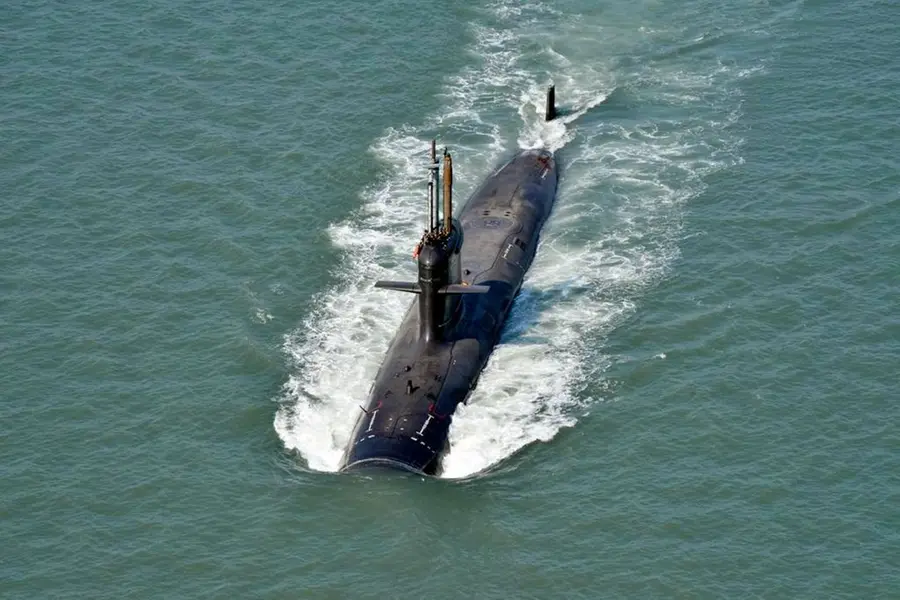
The Bhabha Atomic Research Centre (BARC) is designing a 190-MW nuclear reactor (N-reactor) for submarines. This project represents an important step forward for India's nuclear and naval abilities, enhancing both power and defence capabilities in the maritime sector.
According to the well-known website, spsnavalforces.com, this reactor will be used to power the P77 nuclear attack submarine (SSN), as well as the S-5 ballistic missile nuclear submarines (SSBN), boosting their overall capabilities. India has a plan to develop six nuclear attack submarines (SSNs) under Project 75 Alpha.
Also Read

This development comes close on the heels of China building a land-based prototype N-reactor intended for a large surface warship. According to new satellite imagery analysis and reports, China is moving closer to building its first nuclear-powered aircraft carrier.
SSN vs SSBN Submarines: Key Differences
SSNs and SSBNs are two types of N-powered submarines, but serve different roles:
* Nuclear Attack Submarine (SSN): These are designed to hunt down, and attack, enemy ships and submarines. They do not carry nuclear missiles, but are powered by a nuclear-reactor, allowing them to stay underwater for long periods. Their main job is to protect other ships, attack enemy vessels and gather intelligence.
* Ballistic Missile Submarine (SSBN): These are also powered by a nuclear reactor, but their primary role is to carry, and launch, nuclear missiles. They act as a strategic deterrent, meaning they can hide underwater and, if needed, launch nuclear missiles from below the ocean's surface.
In short, SSNs are hunters focused on attacking and defending while SSBNs are carriers of nuclear-missiles, providing a powerful defence deterrent.
India's fleet of nuclear submarines
At present, India operates two N-ballistic missile submarines (SSBNs). The first, the INS Arihant, was commissioned in August 2016. It is powered by an 83-MW pressurized, light-water reactor fuelled with enriched uranium and has a displacement of 6,000 tons.
The second SSBN, the INS Arighaat (S3), with the same reactor and size as its predecessor, but featuring several technological improvements, was commissioned at end-August 2024.
The third SSBN, the Aridhman (S4), a 7,000-ton submarine, is now undergoing sea trials and will, possibly, officially inducted into the fleet in 2025, sources say.
India's fourth nuclear-powered ballistic missile submarine -- S4* -- hit the waters at the Ship Building Centre in Visakhapatnam on October 16 this year, multiple sources report. The first two SSBNs use the same type of reactor, but the S4 and S4* are equipped with an upgraded version.
The S4* is larger and can carry several K-4 submarine-launched ballistic missiles (SLBMs), sources add.
Earlier in October, the Cabinet Committee on Security approved building two homegrown SSNs, known as 'hunter-killers'. These submarines are essential for the Indian Navy to keep a close watch on the Indo-Pacific region.
The lease for India's Russian Akula-class SSN ended in 2021, leaving the Indian Navy without any SSNs in its fleet. There were plans to lease another Akula-class submarine from Russia, but the ongoing conflict with Ukraine and resulting global sanctions disrupted these plans.
The INS Arihant is, at present, equipped with the K-15 submarine-launched ballistic missile (SLBM), which has a range of 750 km. The S4* submarine is equipped the advanced K-4 SLBM, which has a range of 3,500 km. It was first tested in 2020.
The K-4 missile will play a central role in India's underwater nuclear defence, allowing the launch of nuclear weapons from the Indian waters. This capability will be even stronger once a longer-range, 5,000-km SLBM is developed and deployed.
Bhabha Atomic Research Centre Reactor
The Bhabha Atomic Research Centre (BARC) is preparing to build a 190-MW nuclear reactor for India’s P77 SSNs and S-5 SSBNs. This development represents a significant step forward in strengthening India’s defence and naval power.
This step comes as India's strategic and defence needs are growing quickly and its drive for self-reliance in advanced technology is stronger than ever.
BARC's contribution to India's nuclear plan
Established in 1954, BARC has been at the heart of India's nuclear energy and defence programmes. It serves as the main R&D organization for India’s civilian and military nuclear sectors. It has played a key role in creating homegrown nuclear technology, including reactors, fuel-processing and weapons grade materials for defence purposes. The centre has been crucial to India's nuclear submarine programme.
Importance of nuclear reactors
A nuclear-powered submarine (SSN or SSBN) uses nuclear reactors to produce the energy needed to stay submerged and travel underwater for long periods without needing to come up for fuel. This provides a major advantage, as it enables submarines to stay underwater for months, making them hard to detect and able to carry out long missions without supply limitations.
India has aimed to create, and use, this technology for a long time to strengthen its strategic defence abilities. Nuclear-powered submarines, especially those armed with SSBNs, are viewed as the strongest defence against opponents. Their stealth and guaranteed ability to strike back make them a powerful safeguard in the event of a nuclear conflict.
India has set a plan to build six nuclear attack submarines (SSN) as part of Project 75 Alpha, boosting its strategic naval power in response to increasing regional tensions. Examining these two areas shows the urgent need to increase both defence and strike capabilities. There are significant concerns in these areas, especially regarding strategic defence and strike power.
Pakistan has obtained eight Chinese Type 039B Yuan-class submarines, with the first of these launched in April this year. China's People’s Liberation Army Navy possesses a fleet of 60 submarines, comprising six SSBNs, six SSNs and 48 diesel-electric subs. Two new types of nuclear submarines, Type 95 SSN and Type 96 SSBN, are also currently in development.
India is particularly concerned as the Chinese Navy could soon approach the large size of the US Navy, which currently has 68 nuclear submarines, comprising 14 SSBNs, four Nuclear-Powered Guided Missile Submarines (SSGNs) and 49 SSNs. These subs are designed to carry, and launch, guided missiles, such as cruise missiles, rather than ballistic missiles.
SSGNs can stay underwater for long periods, making them ideal for stealth operations and precise, long-range attacks against surface targets or land-based positions.
Timeline of India's N-Sub programme
India's path to developing nuclear-powered submarines has been both ambitious and filled with challenges. India;s first homegrown nuclear-powered submarine, the INS Arihant, was launched in 2009 and became fully operational in 2016 after completing extensive sea trials.
This achievement was a significant milestone in India's defence history, making it one of the few countries in the world with a nuclear triad—the capability to launch N-weapons from land, air and sea.
The INS Arihant’s reactor was, initially, based on a design borrowed from Russia, specifically the VM-4 reactor, a technology originally developed by the Soviet Union for its submarines.
Although this was a major step forward, India's long-term aim is to create a fully homegrown nuclear reactor for submarines that fulfils its security and technological requirements.
Indigenous N-Sub Reactors: BARC's Role
BARC's latest project to develop, and build, a nuclear reactor for submarines marks an important move towards boosting self-sufficiency in defence technology. This project is expected to include advanced reactor designs tailored to the specific needs of submarines—such as being compact, efficient and long-lasting.
The reactor must also be able to handle the tough underwater conditions, such as high pressure and constant vibrations, while staying safe and reliable on long missions. The reactor design for these subs is expected to build on the technology used in Arihant-class submarines, aiming to create an even more advanced and efficient power system.
What is a pressurized water reactor?
A Pressurized Water Reactor (PWR) is a type of N-reactor that uses water to keep the reactor core cool and safe. Inside the reactor, N-fuel generates a great deal of heat.
To control this heat, water flows around the fuel, absorbing the energy and preventing overheating. The water is kept under very high pressure, which stops it from boiling, even though it is extremely hot.
This hot, pressurized water channeled through pipes then heats another separate water supply system. This second water supply turns into steam, which spins turbines to produce electricity. This set-up keeps the reactor safe while generating power efficiently.
Why India needs more submarines?
Adding more submarines to India's fleet will enable the navy to keep a steady deterrent patrol, helping ensure that India's second-strike defence -- which is a country's ability to respond to a nuclear attack with a powerful counter-attack -- remains strong and reliable.
In second-strike defence, even if an enemy launches a surprise nuclear strike and destroys some of its forces, the country can still launch a retaliatory strike with its remaining weapons.
This capability serves as a strong deterrent, as it assures potential attackers that any nuclear aggression would lead to serious consequences.
To bridge the gap in SSN capabilities, India is planning to lease an Akula-class submarine, the INS Chakra III, from Russia. Although delayed, it is expected to arrive by 2025. This development also supports India's wider maritime goals.
With rising global tensions and the Indo-Pacific becoming a key area for international competition, India's ability to strengthen its naval power is important for ensuring both regional and global security.
BARC's construction of an indigenous nuclear reactor for submarines is a major advancement in technology and a critical move to strengthen India's strategic defence capabilities.
Published: 16 Nov 2024, 12:21 pm IST
Disclaimer: Kindly avoid objectionable, derogatory, unlawful and lewd comments, while responding to reports. Such comments are punishable under cyber laws. Please keep away from personal attacks. The opinions expressed here are the personal opinions of readers and not that of Mathrubhumi.