
From celebrating the Bengali language to portraying the lives of migrant workers and refugees, this year’s Durga Puja pandal themes capture both pride and pain.
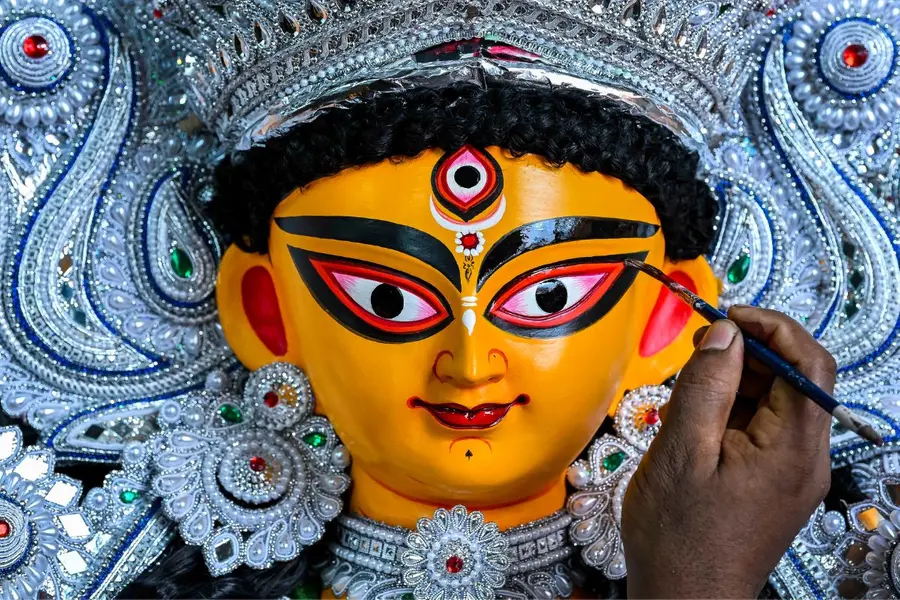
Kolkata: As Durga Puja 2025 begins, Kolkata’s Chaltabagan Sarbojanin Durga Puja opens with a theme centred on the Bengali language. Titled “Ami Banglai Bolchi” (I speak in Bengali), the pandal pays homage to the mother tongue.
Visitors are greeted by a “language tree”, tracing how modern Bengali grew from its ancient linguistic roots.
Artist Pradipta Karmakar, who designed the installation, said it represents not just Bengali but the dignity of all mother tongues.
Inside the pandal, performers restage scenes from Satyajit Ray’s classic film 'Hirak Rajar Deshe’ (1980).
Through the witty exchanges of a king and his jester, the play stresses the cultural and political weight of the Bengali language today.
Durga Puja pandals in Bengal have often mirrored current debates. This year, they unfold against a tense backdrop: since May, Bengali-speaking Muslim migrant workers have been reportedly forced across the border into Bangladesh, sparking heated discussion about language, citizenship, and belonging.
The row intensified in August when Chief Minister Mamata Banerjee slammed a Delhi Police circular for calling Bengali a “Bangladeshi language.” Soon after, she accused the BJP of being “anti-Bengali” during a state assembly debate on migrant workers.
The BJP has long criticised Bengal’s Durga Puja traditions, claiming organisers dilute Hindu customs by altering goddess idols, eating meat during the festival, and adopting experimental themes.
This year, several community pujas have responded with themes that reclaim history and identity.
In Baguihati, the Aswininagar Bandhumahal Puja charts how Bengalis settled in Bengal’s river systems, mapping their prosperity and migration.
Its theme, “Bangla O Bangali’r Samriddhir Adyopanto” (The complete story of Bengal and Bengalis’ prosperity), draws parallels between Bengal and global migrant journeys.
In Thakurpukur, the State Bank Club Puja revisits the archaeological site of Moghalmari in West Medinipur, where a Buddhist monastery from the 6th–12th centuries was unearthed. With the theme “Protno Kotha” (Old Tales), the pandal demands recognition for Bengal’s ancient history.
Durga Puja themes have steadily evolved from decorative replicas of monuments into bold statements on justice, environment, migration, and resilience.
UNESCO’s 2021 recognition of the festival as an Intangible Cultural Heritage of Humanity only underlined this transformation.
In Garia, the Ramgarh Raipur Club Puja highlights the struggles of migrant labourers — or porijayi — who are unable to return home during the festival.
With little money, they still organise Durga Puja at their worksites, a reminder of how worship survives displacement.
In Behala, the Adarsha Pally Puja marks the centenary of filmmaker Ritwik Ghatak, taking inspiration from his Partition-era classic 'Meghe Dhaka Tara' (1960).
A world map torn by scissors captures the trauma of division and the endless cycle of refugees.
The Samaj Sebi Sangha Puja in Gariahat turns to Bengal’s wartime past with the theme 'Pather Panchali' (1955) (Song of the Road).
Its trucks symbolise both despair and survival — a nod to freedom fighter Lila Roy, who rescued riot victims in 1946 using trucks. Here, Durga is envisioned as Roy herself, breaking colonial chains.
Meanwhile, the Hanuman Mandir Jopur Jayashree Club delivers a sharp warning through its theme “Bangla Mar”. The phrase doubles as “Bengali Mothers” and “Bengal’s slap”.
Its imagery of detention camps, barbed wire, and arms breaking free insists that Bengalis will not silently accept humiliation.
From migrant workers’ sacrifices to Bengali pride and historic memory, this year’s Durga Puja pandals reaffirm the festival’s role as Bengal’s most powerful cultural voice.
Published: 22 Sept 2025, 10:04 am IST
Related Topics
Disclaimer: Kindly avoid objectionable, derogatory, unlawful and lewd comments, while responding to reports. Such comments are punishable under cyber laws. Please keep away from personal attacks. The opinions expressed here are the personal opinions of readers and not that of Mathrubhumi.
