
Delhi to launch smart travel cards, restructured bus routes, modernised interstate bus terminals, and redesigned bus queue shelters
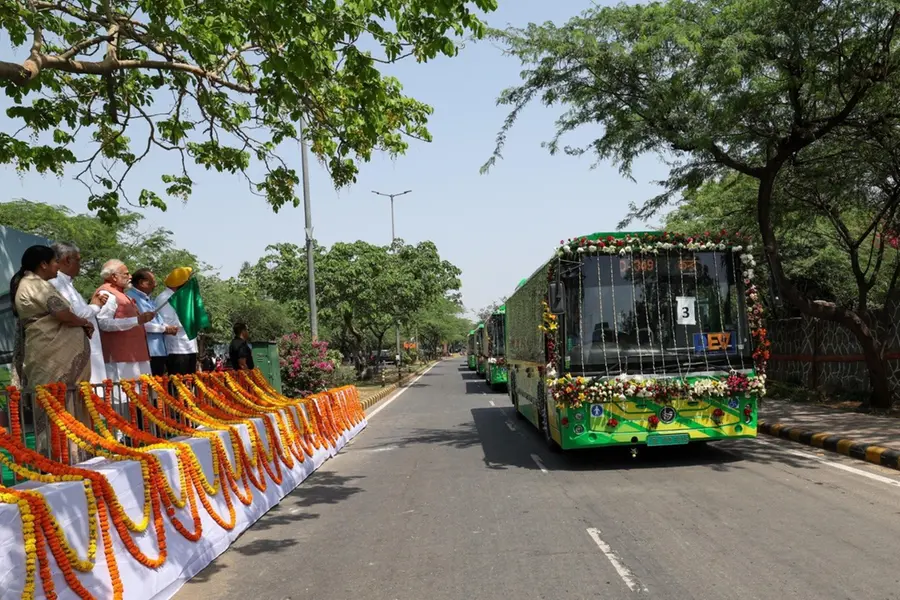
New Delhi: Chief Minister Rekha Gupta, while addressing a high-level review meeting of the Transport Department on Tuesday, asserted that with the guidance and support of Prime Minister Narendra Modi, the dream of equipping Delhi with world-class public transport will soon be realised.
CM Rekha Gupta stated that, "With the guidance of Prime Minister Narendra Modi and collaborative efforts between the Centre and Delhi Government, we are determined to give Delhi citizens a sustainable, green, and smart public transport experience."
The Delhi government has initiated a major overhaul of the Delhi Transport Corporation (DTC) to provide world-class public transport services to the citizens of the national capital.
CM Gupta stated that DTC, which is currently running at a loss of Rs 60,000 crore due to past mismanagement, will be revitalised and transformed into a robust transport service.
While reviewing the city's transport systems, she laid out key developments that will shape Delhi's public transport future.
The meeting was attended by Transport Minister Dr Pankaj Singh, Chief Secretary Dharmendra, Transport Commissioner Niharika Rai, and other senior officials.
What is smart travel card?
According to a release, under this initiative, smart travel cards will soon be introduced, bus routes are being restructured, interstate bus terminals (ISBTs) will be modernised, and bus queue shelters (BQSs) will be redesigned to be more comfortable and high-tech.
One of the major announcements was the introduction of a unified smart card system for all modes of public transport in Delhi. This card will enable seamless travel across DTC buses, Delhi Metro, and the upcoming Regional Rapid Transit System (RRTS). The Chief Minister also announced a special Pink Card for women and transgender residents, which will allow them free travel in DTC buses. Discussions are currently underway with banks to ensure a smooth and foolproof rollout of these cards, aimed at making public transportation more accessible and hassle-free.
Increased bus fleet to improve accessibility
She further added that the number of both small Delhi EV Inter-connector (DEVI) and large buses is being increased, and the new routes are being strategically planned to enhance accessibility for commuters in collaboration with IIT Delhi to design route plan.
"Our government envisions DTC as a symbol of excellent transport service in Delhi," the CM stated, as per the release.
CM Gupta also shared the current status of the DTC fleet, noting that Delhi operates 660 small electric buses, 1,800 large electric buses, and 1,800 CNG buses, with a total of 4,800 electric buses forming the city's robust EV fleet. However, she acknowledged that many of these buses still operate on outdated routes, limiting their effectiveness in serving the city's population.
To address this, the government has collaborated with IIT Delhi to design a comprehensive new route plan. This plan aims to enhance bus connectivity in underserved areas and improve integration with Metro services. A pilot project will be initiated in Yamuna Vihar, following which the model will be implemented citywide, the release said.
What’s new in Bus Queue Shelters?
Another key area of focus is the modernisation of Bus Queue Shelters (BQS) across the capital. All BQS will be upgraded with real-time arrival displays, LED lighting, digital boards, solar power support, and weather-resistant designs. These upgrades will be executed through the Public-Private Partnership (PPP) model.
Currently, out of the 4,627 shelters in Delhi, only 2,021 are functional. The new shelter designs are inspired by global standards and tailored to Delhi's local needs, the press release added.
The Chief Minister also emphasised the need to transform Delhi's Inter-State Bus Terminals (ISBTs) into world-class facilities. Terminals like Kashmere Gate, Anand Vihar, and Sarai Kale Khan will be revamped to provide airport-like amenities, ensuring passenger comfort, safety, and accessibility. These terminals will be equipped with modern infrastructure and will serve as model hubs for intercity travel in India's capital.
(With ANI inputs)
Published: 16 Jul 2025, 08:36 am IST
Disclaimer: Kindly avoid objectionable, derogatory, unlawful and lewd comments, while responding to reports. Such comments are punishable under cyber laws. Please keep away from personal attacks. The opinions expressed here are the personal opinions of readers and not that of Mathrubhumi.
