
Cyclone Arnab intensifies over the Bay of Bengal as Andhra Pradesh and Odisha prepare for heavy rain, strong winds, evacuations and transport disruptions.
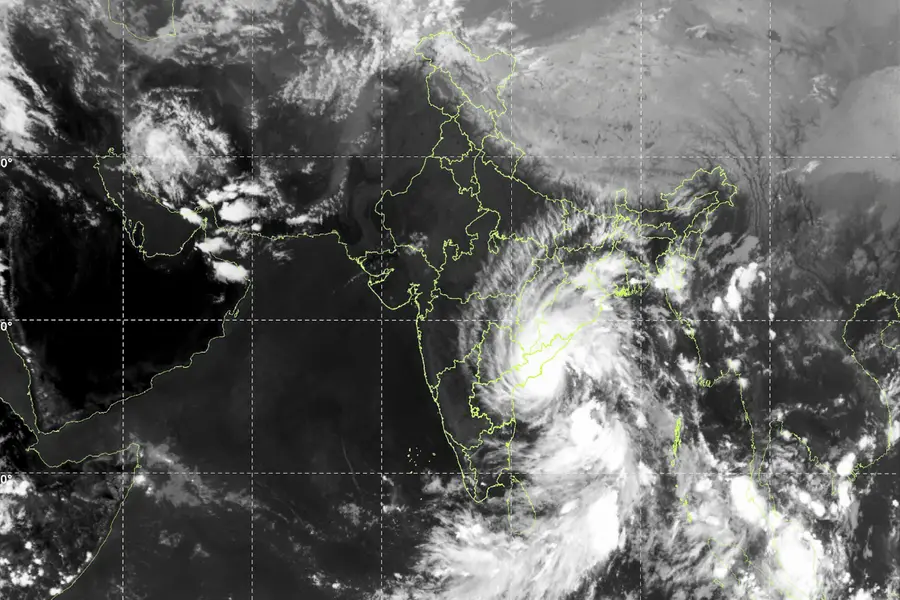
Hyderabad: Cyclone Arnab intensified into a very severe cyclonic storm over the Bay of Bengal on Tuesday, October 27, with sustained winds of 125–135 kmph and gusts of up to 150 kmph. Andhra Pradesh and Odisha stepped up emergency preparations ahead of the storm’s expected landfall along the Andhra Pradesh coast on Wednesday morning, October 28.
Evacuations, traffic restrictions, school closures and transport cancellations were reported as authorities prepared for heavy rain and strong winds.
Authorities in Visakhapatnam and Anakapalli announced traffic restrictions from 9 pm on Tuesday as Cyclone Arnab approached the Andhra Pradesh coast. Residents were advised to leave their homes only in emergencies and avoid unnecessary travel.
In Visakhapatnam, authorities established 56 rehabilitation centres to accommodate people evacuated from vulnerable hillocks, low-lying neighbourhoods and coastal settlements. Areas mentioned in evacuation efforts included Hanumanthawaka, Kapparada, Venkojipalem, Gajuwaka, Vepagunta, Arilova and parts of One Town, as well as fishing hamlets such as Mangamaripeta. The total number of people evacuated from these localities was not immediately available.
City bus services were also cancelled as a precaution. The Greater Visakhapatnam Municipal Corporation placed emergency teams and equipment on alert, including earth movers, cranes, water pumps and generators. Officials were instructed to clear drains, secure water supplies, remove fallen trees and inspect dilapidated buildings.
Cyclone Arnab’s intensity and expected landfall
The India Meteorological Department said the storm was around 170 km south-southeast of Visakhapatnam at 11.30 am on Tuesday. It was forecast to move west-northwestwards before turning northwestwards and crossing the Andhra Pradesh and Yanam coasts, close to Yanam and between Bapatla and Visakhapatnam, by Wednesday morning.
The storm’s sustained wind speeds were forecast at 125–135 kmph, with gusts reaching 150 kmph. Heavy to extremely heavy rainfall was expected in several areas as the system approached and moved inland.
The storm’s name, Arnab, means “sea” or “ocean” in Bengali and was assigned by Bangladesh.
Andhra Pradesh steps up emergency preparations
Andhra Pradesh began evacuating residents from vulnerable areas ahead of the storm. According to figures reported by Reuters, nearly 50,000 people had been moved to shelters by Monday night, out of an estimated four lakh who might need evacuation.
Chief Minister N Chandrababu Naidu directed officials to prioritise evacuations, arrange relief supplies and prepare for power restoration. The state identified 2,131 shelter locations across 20 districts and issued alerts to around 2.70 crore people in 18 districts.
More than 30,000 fishing boats were secured. Authorities also deployed 1,087 medical teams, arranged 8,281 emergency beds and kept 1,274 ambulances ready. Pregnant women were shifted to hospitals, while emergency supplies, water tankers, generators and reverse-osmosis plants were arranged.
Schools were closed in 10 districts from Tuesday to Thursday. Heavy rain was reported in Srikakulam, while strong winds affected Visakhapatnam and Kakinada. High waves disrupted traffic along parts of the Uppada–Kakinada stretch.
Odisha prepares for evacuations and rescue operations
Odisha prepared to evacuate around 48,000 people from low-lying and landslide-prone areas, according to Reuters. Districts including Gajapati and Nabarangpur were among those expected to require significant evacuation efforts.
The state identified 135 permanent cyclone shelters and around 1,600 temporary shelters. It also mobilised 294 rescue teams, comprising National Disaster Response Force, State Disaster Response Force and Fire Services personnel.
Schools and colleges were ordered to close in several districts. Ports at Paradip, Dhamra and Gopalpur were placed on alert, while fishermen were advised to remain ashore.
Authorities issued rainfall warnings for several districts and prepared for possible flash floods caused by heavy rain in river catchments extending into neighbouring states.
Trains, flights and coastal transport affected
Cyclone preparations disrupted transport across parts of eastern and southern India. Railway authorities reported cancellations and suspensions affecting multiple services and routes. Two IndiGo flights were also reported cancelled.
Railway officials were monitoring around 600 km of tracks, while coastal roads faced disruption from high waves and heavy rain. Authorities advised residents to follow official travel updates and avoid exposed coastal areas.
The IMD forecast heavy rain in parts of West Bengal, Jharkhand, Chhattisgarh and Uttar Pradesh as Cyclone Arnab moved inland. Several districts in these states were placed under yellow or orange alerts for rainfall, thunderstorms and strong winds.
Sri Lanka also issued warnings over heavy rain, flash floods and landslides, while Nepal’s disaster authorities cautioned that the system’s effects could extend towards the Himalayas, increasing the risk of heavy snowfall, snowstorms and avalanches in high-altitude areas.
The potential for widespread rainfall means the cyclone’s effects may extend well beyond its landfall location, with authorities monitoring flood-prone areas, transport networks and vulnerable communities.
Published: 27 Oct 2026, 08:49 pm IST
ABOUT THE AUTHOR

Disclaimer: Kindly avoid objectionable, derogatory, unlawful and lewd comments, while responding to reports. Such comments are punishable under cyber laws. Please keep away from personal attacks. The opinions expressed here are the personal opinions of readers and not that of Mathrubhumi.