
The Cockroach Janta Party’s protest at Mumbai’s Shivaji Park drew thousands of participants and several film personalities, while a 75-year-old man died after suffering a heart attack following his attendance at the gathering. The protest was held despite police denying permission for the proposed demonstration.
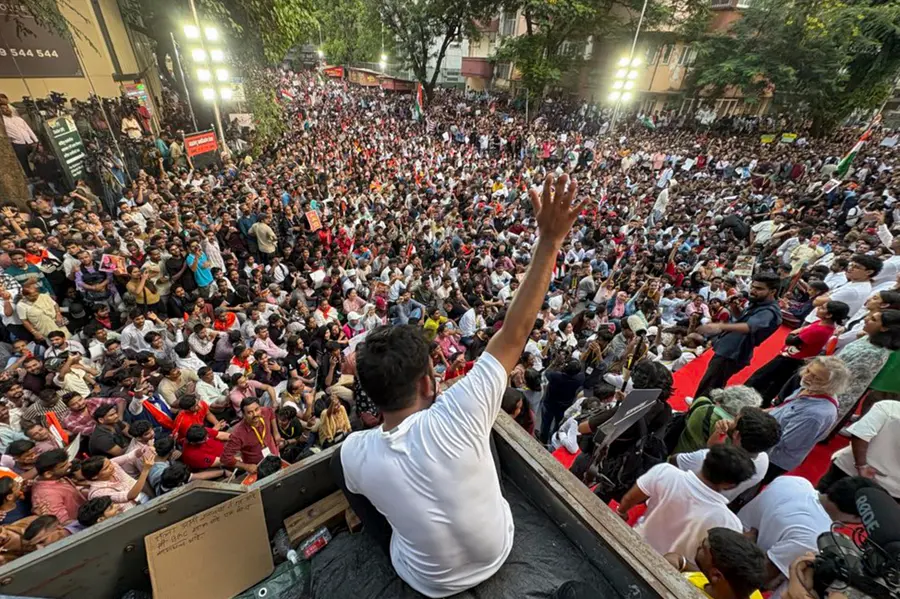
Mumbai: The Cockroach Janta Party (CJP) held a protest at Mumbai’s Shivaji Park on Friday, demanding the resignation of Chief Election Commissioner Gyanesh Kumar over allegations concerning the Special Intensive Revision (SIR) of electoral rolls.
Actors Naseeruddin Shah and Shabana Azmi, along with singer-composer Vishal Dadlani, were among those who joined the gathering.
Also Read

Vishal Dadlani sings ‘Mera Rang De Basanti Chola’
Singer and composer Vishal Dadlani performed the patriotic song ‘Mera Rang De Basanti Chola’ during the protest. He later modified the lyrics while calling for Gyanesh Kumar to step down, according to reports from the event.
The song was one of several musical and cultural elements at the gathering, where student groups and protesters raised slogans against the Election Commission and its handling of electoral-roll revision.
Naseeruddin Shah and Shabana Azmi join protest
Naseeruddin Shah and Shabana Azmi were among the prominent personalities who attended the demonstration. Director Vishal Bharadwaj was also reported to be present.
Azmi spoke about voting rights and the right to protest, while the CJP used the gathering to press its demand for Kumar’s resignation. The party has linked its campaign to questions raised about the SIR exercise and reported disagreements within the Election Commission.
75-year-old man dies after heart attack
A 75-year-old man from Thane died after suffering a heart attack after attending the protest at Shivaji Park, according to reports. The Indian Express reported that he had travelled to the venue to witness the event.
The incident occurred amid the large gathering and heavy security deployment around Shivaji Park and Dadar.
Resident files complaint over traffic congestion
A Shivaji Park resident and advocate, Siddhi Devdekar, has reportedly filed a police complaint over the protest, raising concerns about traffic congestion and disruption in the area.
Police had earlier denied permission for the proposed gathering at Shivaji Park. Officials cited restrictions governing the use of the venue and its status as a silence zone. Despite this, the CJP proceeded with its planned agitation.
CJP announces continued protests
CJP founder Abhijeet Dipke said the organisation would continue its campaign and indicated that it could return to Delhi's Jantar Mantar. He also challenged Maharashtra Chief Minister Devendra Fadnavis to arrest the protesters.
The organisation has demanded Kumar's resignation and questioned the SIR process. It has also announced plans for protests in other parts of the country.
What is behind the protest?
The Mumbai demonstration comes amid wider political and legal questions surrounding the Election Commission's SIR exercise.
Reports have said Election Commissioners Sukhbir Singh Sandhu and Vivek Joshi raised objections on multiple occasions over decisions and procedures connected with electoral rolls, registration and the Commission's digital systems. The Election Commission has rejected suggestions of a split among its three members and has maintained that decisions, including those concerning SIR, were taken unanimously.
The protests therefore centre on two separate issues: the CJP's allegations concerning electoral-roll revision and the reported internal objections within the Election Commission. The allegations about manipulation of electoral rolls remain claims by critics and protesters and should not be treated as established findings.
Counter-protest at Shivaji Park
A group calling itself Gen Next Mumbai also held a counter-protest against the CJP demonstration. A participant accused Dipke of making statements about dismantling the Constitution and said their gathering was intended to uphold constitutional values.
Security was tightened around Shivaji Park and Dadar station, with barricades and additional personnel deployed to manage the gathering and traffic.
The Shivaji Park demonstration reflects the growing political dispute over the Election Commission's electoral-roll revision process. The controversy has expanded beyond political parties to include civil society groups, student organisations and public figures.
At the same time, the Election Commission's position remains that its decisions were taken collectively and unanimously. This distinction is important because reported internal objections and political allegations do not, by themselves, establish that electoral rolls were deliberately manipulated.
The Mumbai protest also comes ahead of further demonstrations planned by Opposition parties and other groups, making the handling of electoral-roll revision and public confidence in the election process an increasingly prominent political issue.
Published: 02 Oct 2026, 10:52 pm IST
ABOUT THE AUTHOR
Related Topics
Disclaimer: Kindly avoid objectionable, derogatory, unlawful and lewd comments, while responding to reports. Such comments are punishable under cyber laws. Please keep away from personal attacks. The opinions expressed here are the personal opinions of readers and not that of Mathrubhumi.