
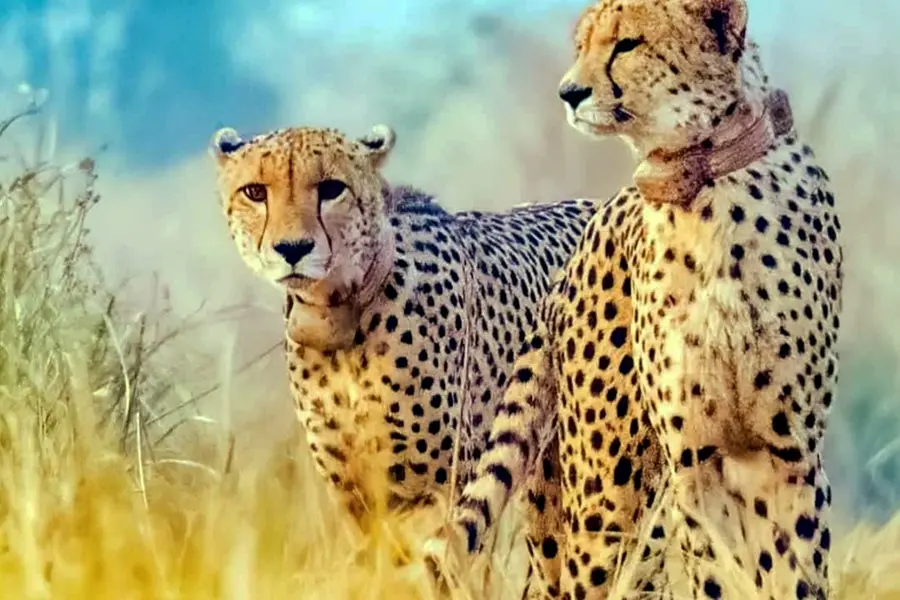
Kochi: It has been two years since the 'Project Cheetah' was launched to reintroduce the fastest land animal, which had vanished from Indian forests for seven decades. Now, preparations are underway to release these majestic creatures from their enclosures into their natural habitat. As soon as the monsoon ends, the cheetahs will be set free one by one. Soon, like tigers, they could become a familiar sight for those venturing into the forests. The regions of Madhya Pradesh, Rajasthan, and Uttar Pradesh are expected to become the new domain of these cheetahs, marking a significant milestone in India’s ‘Cheetah Project’.
Cheetah reintroduction
India’s Cheetah Project began two years ago, with 20 African cheetahs brought to Kuno National Park in Madhya Pradesh from South Africa and Namibia. Prime Minister Narendra Modi took part in the event on 17 September 2022, releasing the cheetahs into a specially designed 'jungle cage'—an enclosure covering just one square kilometre. The first phase aimed to help the cheetahs adapt to India’s climate and environment.
The 'Boma' enclosures, as they are called, allowed the cheetahs to hunt small live animals, simulating a natural environment. After this, some of the cheetahs were released into the wild and later brought back into their enclosures to monitor their progress. During this period, the cheetahs successfully bred, and 17 cubs were born on Indian soil. Of the original 20 cheetahs brought from Africa, 12 have successfully adapted to their new environment, while the remaining eight have died due to various issues, including mating complications and infections from their radio collars. Tragically, five of the 17 cubs did not survive, leaving a total of 24 cheetahs, including the cubs, currently in India.
Significant success in wildlife conservation
The successful adaptation and reproduction of cheetahs in India have been hailed as a major success in the wildlife community. The next step is to release them fully into the wild, where they will roam freely like tigers and leopards. Research shows that cheetahs travel five to six kilometres each day. Ranthambore Tiger Reserve in Rajasthan and Kuno National Park in Madhya Pradesh, along with 27 other forest divisions across Madhya Pradesh, Rajasthan, and Uttar Pradesh, will soon be the natural habitat for these cheetahs.
Future of cheetah conservation in India
Dr Rajesh Gopal, Secretary General of the Global Tiger Forum and a key figure in India's Cheetah Steering Committee, shared insights with Mathrubhumi.

How far has Cheetah Project come?
The efforts to reintroduce cheetahs into India are commendable. Currently, we have 24 cheetahs, of which 12 are adults—seven females and five males. The remaining 12 are cubs. The fact that they have mated and given birth to cubs is a sign of success. Now, it’s time for the people to judge how far we’ve come. Rajasthan and Madhya Pradesh have already begun future plans to safeguard the cheetahs.
Will cheetahs be released into the wild?
Preparations for releasing the cheetahs are in full swing. Once the India Meteorological Department (IMD) confirms the end of the monsoon, the process will start. A schedule has been approved, detailing which cheetahs will be released and when. We will release them one at a time, observing their behaviour before the next one is set free.
Will a single corridor form in North India?
There is no need for a separate corridor for the cheetahs. It is a misconception that a separate forest area is needed for the cheetahs. The forests are already close to one another, and the cheetahs will move through them just as tigers do.
Can tourists see cheetahs on safari?
There are plans to establish a safari park at Sesaipura, the gateway to Kuno National Park. This park will also feature a cheetah awareness centre.
Are there plans to import more cheetahs from Africa?
At present, there are no plans to bring additional cheetahs to Kuno National Park. Any decision to import more cheetahs for other forest areas will be made by the union government.
Published: 05 Oct 2024, 06:30 am IST
Related Topics
Disclaimer: Kindly avoid objectionable, derogatory, unlawful and lewd comments, while responding to reports. Such comments are punishable under cyber laws. Please keep away from personal attacks. The opinions expressed here are the personal opinions of readers and not that of Mathrubhumi.