
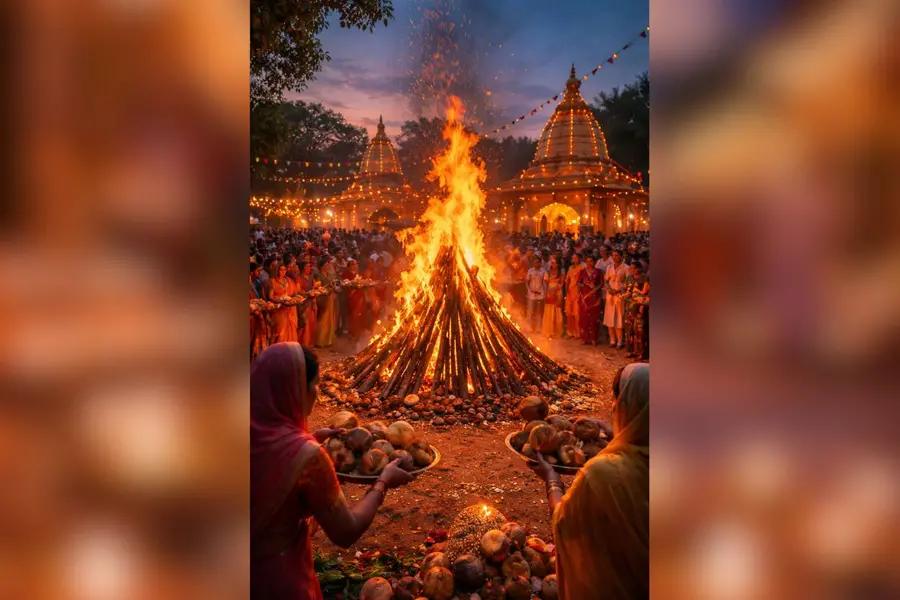
Holika Dahan 2026 marks the spiritual prelude to Holi, symbolising the victory of good over evil. Here’s everything you need to know about the muhurat, rituals, and the mythological significance behind the sacred bonfire tradition.
Holi 2026 is set to become even more memorable as the festival of colours coincides with a Chandra Grahan (lunar eclipse). The rare overlap of a vibrant cultural celebration with a striking astronomical event has sparked curiosity among devotees, skywatchers, and planners alike.
According to astronomical forecasts, the lunar eclipse is expected to occur on the day of Holi in March 2026. While Holi is traditionally celebrated with colours, gatherings, and rituals marking the triumph of good over evil, the presence of a Chandra Grahan adds a unique cosmic dimension to the festivities.
A Chandra Grahan takes place when the Earth moves between the Sun and the Moon, casting its shadow on the lunar surface.
Unlike a solar eclipse, a lunar eclipse is safe to observe with the naked eye. Depending on its type, penumbral, partial, or total, the Moon may appear slightly dimmed or take on a dramatic reddish hue, often referred to as a “Blood Moon.”
Will the Chandra Grahan be visible in India?
Visibility of the eclipse will depend on its timing relative to moonrise and moonset across regions. Early projections suggest that parts of India may experience at least a partial phase of the eclipse, although official confirmation from scientific bodies closer to the date will clarify the exact viewing conditions.
In 2026, Holika Dahan (Chhoti Holi) is observed on Tuesday, March 3, with the most auspicious time for bonfire lighting occurring in the evening after sunset.
Holika Dahan 2026 Shubh Muhurat
The primary auspicious timings for the ritual are as follows:
- Main Muhurat Window: 06:22 PM to 08:50 PM
- Total Duration: 2 Hours 28 Minutes
- Pradosh Kaal: The ritual is traditionally performed during this evening twilight period.
Purnima Tithi (Full Moon) Details
The timing for Holika Dahan is tied to the Purnima Tithi in the Hindu month of Phalguna:
- Begins: 05:55 PM on Monday, March 2, 2026
- Ends: 05:07 PM on Tuesday, March 3, 2026
Important Astrological Considerations
- Bhadra Kaal: It is strictly advised to avoid lighting the bonfire during the inauspicious Bhadra period. In 2026, Bhadra ends in the early morning of March 3 (around 04:30 AM), leaving the evening of March 3 safe for the ritual.
- Lunar Eclipse (Chandra Grahan): A total lunar eclipse is expected on March 3, 2026. Some local calendars suggest performing the Dahan after the eclipse concludes, which aligns with the evening muhurat starting around 06:25 PM.
- Holi (Dhulendi): The festival of colors will be celebrated the following day, Wednesday, March 4, 2026.
Impact on Holi celebrations
From a scientific standpoint, the lunar eclipse has no direct effect on human activities or festival observances. However, in Hindu tradition, eclipses are often associated with spiritual significance. Many people observe sutak rules, a period considered inauspicious for certain rituals, leading to questions about whether Holika Dahan or Holi festivities will be altered.
Religious scholars note that the influence of sutak typically depends on whether the eclipse is visible in a specific location. If the Chandra Grahan is not visible in India or occurs outside active celebration hours, rituals may proceed as usual.
In cases where timings overlap, some devotees may adjust puja schedules or avoid certain activities during the eclipse window.
Precautions and beliefs
Traditionally, people are advised to refrain from eating cooked food during sutak, engage in prayers or mantra chanting, and take a purifying bath after the eclipse ends.
Pregnant women, in particular, are often urged by elders to follow customary precautions, though medical science does not support any eclipse-related health risks.
A blend of culture and cosmos
For many, Holi 2026 offers the chance to celebrate both earthly joy and celestial wonder. As colours fill the air, the Moon’s transformation could provide a stunning visual contrast, a reminder of how ancient traditions and modern science often intersect in everyday life.
With excitement building around this rare alignment, authorities and experts are expected to release detailed eclipse timings and guidance well ahead of Holi 2026, helping people prepare for a festival marked by both colour and cosmic curiosity.
Published: 23 Feb 2026, 02:57 pm IST
Related Topics
Disclaimer: Kindly avoid objectionable, derogatory, unlawful and lewd comments, while responding to reports. Such comments are punishable under cyber laws. Please keep away from personal attacks. The opinions expressed here are the personal opinions of readers and not that of Mathrubhumi.
