
Census 2027 will collect caste data for the first time since Independence along with information on Aadhaar, bank accounts, digital literacy, jobs, migration and Covid vaccination
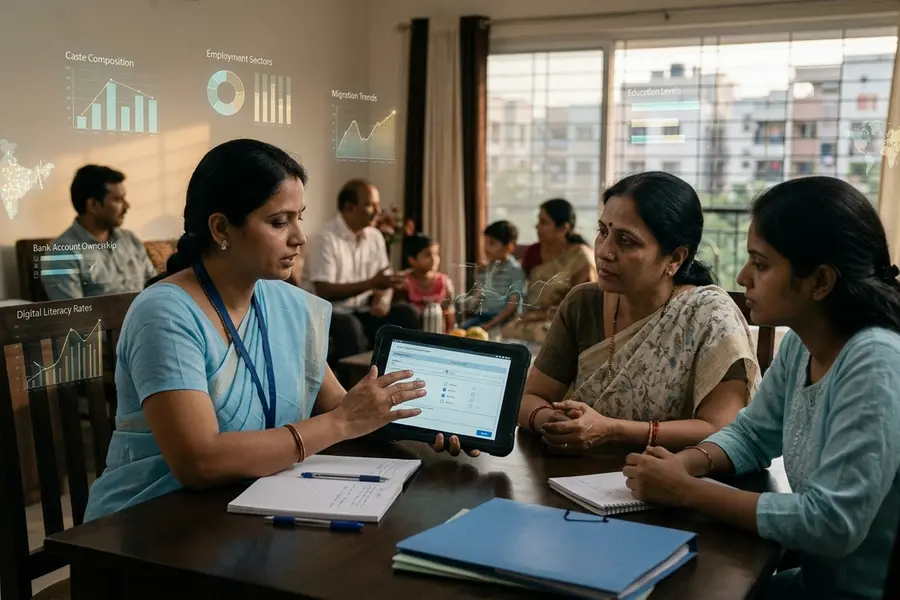
Caste, employment, migration, digital literacy and even Covid-19 vaccination, Census 2027 will ask 40 questions that could give India a far more detailed demographic picture and influence how governments plan welfare, jobs, education and public services.
Census 2027: What will India be asked?
Also Read

The Centre has notified 40 questions for the population enumeration phase of Census 2027, up from 29 in the 2011 Census.
For the first time since Independence, the Census will collect caste data for all communities. Respondents will provide their caste, and the answer will be recorded as stated rather than selected from a pre-prepared list.
The questionnaire will cover:
- Name, age, sex, date of birth and marital status
- Religion, nationality and caste
- SC/ST status
- Parents' and spouse's details
- Disability and languages known
- Literacy and digital literacy
- Education and field of study
- Employment, occupation and workplace
- Migration and permanent residence
- Fertility and family details
- Covid-19 vaccination location
- Bank accounts
- Mobile number
- Aadhaar, Voter ID and passport details, if available
- Driving licence status
Caste data returns to the Census
Comprehensive caste enumeration has not been conducted through the population Census since 1931, although SC and ST populations have continued to be counted.
The decision could have major implications for debates on reservations, welfare, representation, education, recruitment and resource allocation.
However, collecting caste data will not automatically change reservation policies or quotas. Any such changes would require separate political, legal and administrative decisions.
A major challenge will be classification. The 2011 Socio-Economic and Caste Census reportedly produced more than 46 lakh caste names, compared with 4,147 entries in the government's caste list. Census 2027's decision to record answers as provided could again create a highly detailed but complex dataset.
Why Aadhaar, bank accounts and digital literacy matter
The questionnaire goes beyond traditional population data.
Information on bank accounts, digital literacy, Aadhaar, Voter ID, passports and mobile numbers could help build a broader picture of financial access, documentation and digital connectivity.
Digital literacy data could help identify regional and demographic gaps and inform planning for digital services and skilling.
At the same time, the inclusion of personal identifiers makes privacy and data protection particularly important. The government says individual Census information is protected by confidentiality provisions.
Jobs and migration get a closer look
Census 2027 will ask whether a person worked during the previous year and record their occupation, economic activity, industry and class of worker. It will also ask whether non-workers are available for employment and whether workers travel to their workplace.
This could provide valuable information for employment policy, skill development, industrial planning and transport infrastructure.
Migration questions will record birthplace, previous residence, reason for migration, duration of stay and permanent address. This could show where people are moving from and where they are settling, helping governments plan housing, healthcare, schools and transport.
Covid vaccination and fertility also included
The questionnaire will ask where respondents received their Covid-19 vaccination, creating a nationwide record of vaccination locations.
Women who are currently married, widowed, divorced or separated will also be asked about surviving children, children in the current marriage and children born alive, including during the previous year. This will contribute to India's understanding of fertility and demographic change.
India's first digital Census
Census 2027 will be India's first digital Census, with an option for self-enumeration.
Self-enumeration is scheduled from August 17 to 31 in areas covered by the relevant schedule.
For most of India, population enumeration will take place in February 2027. In Ladakh and specified snow-bound areas of Jammu and Kashmir, Himachal Pradesh and Uttarakhand, it will take place from September 1 to 30, 2026.
The 2021 Census was postponed because of the Covid-19 pandemic. The Union Cabinet has approved ₹11,718.24 crore for the Census exercise.
Why the 40 questions could matter
Census 2027 is more than a population count. It could create a new evidence base on caste, employment, migration, education, fertility, digital access and financial inclusion.
The caste data could become particularly important for India's policy and political debates, while employment and migration figures could show how India's workforce and population are shifting.
But the impact will ultimately depend on what happens after the data is collected — how responses are verified, how caste names are classified, what information is released publicly and how governments use the findings.
The decision to record caste responses verbatim could provide a more granular picture of India's social diversity, but it could also make classification and analysis significantly more difficult.
Analysis
The biggest change is that Census 2027 is designed to capture how Indians live, work, move and access formal systems, rather than simply how many people live in the country.
Its findings could influence welfare targeting, infrastructure planning, employment programmes, education policy and debates over social representation for years. At the same time, the scale of personal information being collected means accuracy, classification, privacy and eventual data release will be as important as the questions themselves.
Published: 14 Aug 2026, 01:15 pm IST
ABOUT THE AUTHOR
Disclaimer: Kindly avoid objectionable, derogatory, unlawful and lewd comments, while responding to reports. Such comments are punishable under cyber laws. Please keep away from personal attacks. The opinions expressed here are the personal opinions of readers and not that of Mathrubhumi.