
When a lawyer submitted that police personnel had also been assaulted, the Bench said, "Life of every individual irrespective of who they are is important."
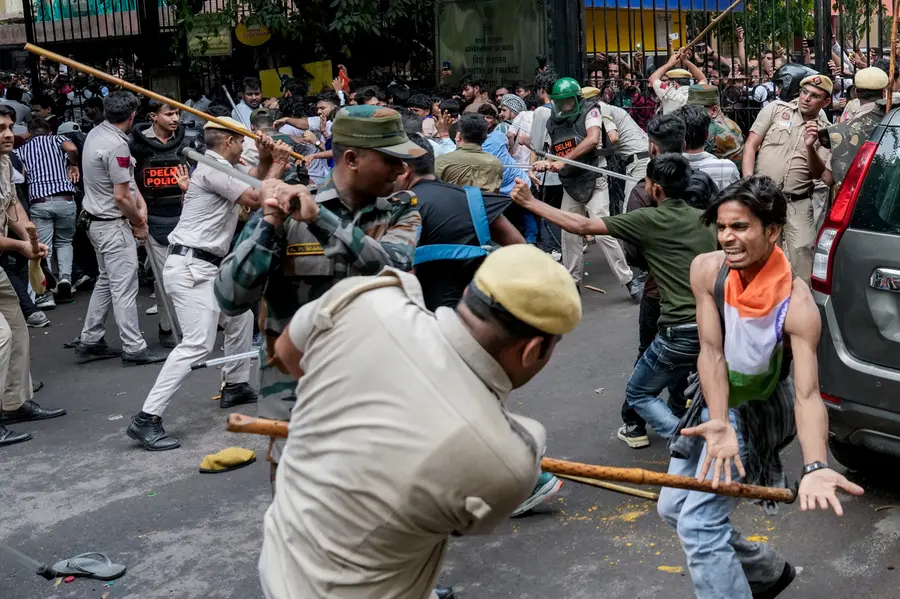
New Delhi: Chief Justice of India (CJI) Surya Kant, whose "cockroaches" remark in May 2026 triggered widespread public controversy that later snowballed into nationwide student protests, on Monday underlined that the right to peaceful protest is "absolutely guaranteed" as the Supreme Court agreed to hear petitions alleging police excesses during demonstrations over the NEET paper leak and other examination irregularities.
A Bench comprising CJI Surya Kant, Justice Joymalya Bagchi and Justice V. Mohana said protests alone could not justify the use of excessive force by police. The court also agreed to hear a separate plea filed by family members of police personnel allegedly attacked during the demonstrations.
"The right to peaceful protest is absolutely guaranteed. That cannot be denied. Merely because there is agitation cannot justify police excesses," the CJI observed.
When a lawyer submitted that police personnel had also been assaulted, the Bench said, "Life of every individual irrespective of who they are is important."
Court calls for uniform protest protocol
The Bench said there should be a standard protocol governing peaceful protests across the country, including designated spaces without unnecessary restrictions, while allowing authorities to deal with anti-social elements separately.
"There should be a protocol in place. There should be proper space and no restriction. But if there are some anti-social elements etc that can be taken care of. This is not a question of Delhi only. Uniformity of protocol is needed," the Bench observed.
It added that agitation by itself could not justify a lathi charge.
"Self-evolved discipline is needed, which is essential to the democratic process," the CJI said, urging all parties to assist the court in a non-adversarial manner.
Solicitor General Tushar Mehta, appearing for the Centre, told the court that he would assist it dispassionately.
The Supreme Court had earlier agreed to hear the petitions after students staged protests in several states over the alleged NEET paper leak.
Protests followed earlier controversy
The latest observations come months after CJI Surya Kant became the centre of public debate over remarks made during a Supreme Court hearing in May 2026, when he referred to certain individuals using fraudulent credentials to attack national institutions as "cockroaches and parasites". Clips of the oral observations circulated widely on social media, with many interpreting them as directed at unemployed youth and job seekers.
The CJI later clarified that his remarks had been taken out of context and were aimed only at people using fake degrees to enter the legal or professional system before posing as activists or experts. He said India's youth remained the nation's greatest strength.
The controversy eventually gave rise to the satirical Cockroach Janta Party, which became associated with student protests over the NEET paper leak. During its march in Delhi on July 20, clashes broke out after protesters attempted to move towards Parliament, with police allegedly using lathis and tear gas to disperse the crowd. The protesters were demanding the resignation of then Union Education Minister Dharmendra Pradhan.
The issue had intensified further after the CJI declined an urgent oral request for a hearing on police action against student protesters, saying the court would not examine video clips without a properly filed writ petition. He later clarified that media reports suggesting the court had refused to hear the matter were inaccurate, as no formal petition had been filed.
Petitioner welcomes court's observations
Advocate and petitioner Shailendra Mani Tripathi welcomed the court's observations, saying the Chief Justice had reaffirmed that peaceful protest is a constitutional guarantee.
According to Tripathi, the CJI made it clear that neither the police nor any other authority has the right to interfere with peaceful demonstrations, even on security grounds, and that the protection of this right should apply uniformly across India. He added that the court had also indicated the need for nationwide guidelines governing peaceful protests.
Published: 27 Jul 2026, 12:05 pm IST
Related Topics
Disclaimer: Kindly avoid objectionable, derogatory, unlawful and lewd comments, while responding to reports. Such comments are punishable under cyber laws. Please keep away from personal attacks. The opinions expressed here are the personal opinions of readers and not that of Mathrubhumi.
