
India is weighing the C-390 and C-130J-30 for its next military transport aircraft, with a bigger industrial opportunity at stake.
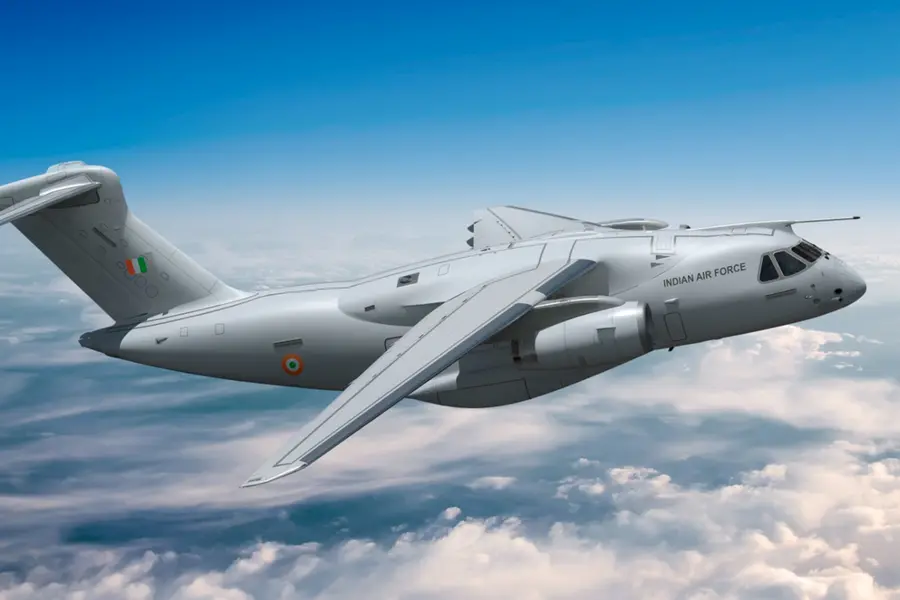
Embraer-Mahindra's proposed C-390 assembly line in Nagpur puts India's Medium Transport Aircraft contest under a larger spotlight, the real prize may not be the aircraft alone, but how much of its industrial ecosystem India can build, own and sustain.
The Indian Air Force's search for a new Medium Transport Aircraft is beginning to look like more than a competition between military aircraft. It is also becoming a competition between industrial models.
Also Read

Embraer and Mahindra Group have now identified Nagpur in Maharashtra as the potential location for a Final Assembly Line for the C-390 Millennium, if the Brazilian aircraft is selected for the IAF's Medium Transport Aircraft programme and an order is placed by the Government of India.
The announcement is significant because the proposal goes beyond putting together aircraft in India. The two companies envisage an industrial and support ecosystem involving aircraft assembly, system integration, manufacturing engineering, local supply-chain development, aftermarket services, training and lifecycle support.
That makes Nagpur an important piece of the larger question surrounding India's military aviation ambitions, how much value can a major defence acquisition create inside the country after the aircraft is delivered?
Also read | Should planes have cockpit cameras? The flydubai incident revives the debate
Nagpur is being prepared before the contract exists
Embraer and Mahindra say they are continuing preparatory discussions and planning activities with the Government of Maharashtra so that the necessary industrial infrastructure can be progressed quickly if the C-390 programme is awarded to the partnership.
The proposed facility would support local assembly and industrialisation of the C-390 in India. However, there is an important qualification: there is no C-390 production contract for India yet.
The facility, like the wider industrialisation programme, is conditional on the C-390 being selected by the Government of India and an order being placed under the IAF's MTA programme. The announcement is therefore not the launch of a C-390 production line in India. It is evidence that Embraer and Mahindra are trying to make the industrial proposition sufficiently concrete before the procurement decision is made.
For India, that could be just as important as the aircraft's specifications.
Bosco da Costa Junior, President and CEO, Embraer Defense & Security, said the company was pleased to deepen its partnership with Mahindra as preparations advance to bring the C-390's industrial capabilities to India.
“Identifying Nagpur as a potential location for an assembly facility is an important step in building a robust, long-term aerospace ecosystem in the country,” he said. He added that Embraer values the support of the Maharashtra government and intends to work with its partners to strengthen India's indigenous aerospace and defence capabilities, subject to the C-390 being selected for the IAF programme.
Mahindra Group is making a similar argument. Vinod Sahay, Member of the Group Executive Board, Mahindra Group, said the company is committed to building a globally competitive aerospace ecosystem in India and creating manufacturing and technology capabilities that contribute to the country's Atmanirbhar Bharat ambitions.
“Mahindra is committed to building a globally competitive aerospace ecosystem in India and to creating meaningful manufacturing and technology capabilities that contribute to the country's Atmanirbhar Bharat ambitions,” Sahay said. He said Nagpur offered a compelling opportunity for such a capability and thanked the Maharashtra government for expeditiously allotting land and supporting the associated requirements.
But Sahay also repeated the most important caveat that the preparations are subject to the selection of the C-390 by the Government of India and placement of the IAF order.
That caveat should remain central to any assessment of the announcement.
Also read | Is Hotan the answer to India’s new air route as Pakistan airspace restrictions continues
From an aircraft order to an aerospace ecosystem
The more interesting part of the proposal is what happens around the aircraft. Embraer and Mahindra envisage a facility that could bring aircraft assembly, system integration, manufacturing engineering and local supply-chain development into India.
Subject to the programme award, the partnership also intends to progressively bring Indian aerospace companies into the C-390 ecosystem. That could eventually extend across manufacturing, aftermarket services, training and lifecycle support. This is where the phrase Make in India becomes more meaningful.
A Final Assembly Line alone does not automatically create a deep aerospace manufacturing ecosystem. The real industrial impact comes from what sits underneath it. Indian companies producing aerostructures and components, engineers participating in design and manufacturing processes, local companies receiving certifications, maintenance capabilities being established, tooling and testing capabilities being developed, and suppliers becoming competitive enough to participate in global programmes.
If those capabilities remain in India after the first aircraft is delivered, the value of the programme becomes considerably broader than the aircraft purchase itself.
The C-390 proposal is therefore being positioned as an industrialisation programme as much as an aircraft programme.
The C-390 and C-130J-30 – the rivals with two different propositions
The C-390 Millennium is not competing in isolation.
Lockheed Martin's C-130J-30 Super Hercules, offered in partnership with Tata Advanced Systems, represents another established option for India's transport requirement. The two aircraft occupy a broadly similar military transport category, but they are not identical in size, payload, speed or programme maturity.
Embraer's C-390 is a newer-generation platform. The manufacturer lists a maximum payload of 26 tonnes and a maximum cruise speed of 470 knots, or approximately Mach 0.80. It is designed for missions including troop and cargo transport, airdrop, medical evacuation, search and rescue, firefighting and humanitarian operations. It can also be configured for aerial refuelling.
Lockheed Martin describes the C-130J-30 as the stretched version of the C-130J Super Hercules. Its published specifications give it a maximum allowable payload of 44,000 pounds, or approximately 20 tonnes, and a maximum speed of 356 knots. The additional fuselage length gives the C-130J-30 more usable cargo space than the standard C-130J.
On the basic numbers, therefore, the C-390 offers a higher maximum payload and significantly higher published speed. But military transport aircraft cannot be judged by payload and speed alone.
C-390 Millennium versus C-130J-30 Super Hercules
The C-390's principal attraction is its combination of payload, speed and multi-mission capability.
With a maximum payload of 26 tonnes, it sits above the C-130J-30's published maximum allowable payload of about 20 tonnes. Embraer also says the aircraft can operate from temporary and unpaved runways and can be configured for missions ranging from cargo and troop transport to medical evacuation, search and rescue and firefighting.
The C-390 also has a relatively young global customer base. It entered Brazilian service in 2019, followed by Portugal in 2023 and Hungary in 2024, and has subsequently been selected by several European and other air forces.
The C-130J-30, by contrast, belongs to the much longer-established C-130 Hercules family.
That maturity has a different value. The Super Hercules has a long operational history, an established international user base and a mature global support structure. Lockheed Martin describes the C-130J as a proven platform backed by an established production line and global supply chain. For an air force, that can translate into familiarity, an established logistics ecosystem and a large existing international user community.
India already operates C-130J-30 aircraft. That creates an additional factor in the Indian equation, commonality with an aircraft already in IAF service. The comparison, therefore, is not simply newer aircraft versus proven aircraft.
It is closer to a newer high-capacity transport platform with an Indian industrialisation proposition versus an established transport family with an existing Indian operating footprint and mature global ecosystem.
Assembly is only the beginning
There is a temptation in defence procurement to treat the announcement of a Final Assembly Line as the finish line. For India, it should arguably be the starting line.
Aircraft assembly creates visibility. A genuinely competitive aerospace ecosystem requires much more. Indian companies would need to participate in the supply chain at meaningful levels. They would need the skills, quality systems, certifications, tooling and engineering capabilities required by a modern military aircraft programme. Indian MRO companies would need the capability to maintain the fleet throughout its lifecycle. Training institutions would need to develop technicians and engineers who understand the aircraft and its systems.
And, perhaps most importantly, Indian suppliers should ideally be capable of supplying components not only to aircraft delivered to India but potentially to the wider global C-390 fleet.
That is when Make in India starts becoming Make in India for the world.
The C-130J proposition has its own industrial logic
The C-130J-30 should not be reduced to the role of a competing aircraft simply because the C-390 proposal currently offers a prominent Nagpur industrialisation plan.
The C-130J is already an established platform with a large international operating community, while India already has experience operating the C-130J-30. That existing footprint can potentially provide advantages in training, operational familiarity, maintenance knowledge and infrastructure.
Lockheed Martin also points to the C-130J's established production line and global supply chain. The critical question for India would therefore be how a new procurement expands the country's existing C-130J ecosystem rather than simply adding more aircraft to it.
If an Indian industrial arrangement can move beyond assembly into component manufacturing, engineering, repair capability, supply-chain participation and exports, the C-130J proposition could also contribute to India's aerospace ambitions.
The size of the industrial opportunity, however, depends on the precise contractual terms.
The real comparison is not aircraft versus aircraft It is a 20-, 30- or even 40-year relationship involving aircraft, engines, spare parts, maintenance, upgrades, training, software, engineering support and industrial participation. The initial purchase price is only one part of that equation.
For India, the larger economic question is what percentage of that long lifecycle can be captured domestically.
A successful Make in India programme should ideally produce more than an Indian assembly line. It should create Indian suppliers, Indian engineering expertise, Indian MRO capability and intellectual and manufacturing capabilities that can spill into other aerospace programmes.
That is the benchmark against which both proposals should ultimately be examined.
C-390 or C-130J-30: what matters for India?
There are clear differences.
The C-390 offers a higher published maximum payload, higher speed and a modern multi-mission design. Embraer also has an explicit industrialisation proposal with Mahindra that includes a potential Final Assembly Line in Nagpur, supply-chain development, MRO, training and lifecycle support.
The C-130J-30 offers a mature platform, an established global support ecosystem and the benefit of India's existing experience with the aircraft. Lockheed Martin's published data gives the C-130J-30 a maximum allowable payload of approximately 20 tonnes and highlights its established production and global supply-chain infrastructure.
Neither set of characteristics, by itself, answers the larger Indian question.
India needs to examine the depth of technology transfer, the percentage and quality of Indian content, the number and capability of Indian suppliers, the nature of the MRO commitment, lifecycle costs, upgrade rights, training, intellectual-property arrangements, export opportunities and the ability of the Indian industrial base to participate in the aircraft's global supply chain.
Those details could ultimately matter as much as the aircraft's performance.
Nagpur could become more than an assembly location
There is another reason the Nagpur proposal deserves attention. Mahindra has separately been moving towards a major manufacturing presence in Nagpur, including plans for a large facility with a focus on skilling and job creation. An aerospace Final Assembly Line integrated into a wider industrial base could potentially create an ecosystem rather than an isolated defence facility. But again, potential should not be confused with outcome.
The C-390 facility will exist only if the aircraft is selected and the contract is placed. Even then, the long-term industrial value will depend on the contractual structure and execution.
The most important question will be what happens after the first Indian-assembled aircraft rolls out.
India's Make in India test
India has spent years trying to move from being primarily an importer of defence equipment to becoming a manufacturer and eventually an exporter.
The MTA programme offers an opportunity to test whether that transition can happen in a sophisticated aerospace segment. The country does not merely need an aircraft that arrives with an Indian nameplate on the assembly line. It needs Indian companies that can build aerospace components to global standards. It needs engineers who can participate in manufacturing and systems integration. It needs MRO facilities that can support the aircraft without depending excessively on overseas infrastructure. It needs a domestic supplier base that can survive beyond a single procurement.
And, ultimately, it needs Indian industry to become part of the aircraft's global story. That is a much bigger ambition than simply assembling aircraft in Nagpur or anywhere else.
The difficult question India must ask
So, which deal will benefit India the most? The answer cannot responsibly be determined simply by declaring the C-390 or C-130J-30 the winner.
The more useful question is, which proposal can give India the deepest, most sustainable industrial capability over the aircraft's entire lifecycle?
Published: 02 Oct 2026, 09:40 pm IST
ABOUT THE AUTHOR
Disclaimer: Kindly avoid objectionable, derogatory, unlawful and lewd comments, while responding to reports. Such comments are punishable under cyber laws. Please keep away from personal attacks. The opinions expressed here are the personal opinions of readers and not that of Mathrubhumi.