
Uttar Pradesh is positioning itself as a central pillar of India’s defence manufacturing and self-reliance push, backed by strong policy intent and execution by the state and Union governments
Lucknow: For decades, India’s defence manufacturing ecosystem was largely concentrated around coastal or legacy industrial hubs.
That geography is now decisively changing. Uttar Pradesh, traditionally known for agriculture and political heft, is steadily transforming into a core centre of defence production, driven by coordinated action between the state government, the Ministry of Defence and public-private partnerships.
Also Read

At the heart of this shift lies the Uttar Pradesh Defence Industrial Corridor (UPDIC), a flagship initiative aligned with the Centre’s Aatmanirbhar Bharat vision. Spread across six nodes—Lucknow, Kanpur, Jhansi, Aligarh, Agra and Chitrakoot—the corridor is designed to decentralise defence manufacturing and deepen indigenous capabilities.
The BrahMos facility: A new industrial anchor for Lucknow
The BrahMos Aerospace Integration and Testing Facility on the outskirts of Lucknow has emerged as the corridor’s most significant anchor project. Developed on nearly 200 acres of land provided by the Uttar Pradesh government along the Lucknow–Kanpur highway, the facility addresses the growing production and export demands of the BrahMos missile system.
Built at an estimated cost of ₹380 crore, the campus functions as a fully integrated production and validation complex. It includes large integration halls, a booster production block, a warhead mating facility, a high-speed sled track for subsystem testing, and an environmentally controlled inspection bay designed to aerospace-grade standards.
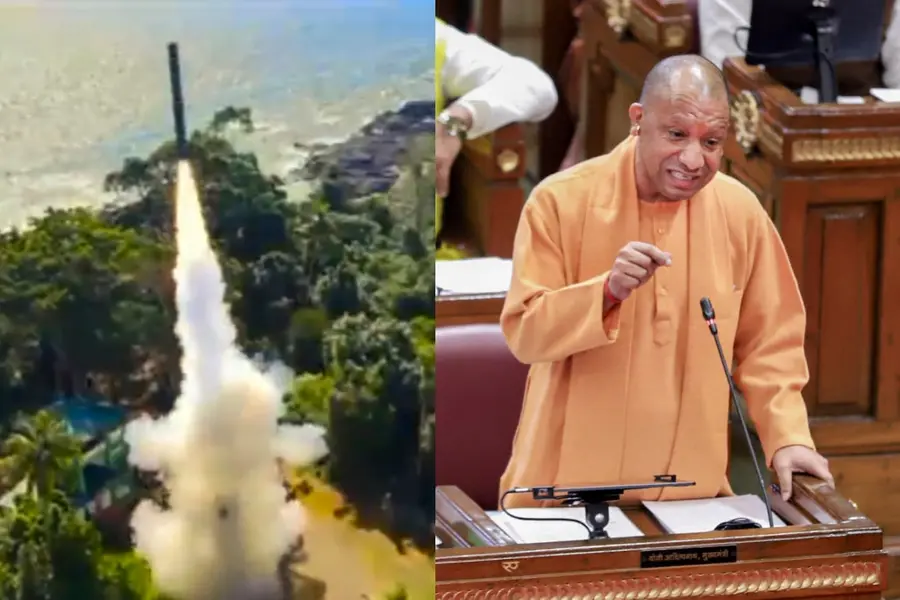
The facility was virtually inaugurated by Defence Minister Rajnath Singh in May and began dispatching missiles to the Indian Armed Forces in October, in the presence of Chief Minister Yogi Adityanath. The rollout marked a symbolic and operational shift, signalling Uttar Pradesh’s arrival on India’s defence manufacturing map.
Meeting domestic and global demand
BrahMos Aerospace, an Indo-Russian joint venture between DRDO and NPO Mashinostroyeniya, has seen a sharp rise in demand in recent years. Orders from the Indian Army, Navy and Air Force have expanded across land, sea and air-launched variants. Export momentum has also accelerated, with the Philippines already taking delivery under a USD 375 million deal and negotiations underway with several other countries.
The Lucknow facility is expected to produce 80–100 missiles annually and contribute nearly ₹3,000 crore in revenue by FY 2027–28. Each missile generates approximately ₹8 crore in GST, directly benefiting state revenues. In October, BrahMos officials handed over a GST cheque of around ₹40 crore to the Uttar Pradesh government, underlining the project’s fiscal impact.
Strengthening indigenous capability and supply chains
A critical objective of both the Centre and the Uttar Pradesh government has been to raise indigenous content in defence systems. Current BrahMos production has achieved around 83 per cent indigenous content, with a target of 85 per cent by 2026. Key components such as titanium castings, airframes, avionics and propulsion systems are increasingly sourced from Indian firms, including MSMEs.
The Lucknow facility is expected to further localise supply chains by onboarding vendors from within Uttar Pradesh, enabling faster production cycles, closer quality control and wider industrial participation. Officials have confirmed active scouting of new suppliers in and around the corridor nodes.
Employment, skills and merit-based growth
While defence manufacturing is capital-intensive, its employment impact extends across engineering, electronics, materials science and precision manufacturing. The Lucknow unit currently employs several hundred highly skilled professionals, with indirect employment spanning over 200 partner firms nationwide.
Recruitment follows strict merit-based processes, with an emphasis on advanced technical skills and security clearances. The state government’s role has been to create enabling infrastructure, industrial land and logistics connectivity, ensuring that high-value defence projects can operate efficiently.
The next frontier: BrahMos NG
Beyond meeting current demand, the Lucknow facility has been designed as the future birthplace of the BrahMos Next Generation (NG) missile. The lighter, more compact variant will retain operational range while enabling higher payload flexibility across aircraft, ships and land platforms.
By hosting next-generation missile production, Uttar Pradesh is not only supporting present defence needs but also future-proofing India’s strategic deterrence capabilities.
UPDIC expansion and policy momentum
The BrahMos project is part of a broader acceleration underway in the UP Defence Industrial Corridor. The state government is planning to fast-track more than 100 defence projects worth around ₹23,000 crore, spanning drones, arms, ammunition, propulsion systems, parachutes and defence textiles. So far, dozens of projects have been allotted land across corridor nodes, backed by policy incentives and single-window clearances.
A coordinated model of defence self-reliance
The transformation underway in Uttar Pradesh reflects a coordinated governance model—where central policy direction, state-level execution and private-sector participation converge. By combining infrastructure readiness, industrial scale and strategic intent, the state is increasingly central to India’s defence manufacturing ambitions.
As production lines expand and export orders grow, Uttar Pradesh’s role is no longer peripheral. It is fast becoming integral to how India builds, sustains and projects its defence capability in a changing global order.
Published: 22 Dec 2025, 04:54 pm IST
Related Topics
Disclaimer: Kindly avoid objectionable, derogatory, unlawful and lewd comments, while responding to reports. Such comments are punishable under cyber laws. Please keep away from personal attacks. The opinions expressed here are the personal opinions of readers and not that of Mathrubhumi.